The United States housing market is facing a critical juncture as a convergence of resurgent inflation, geopolitical instability, and historically low consumer sentiment threatens to derail recent affordability gains. Following a period of relative stabilization, new economic data released in mid-April indicates a sharp reversal in market trajectories. Mortgage rates have climbed back to approximately 6.4% in response to a significant energy shock and higher-than-anticipated inflation readings, while home sales volume continues to hover at levels not seen in decades. As the Federal Reserve’s path toward interest rate cuts becomes increasingly clouded, real estate investors and industry professionals are recalibrating their strategies for a "higher-for-longer" environment that may persist through the remainder of the year.
A Sudden Reacceleration of Inflationary Pressures
The primary catalyst for the current market shift is the dramatic spike in the Consumer Price Index (CPI), which serves as the nation’s benchmark for inflation. After peaking at 9.1% in 2022 and steadily declining for nearly two years, inflation data for March 2026 revealed a startling reacceleration. The headline CPI surged from 2.4% to 3.3% in a single month—a 0.9% increase that far exceeds the standard monthly fluctuations of 0.2% or 0.3% observed during more stable periods.
This inflationary spike is not viewed by economists as an isolated anomaly but rather the result of systemic "input cost" increases. The Producer Price Index (PPI), which measures the costs incurred by businesses to manufacture goods and provide services, rose by 0.7% in March, with forecasts suggesting a further increase of over 1.0% in the coming month. Historically, increases in the PPI serve as a leading indicator for consumer prices, as businesses eventually pass these higher costs onto the public to maintain profit margins.
Geopolitical Instability and the Energy Shock
The recent inflation data is inextricably linked to escalating tensions in the Middle East. Following the announcement of a blockade of Iran, crude oil prices have surged above $100 per barrel, representing a 50% increase from levels recorded as recently as February. This energy shock has immediate and secondary effects on the housing sector and the broader economy.
Directly, higher fuel prices increase the cost of transporting construction materials and operating heavy machinery, which puts upward pressure on new home prices. Indirectly, the energy crisis impacts global supply chains; notably, approximately 30% of the world’s fertilizer production passes through the Strait of Hormuz. Disruptions in this region lead to higher food prices and increased costs for service-based businesses, further sapping the purchasing power of the average American household. Analysts from financial institutions such as Goldman Sachs have indicated that even if diplomatic resolutions are reached, oil prices are likely to remain elevated for at least a year, suggesting that the "energy-driven" inflation cycle is only in its nascent stages.
The Mortgage Rate Deadlock and Federal Reserve Policy
The relationship between inflation and the housing market is most visible through the lens of mortgage rates. As inflation expectations rise, bond yields typically follow, which in turn drives up the interest rates offered to home buyers. In response to the latest CPI print, average 30-year fixed mortgage rates jumped from 6.0% to 6.4%.
This shift has effectively neutralized the affordability gains realized during the first quarter of the year. Furthermore, the likelihood of the Federal Reserve implementing rate cuts in the near term has diminished significantly. At the start of the year, market participants anticipated at least two rate cuts in 2026. However, current betting markets now suggest a 75% probability that the Fed will maintain current interest rates through the end of the year.
Compounding this uncertainty is a period of transition within the Federal Reserve’s leadership. Political friction in Washington has slowed the confirmation process for new appointments. Senator Tom Tillis has reportedly declined to bring the nomination of Kevin Warsh to a vote until the Department of Justice resolves outstanding legal matters involving current Fed Chair Jerome Powell. This administrative gridlock, combined with stubbornly high inflation and a massive national debt, suggests that the structural downward pressure required to lower mortgage rates is currently absent from the economy.
Declining Transaction Volume and Market Stagnation
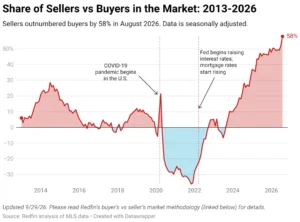
The housing market is currently characterized by a "low-demand, low-supply" equilibrium that prevents a total price collapse but severely restricts transaction volume. Data from the National Association of Realtors (NAR) for April 13 indicates a nearly 4% monthly decrease in existing home sales. On a seasonally adjusted basis, the U.S. is currently on pace for fewer than four million home sales annually, well below the long-term average of 5.25 million.
Weekly data from Redfin corroborates this trend, showing that pending home sales are down 2.5% year-over-year. While some observers anticipated that an increase in inventory would stimulate the market, the opposite appears to be happening. Total housing inventory has moderated, with some metrics showing a 3% year-over-year decline in total homes for sale.
This dynamic is a classic economic response to declining demand: as fewer buyers enter the market due to high rates, potential sellers—many of whom are "locked in" to low mortgage rates from previous years—refuse to list their properties. This mutual retreat by both buyers and sellers has created a stagnant market environment. While national home prices remain relatively flat (up roughly 0.5% year-over-year), the lack of liquidity is creating significant challenges for real estate professionals, including agents, brokers, and lenders.
Consumer Sentiment and the "Normal Person Recession"
Perhaps the most telling indicator of the current economic climate is the University of Michigan’s Consumer Sentiment Index. In April, the index hit its lowest point in 70 years. While the broader economy has not officially entered a technical recession—defined by two consecutive quarters of negative GDP growth—the sentiment data suggests that the American public is experiencing what some analysts call a "regular person recession."
This phenomenon occurs when wage growth fails to keep pace with the rising cost of living. Although unemployment remains relatively low at 4.3%, the labor market is showing signs of underlying weakness. Revised data for 2025 revealed that the economy averaged only 15,000 net new jobs per month, a figure significantly lower than initial reports suggested. Additionally, the rapid integration of Artificial Intelligence (AI) in the corporate sector has created widespread anxiety regarding job security and future displacement.
When consumers feel pessimistic about their financial future, they are less likely to take on the massive debt associated with a home purchase. This psychological barrier, combined with the mathematical reality of 6.4% mortgage rates, suggests that housing demand will remain suppressed for the foreseeable future.
Implications for Real Estate Investors
Despite the somber outlook for the general housing market, the current environment presents a unique set of opportunities for disciplined real estate investors. As transaction volume slows, the "days on market" for listed properties is beginning to increase, providing buyers with more leverage in negotiations.
Strategic investors are increasingly focusing on "motivated seller" scenarios, where properties can be acquired for 5% to 10% below current market comparables. While appreciation is expected to remain stagnant or slightly negative in the short term, the stability of the rental market offers a silver lining. In periods of economic uncertainty, the demand for rental housing often remains robust as individuals defer homeownership. If an investor can acquire a property at a discount while interest rates are high, they may find themselves well-positioned to refinance and realize significant equity gains once the market cycle eventually turns.
Chronology of Recent Economic Events
- February 2026: Oil prices begin a steady climb as geopolitical tensions escalate in the Middle East.
- March 2026: CPI data reveals a surge in inflation to 3.3%, catching many market analysts off guard.
- Early April 2026: The blockade of Iran is officially announced, pushing crude oil prices above the $100 per barrel threshold.
- April 10, 2026: Consumer sentiment reaches a 70-year low, reflecting deep public concern over inflation and job stability.
- April 13, 2026: NAR reports a 4% decline in existing home sales; mortgage rates stabilize at 6.4% after a rapid ascent.
Conclusion and Future Outlook
The U.S. housing market is currently enduring the difficult "correction" phase of its natural cycle. The combination of an energy-driven inflation spike and a stagnant labor market has created a challenging environment for traditional home buyers and industry professionals. While the prospect of a housing "crash" remains unlikely due to the corresponding lack of supply, the era of rapid price appreciation and easy credit has clearly come to a close.
Looking ahead to the second half of the year, the market will likely remain in a state of low-volume equilibrium. Success in this environment will require a long-term perspective and a focus on fundamental value rather than speculative growth. As the economy navigates these structural shifts, the ability to remain informed and prepared will be the primary differentiator for those seeking to thrive in an uncertain landscape.