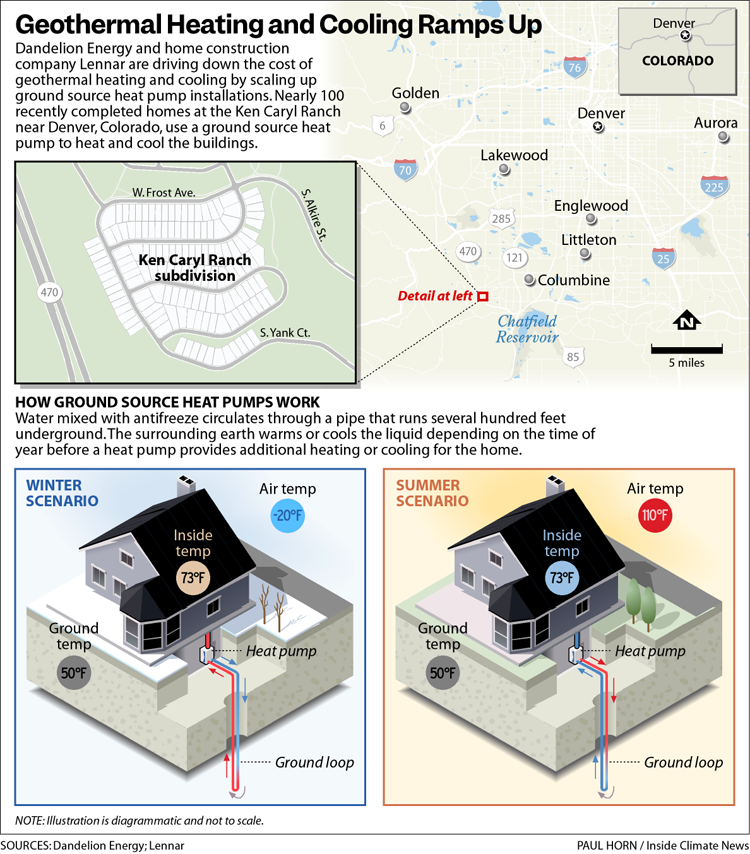
Deep beneath a newly constructed suburban neighborhood south of Denver, a quiet revolution in home energy is taking shape. At the base of Colorado’s Front Range, a pioneering partnership between residential construction giant Lennar and geothermal startup Dandelion Energy has recently culminated in the completion of nearly 100 homes equipped with individual ground-source heat pump systems. This milestone project at the Ken Caryl Ranch development in Littleton is more than just a localized real estate novelty; it serves as a high-stakes proving ground for a technology that energy experts believe could drastically reshape residential heating and cooling across the United States.
For decades, ground-source—or geothermal—heat pumps have been heralded as the gold standard of energy efficiency. By tapping into the stable, moderate temperatures found just a few hundred feet underground, these systems can heat and cool homes using a fraction of the electricity required by traditional HVAC systems or even standard air-source heat pumps. Yet, despite their clear environmental and operational advantages, geothermal systems have historically remained a niche, luxury product. High upfront capital requirements, complex custom engineering, and the logistical nightmare of retrofitting existing properties have kept ground-source heating out of reach for the average American homeowner.
Dandelion Energy, a company born out of X—the famed "moonshot" research and development subsidiary of Alphabet, Google’s parent company—is setting out to dismantle these historical barriers. By applying a mass-market, industrial-efficiency framework to an industry long accustomed to bespoke, single-project installations, the startup claims it can execute geothermal projects twice as fast and at half the cost of traditional competitors. The completion of the Littleton neighborhood marks a vital stress test for this operational model, offering a clear window into how the green energy transition might scale within the massive American suburban housing market.
Engineering the Modern Suburb: How Dandelion and Lennar Streamlined Geothermal
Traditionally, installing a ground-source heat pump is a labor-intensive, disruptive undertaking. A typical residential installation requires specialized drilling contractors to transport heavy rigs to a site, drill one or more boreholes several hundred feet deep, lay specialized piping, and connect the subterranean loop to an indoor heat pump. For a single custom home, the drilling phase alone routinely exceeds $10,000, while the total upfront cost can easily eclipse $25,000.
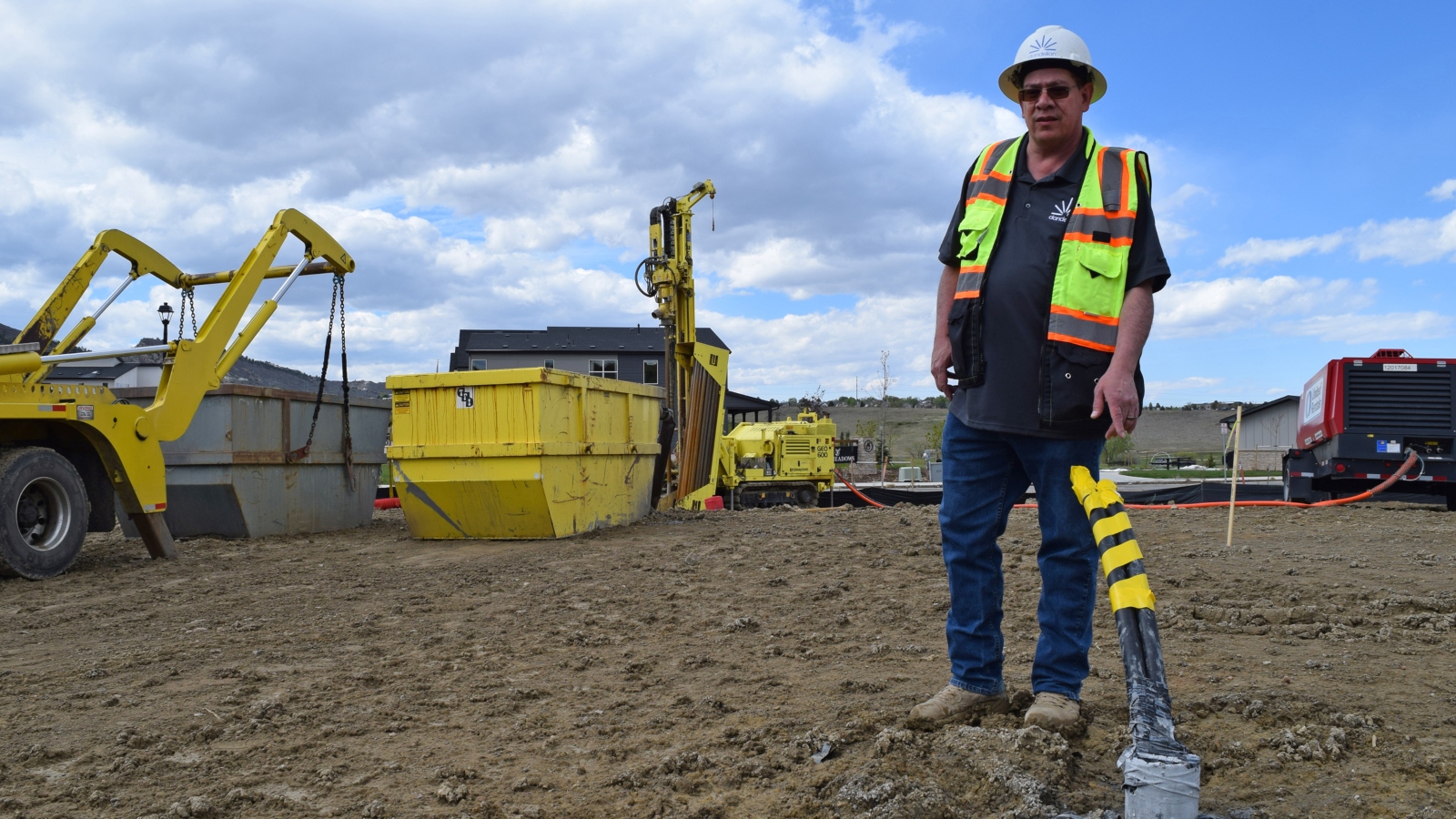
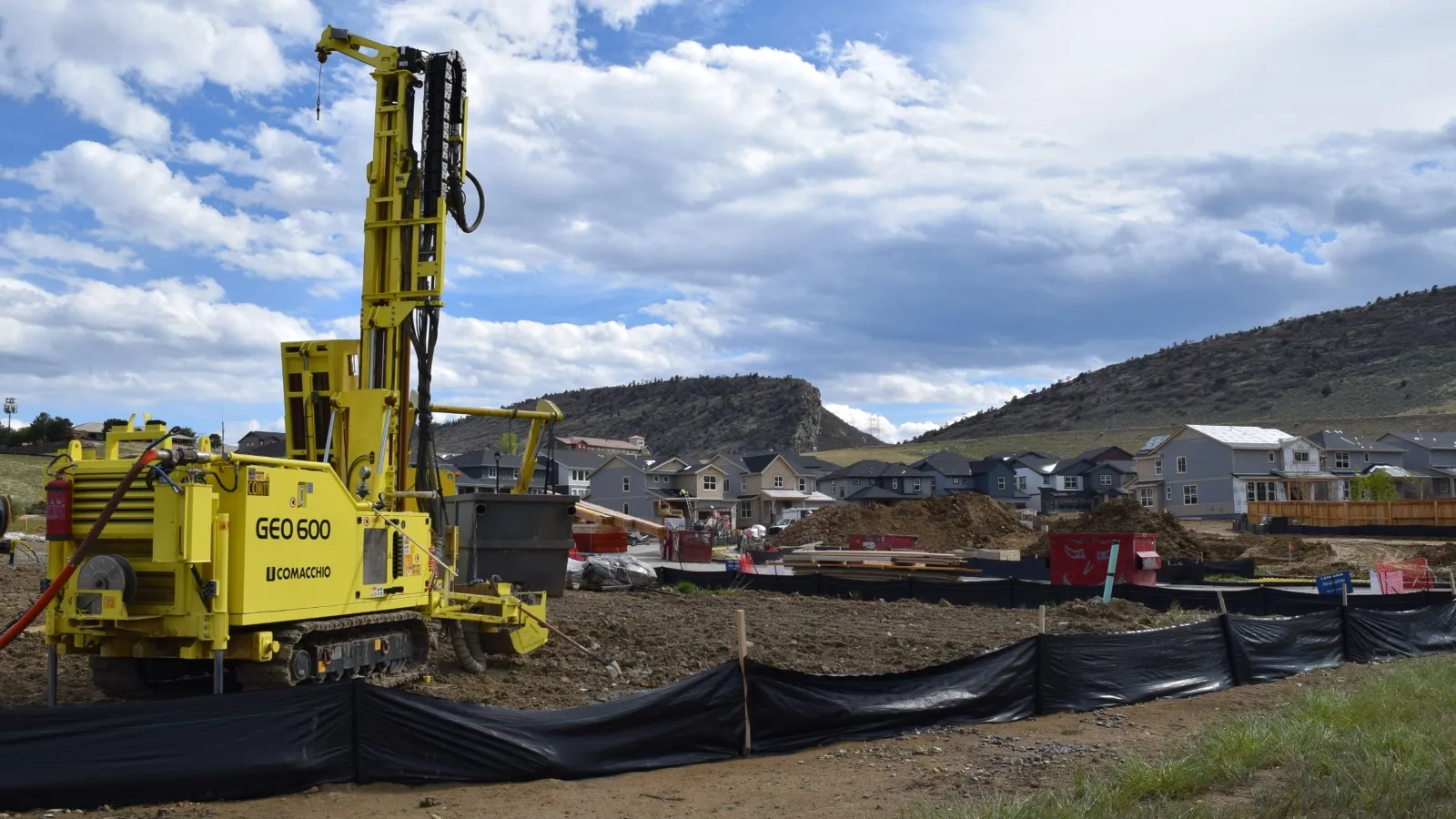
To slash these expenses, Dandelion reimagined the deployment workflow by partnering directly with large-scale homebuilders like Lennar during the earliest phases of master-planned community development. Earlier this year at Ken Caryl Ranch, Dandelion’s specialized drilling teams deployed lightweight, highly mobile rigs designed to glide effortlessly from lot to lot across the sprawling subdivision.
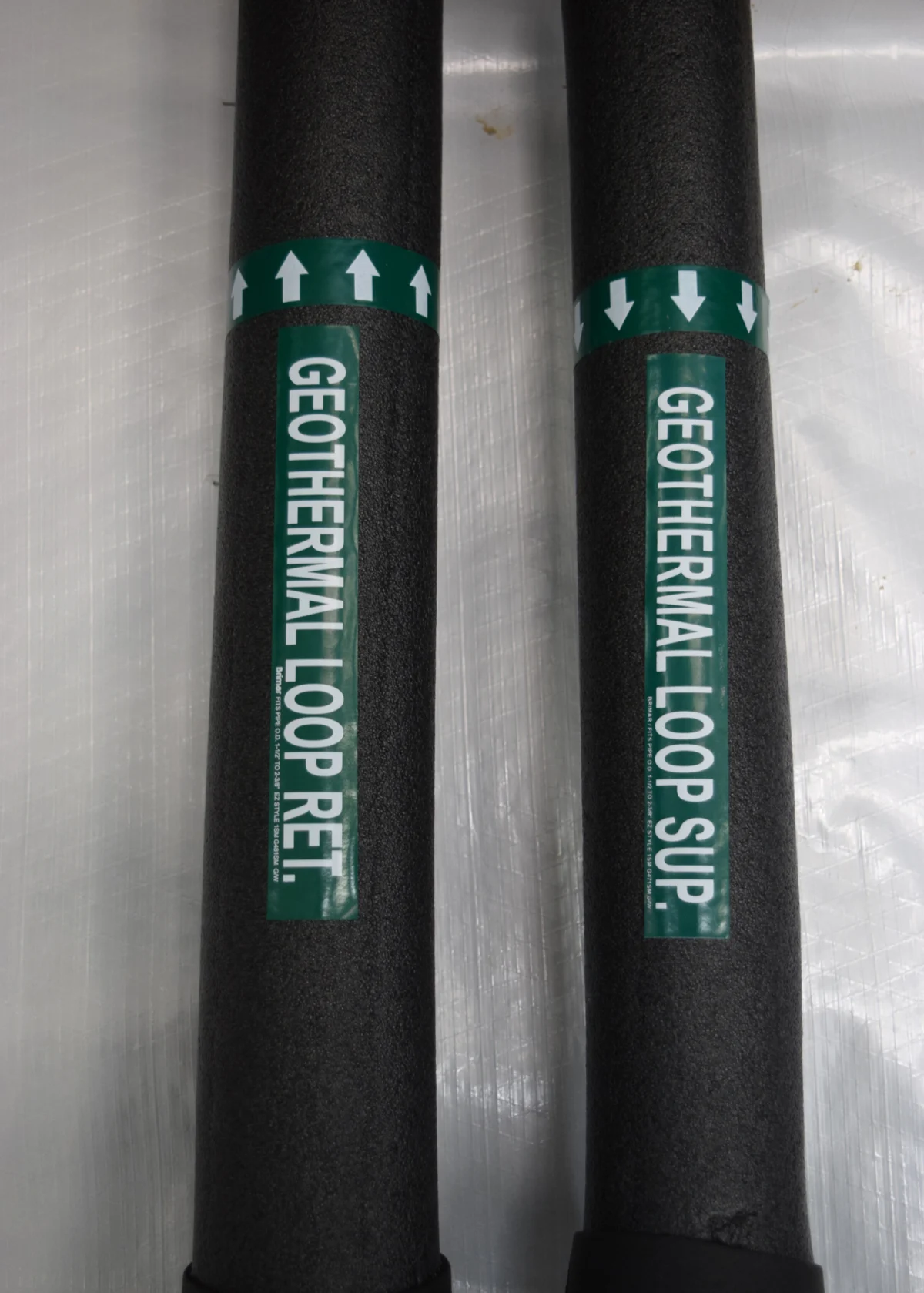
Operating before the building foundations are poured, the drill crews can seamlessly bore a single 200-to-500-foot-deep hole per home, drop in polyethylene piping, and link the system together on a mass scale. In this subterranean zone, earth temperatures hover at a reliable 50 degrees Fahrenheit year-round. Water circulating through the buried loops absorbs warmth from the earth in the winter and releases heat back into the ground during the sweltering summer months. Inside the basement of each newly constructed home, a compact heat pump modulates these thermal exchanges to provide precise climate control.
By handling dozens of neighboring homes simultaneously, Dandelion bypasses the punishing logistical inefficiencies that plague traditional drillers. Instead of losing an entire day to transporting heavy machinery to and from a single-family infill site, the company’s crews can complete boreholes for one or multiple homes every single day. Furthermore, integrating the system into new construction blueprints eliminates the need for expensive post-construction retrofitting of ductwork, electrical panels, or interior climate controls.
The National Landscape: Surging Momentum and Federal Projections

The project at Ken Caryl Ranch is a centerpiece of a broader, multi-year initiative launched by Dandelion and Lennar in 2025, which aims to bring geothermal heating and cooling to more than 1,500 new homes across Colorado. Looking further ahead, Dandelion’s corporate leadership harbors even grander ambitions, targeting a scale of 10,000 completed home installations annually on a nationwide basis.
This aggressive scaling strategy arrives at a pivotal moment for American energy infrastructure. According to a landmark 2025 report published by the U.S. Department of Energy (DOE), ground-source heat pumps are currently installed in just over one million homes nationwide, with roughly 100,000 new systems added annually. However, the federal agency’s modeling suggests that if the industry can successfully reduce costs and streamline deployment, geothermal heating and cooling could expand to roughly 7 million American homes by 2035.
The potential macroeconomic and grid-level benefits of such an expansion are staggering. The DOE report estimates that achieving this level of market penetration would slash winter peak energy demand nationwide by more than 40 gigawatts. This reduction in strain on the electrical grid would translate to approximately $4 billion in annual savings in infrastructure and generation costs for U.S. utilities and ratepayers.
Despite these promising figures, ground-source systems still represent a minor fraction of the broader heat pump market. Air-source heat pumps—which extract heat directly from outdoor ambient air—have experienced explosive growth, with 3.6 million units sold in the United States last year, outpacing traditional gas furnace sales for the fourth consecutive year, notes Yara van Ingen, an associate on BloombergNEF’s building decarbonization team.
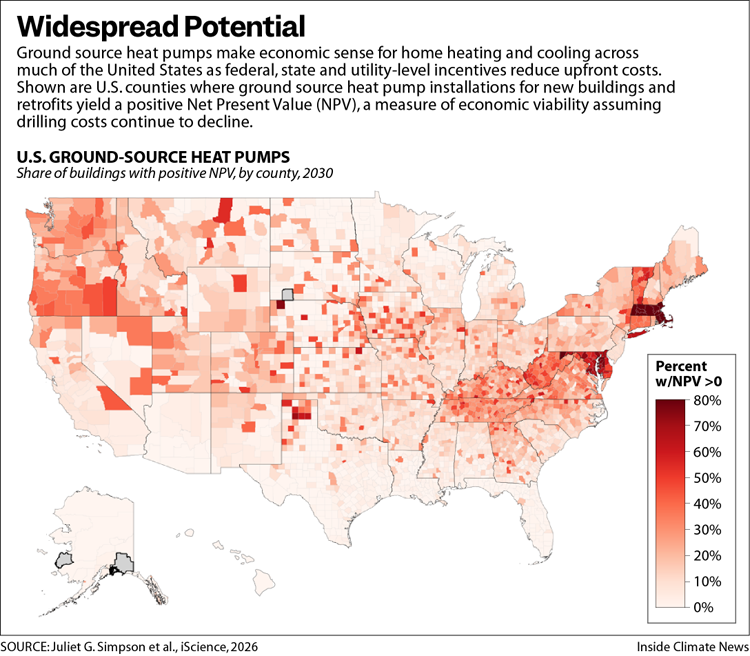
Nevertheless, recent academic research suggests that the physical and economic potential for geothermal is virtually ubiquitous. A comprehensive study published in the journal iScience analyzed regional energy costs, local climate variables, subsurface geological data, and available financial incentives, concluding that ground-source heat pumps are economically viable across the entire continental United States. "It is technically possible everywhere, and there is economic potential across all states," noted Juliet Simpson, former research engineer at the National Laboratory of the Rockies and lead author of the study.
Overcoming Economic and Logistical Hurdles Through Policy and Incentives
While the science is clear and the geographic potential is vast, financial and logistical hurdles remain. Upfront capital requirements are still the primary deterrent for individual homeowners and smaller developers. Additionally, dense urban environments frequently suffer from strict spatial constraints, while a fragmented patchwork of municipal permitting requirements across the country can complicate and delay borehole drilling operations.
To bridge this economic gap, forward-thinking state policies, utility programs, and federal incentives are increasingly stepping in to alter the financial calculus. In Colorado, Xcel Energy—the state’s largest gas and electric utility—operates a lucrative energy efficiency program designed to offset the initial capital outlays of sustainable building practices. The program provides roughly $25,000 per home for newly constructed, high-efficiency buildings equipped with ground-source heat pumps.
"For large neighborhoods with hundreds of homes, builders may receive seven-figure rebate amounts," an Xcel Energy spokesperson noted in a written statement. These substantial rebates serve a dual purpose for the utility: they actively advance corporate sustainability targets while helping the company comply with Colorado’s strict Clean Heat Standard, which mandates a 22 percent reduction in greenhouse gas emissions below 2015 levels by 2030.
State-level legislative frameworks in Colorado further tilt the playing field away from fossil fuels. The state offers a direct $2,000 tax credit for ground-source heat pump installations. More critically, state regulations require homebuilders to shoulder the direct costs of installing new gas service expansion pipes—an expensive infrastructure requirement that developers can bypass entirely by committing to all-electric, geothermal home designs.
"Policies that incentivize high-efficiency electric heating and cooling while discouraging fossil fuel use in homes are intended to reduce greenhouse gas emissions from buildings," explained Will Toor, executive director of the Colorado Energy Office.
The momentum is not confined to the Rocky Mountain State. Similar incentive structures are emerging nationwide. In Maryland, state officials recently launched the Maryland Ground Source Heat Pump Advantage Pilot Program, complementing Dandelion’s newly announced plans to integrate the technology into 129 upcoming residential homes in the state. Furthermore, under provisions in federal clean energy legislation, commercial-scale ground-source heat pump projects are now eligible for robust federal tax credits that cover 30 percent or more of total installation costs.
"The economics just look better and better," said Jessica Silber-Byrne, senior manager of thermal energy networks for the Building Decarbonization Coalition, a nonprofit advocacy group dedicated to phasing out fossil fuel combustion in buildings. "There is a combination of both incentives and market signals that suggest that this is about to really take off."
Grid Resilience, Peak Demand, and the Path to Mainstream Adoption
Beyond carbon reduction, industry advocates emphasize that ground-source heat pumps offer a unique grid-stabilizing capability that standard air-source heat pumps simply cannot match. During extreme winter cold snaps—when heating demand skyrockets and electrical grids are pushed to their absolute limits—air-source heat pumps suffer a drop in efficiency as the outside air grows brutally cold, forcing them to draw massive amounts of electrical power to keep homes warm.
Ground-source systems, by contrast, draw upon the geothermally stabilized earth, requiring a fraction of the electricity during peak freeze events. According to Dan Yates, CEO and chairman of Dandelion Energy, the company’s installations in Colorado use a mere quarter of the electricity consumed by air-source heat pumps during peak cold weather periods.
"It’s the only system that actually reduces peak demand and electrifies homes at the same time," Yates asserted.
By eliminating the need for new natural gas distribution infrastructure in expanding suburban corridors, protecting the local power grid from catastrophic winter overloads, and systematically driving down installation costs through high-volume master-planned construction, projects like the one at Ken Caryl Ranch are charting a clear roadmap for the future. As startups and major homebuilders continue to refine the logistics of mass-market deployment, geothermal energy is rapidly transitioning from an exclusive, high-end luxury to a foundational pillar of modern American sustainable infrastructure.
"Our mission at Dandelion is to mainstream geothermal," Yates concluded, "and we think that the time has finally arrived for that to happen."