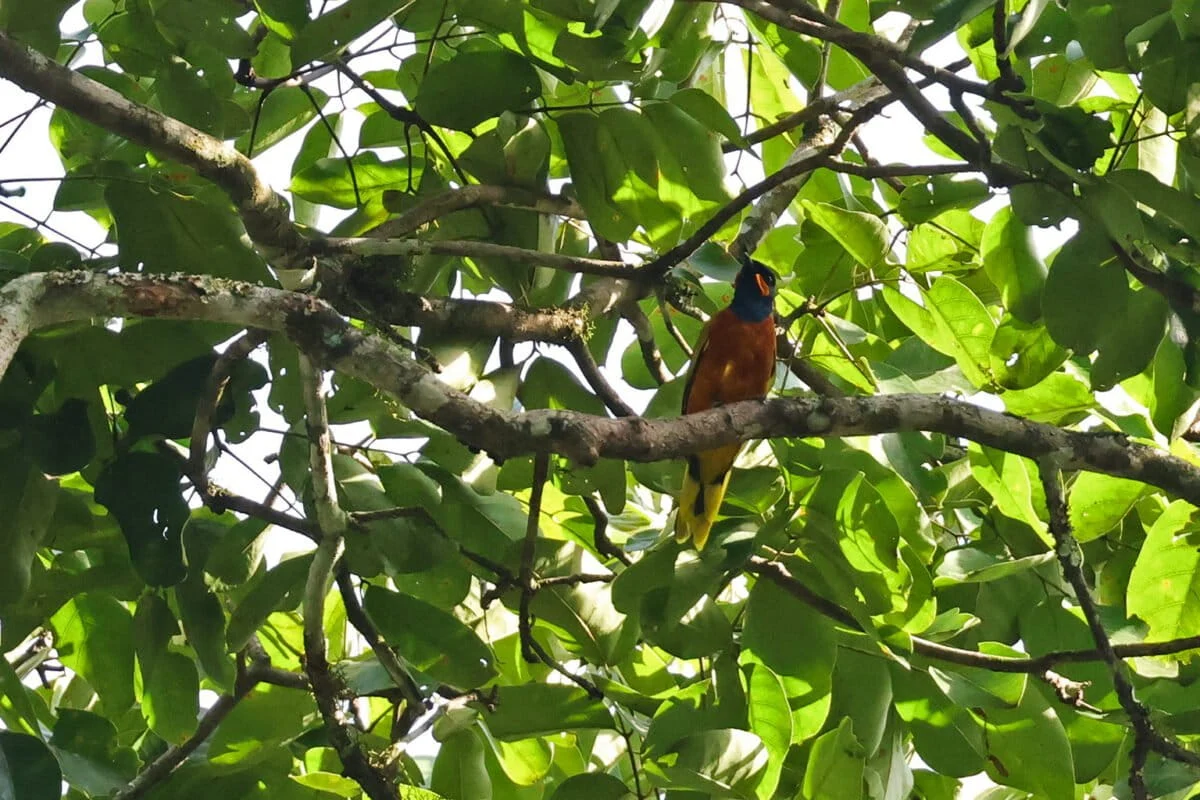
The rediscovery of the Ghana cuckooshrike (Lobotos lobatus) in Côte d’Ivoire’s Taï National Park marks a significant milestone in ornithology and tropical conservation. After thirteen years without a confirmed, scientifically documented sighting, the bird—a species characterized by its vivid orange plumage and distinct black and yellow wings—has finally emerged from the shadows of the Upper Guinean Rainforest. The successful expedition, led by researchers from the International Bird Conservation Partnership (IBCP), serves as both a relief to the scientific community and a stark reminder of the fragile state of biodiversity in West Africa’s remaining forest fragments.
A High-Stakes Search in the Canopy
The identification of the bird was a feat of patience and technical precision. Stephanie Bartlett, a field research fellow with the IBCP, managed to capture the definitive photograph of the elusive species while her colleague, Paulo Ditzel, provided real-time navigational cues from the forest floor. According to Bartlett, the bird’s skittish nature necessitated a reliance on high-resolution camera technology rather than direct observation.
"They are incredibly wary of human presence," Bartlett noted during discussions regarding the expedition. "In these dense forest environments, you often do not have the luxury of extended observation. The camera becomes the primary tool for validation, capturing details that the human eye might miss in a fleeting second."
This encounter was the result of months of systematic surveys conducted throughout the region. The team emphasized that the success of the mission was heavily reliant on the expertise and logistical support of local West African researchers, whose knowledge of the terrain and regional ecology proved instrumental in navigating the complex, isolated patches of the Taï National Park.
Chronology of a Disappearing Species
The Ghana cuckooshrike has long been a subject of concern for global conservationists. The species, which resides in the Upper Guinean Rainforest—a region spanning from Guinea through Liberia, Sierra Leone, and into Ghana—has seen its habitat fragmented by decades of logging, agricultural expansion, and industrial development.
- 2013: The last confirmed, peer-reviewed sighting of the species was documented in the Atewa Forest of Ghana. Following this observation, the bird effectively vanished from the scientific record.
- 2014–2025: Throughout this period, the Ghana cuckooshrike remained on the "lost birds" list, a catalog maintained by the Search for Lost Birds (SLB) initiative. During these years, ornithologists were forced to categorize the species as data-deficient, unable to confirm whether the population had plummeted toward extinction or merely retreated into the most inaccessible reaches of the canopy.
- 2026: Field teams, acting on a hypothesis that the species persisted within the protected corridors of Côte d’Ivoire, launched a concentrated search. The effort culminated in the photographic evidence obtained by the IBCP team in Taï National Park.
The Challenge of Data-Deficient Conservation
The prolonged absence of the Ghana cuckooshrike highlights a broader crisis in environmental management. As John Mittermeier, director of the SLB and a representative of the American Bird Conservancy, points out, conservation planning is fundamentally crippled by a lack of baseline data.
"You cannot design an effective conservation plan for a species that hasn’t been sighted in over a decade," Mittermeier explained. "Without knowing the population size, the nesting habits, or the specific distribution, resources cannot be accurately allocated. This creates a feedback loop of uncertainty: we don’t know where to look, and because we aren’t looking, we don’t find them, which in turn leads to less funding and less protection."
The rediscovery provides a vital data point that allows researchers to pivot from a state of "search and rescue" to one of "monitoring and management." By confirming the presence of the bird in Taï National Park, researchers can now begin to assess whether this population is a remnant group or part of a broader, stable, yet highly localized, distribution.

Habitat Loss and Biodiversity Hotspots
The Upper Guinean Rainforest is classified as one of the world’s most critical biodiversity hotspots. However, it is under constant pressure from human activity. The same factors that drove the cuckooshrike from its historical range—illegal artisanal gold mining, unauthorized hunting, and the conversion of forest land into cocoa plantations—remain prevalent in and around protected areas like Taï National Park.
Saint Guillaume Odoukpe, an ornithologist and assistant professor at the Université Félix Houphouët-Boigny in Côte d’Ivoire, who served as a lead organizer for the expedition, emphasized the park’s role as a biological refuge. "Taï is not just a national park; it is an essential reservoir for the future of West African ecology," Odoukpe stated. "The fact that we found this bird here suggests that there is still much to discover, provided we can maintain the integrity of the forest."
The presence of the Ghana cuckooshrike serves as an "indicator species" of sorts. If the environment is capable of supporting such a specialized bird, it likely harbors other, yet-to-be-documented flora and fauna. Conversely, the bird’s extreme sensitivity to disturbance suggests that any further degradation of the park’s core zones could result in the permanent loss of the species.
The Call for Continued Exploration
The success of the IBCP team has reverberated through the international conservation community, sparking a renewed interest in what Mittermeier calls the "call to exploration." In an era where many believe that the world has been thoroughly mapped and documented, the reappearance of a lost species serves as a potent reminder of the vast, unexplored biological mysteries that persist within fragmented ecosystems.
The implications for policy are clear: protected status for regions like Taï must be strictly enforced. The economic pressure to extract resources—whether timber or gold—often pits local livelihoods against long-term ecological stability. The goal for organizations like the IBCP is to demonstrate that the intrinsic value of these forests, when protected, can support scientific tourism and sustainable biodiversity management, which may provide more durable, long-term economic benefits than the short-term gains of extraction.
Looking Ahead
The path forward for the Ghana cuckooshrike involves rigorous monitoring. Researchers intend to use the recent discovery to establish a baseline for the population. This will likely involve acoustic monitoring, as the bird’s vocalizations—once better understood—could allow researchers to track them without the need for visual confirmation.
Furthermore, the collaboration between international NGOs and local academic institutions like the Université Félix Houphouët-Boigny is expected to be a model for future projects in the region. By integrating local knowledge with international technical resources, these teams are better equipped to navigate the logistical and cultural complexities of field research in West Africa.
As the scientific community celebrates this victory, the focus now shifts toward ensuring that the Ghana cuckooshrike does not return to the "lost" list. The protection of the Taï National Park and the surrounding corridors is now more critical than ever. The bird, once an emblem of scientific mystery, has become a tangible symbol of the urgent need for habitat preservation. The search for the Ghana cuckooshrike is officially over, but the work to ensure its survival has only just begun. The forest, as Odoukpe suggests, still holds many secrets—and it is the responsibility of the global community to ensure that those secrets are protected for future generations of scientists and naturalists alike.