The relentless expansion of niche automotive marketing continues apace as Mini, a subsidiary of German luxury automotive giant BMW Group, reveals the sixth installment in its meticulously planned "Icon Drops" portfolio. The latest vehicle to enter the fray is the 2026 Mini Cooper C 1998 GT Edition, a model that pairs aggressive, motorsport-derived aesthetics from the high-performance John Cooper Works (JCW) division with the modest mechanical underpinnings of the base Cooper C hatchback. Despite numerical nomenclature that might lead casual observers to assume a nostalgic nod to the tail end of the 20th century, the designation has nothing to do with the year 1998. Instead, the numbers serve as an exact mathematical reflection of the vehicle’s engine displacement, maintaining a naming convention established by its historical and modern spiritual predecessors.
While the exterior boasts the visual drama, aerodynamic enhancements, and braking hardware typically reserved for Mini’s more potent offerings, the decision to pair these upgrades with the entry-level 161-horsepower powertrain has already sparked discussions regarding the vehicle’s unique positioning within the current automotive marketplace. Priced at a substantial $38,225 including destination charges in the United States, the 1998 GT Edition commands a significant financial premium over not only the standard Cooper C from which it is derived, but also over the mechanically superior and considerably more powerful Cooper S two-door. As automotive manufacturers increasingly lean toward limited-run, highly customized cosmetic packages to drive showroom traffic and maintain consumer interest, the 1998 GT Edition offers a fascinating case study in the intersection of heritage branding, modern platform-sharing, and premium pricing strategies.
Chronological Evolution: From 1969 Icons to Modern Marketing Drops
To understand the genesis of the 1998 GT Edition, one must look far beyond the contemporary landscape of compact hatchbacks to the late 1960s British automotive industry. The GT lineage traces its roots back to 1969, a pivotal year when British Leyland introduced the Mini Cooper 1275 GT. Conceived as a replacement for the classic Mini Cooper and Cooper S, the original 1275 GT was designed to broaden the appeal of the iconic BMC Mini by offering a more mature, grand-touring-oriented driving experience.
The historical 1275 GT featured a distinctive wedge-shaped profile, a sporty rectangular grille, and prominent side graphics that would come to define the aesthetic of performance-lite hatchbacks of the era. Mechanically, it utilized a 1,275 cc engine that shared displacement figures with the high-performance Cooper S, though it employed a single carburetor and a milder camshaft profile. This configuration yielded approximately 60 brake horsepower, prioritizing relaxed, long-distance cruising capability over raw, point-and-shoot racetrack acceleration. Furthermore, the 1969 model introduced innovative interior packaging for its time, including a comprehensive driver-focused instrument cluster featuring a standard tachometer—a luxury in the utilitarian economy car sector of the period.
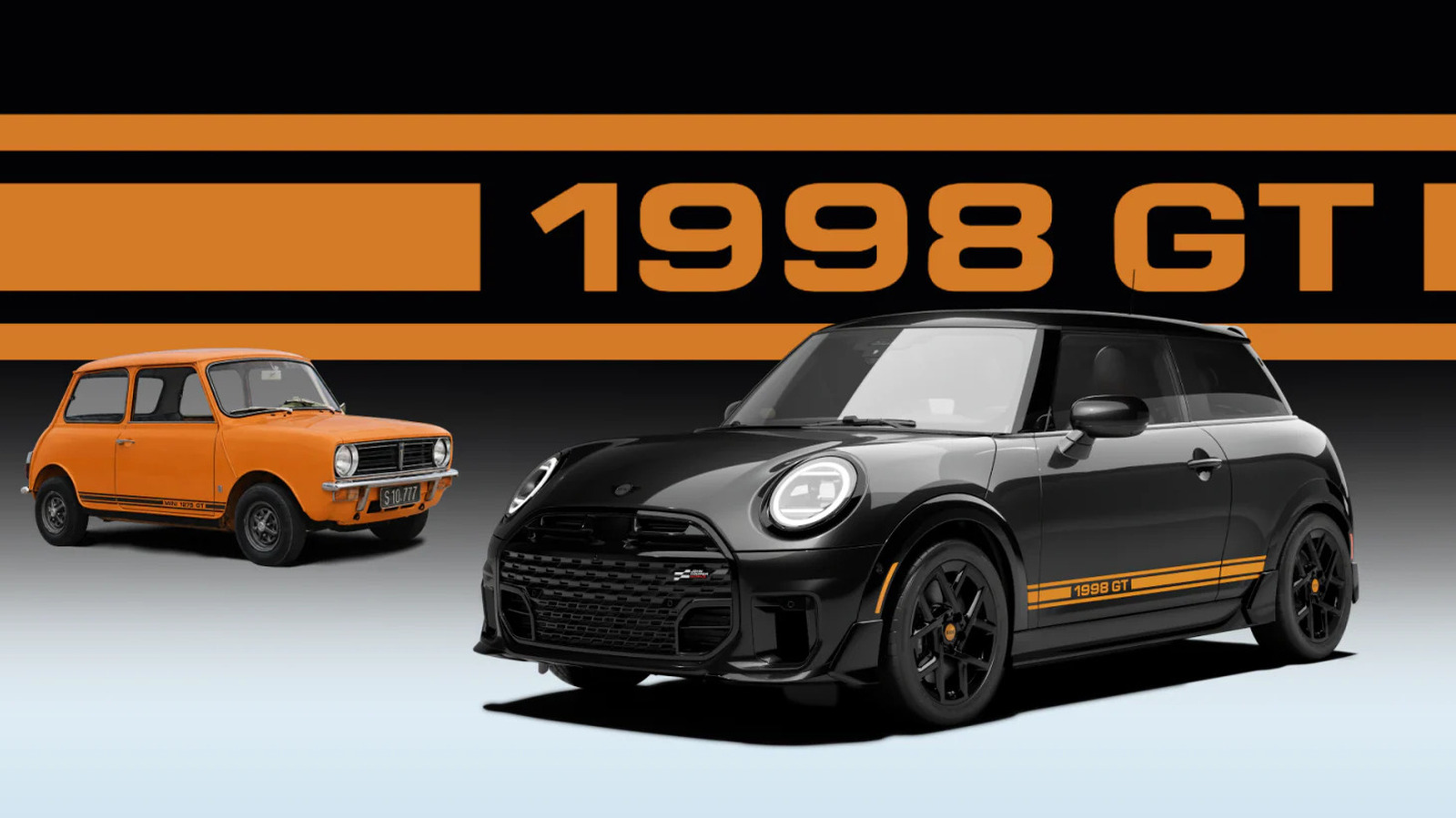
Decades later, Mini revived this nomenclature for the modern era with the introduction of the Cooper 1499 GT in 2020. Much like its 1970s ancestor, the 1499 GT was built upon the foundation of the entry-level model—in that case, utilizing the 1.5-liter, three-cylinder engine whose 1,499 cc displacement directly inspired its moniker. The 2020 model established the visual template that the new 1998 GT follows: a dark, brooding exterior paint scheme contrasted sharply with vibrant orange decals, creating an aggressive visual posture that belied the modest output of its under-hood powerplant.
The current iteration, the 2026 Cooper C 1998 GT Edition, represents the sixth chapter of Mini’s ongoing "Icon Drops" calendar. Throughout the year, the brand has systematically deployed a series of limited-production variants and nostalgic nods—including the cheerful Cooper Paul Smith Edition and the accessible Cooper Oxford—to maintain media momentum across its global sales regions. By translating the numerical naming convention to its current four-cylinder platform, Mini has officially codified a naming methodology where the badge on the trunk directly communicates the physical cubic centimeters of the engine block, regardless of whether that engine sits at the bottom or the top of the performance hierarchy.
Mechanical Specifications and Equipment Analysis
Beneath its evocative exterior, the Mini Cooper C 1998 GT Edition shares its core mechanical architecture with the standard Cooper C. At the heart of the vehicle is a turbocharged 2.0-liter four-cylinder engine. This powerplant is tuned to deliver a respectable, albeit unexceptional, 161 horsepower and 184 lb-ft of torque. Power is routed to the front wheels, providing adequate acceleration for daily commuting and spirited urban driving, though it falls notably short of the performance thresholds established by the Cooper S and the full-fat John Cooper Works models.
However, where the 1998 GT Edition diverges sharply from the standard Cooper C is in its chassis hardware, braking system, and aesthetic appointments. Mini has heavily plundered the John Cooper Works parts bin to elevate the dynamic presentation of the vehicle. Most notably, the 1998 GT adopts the larger, higher-performance braking system found on JCW variants, providing enhanced stopping power and improved pedal feel over the stock setup.
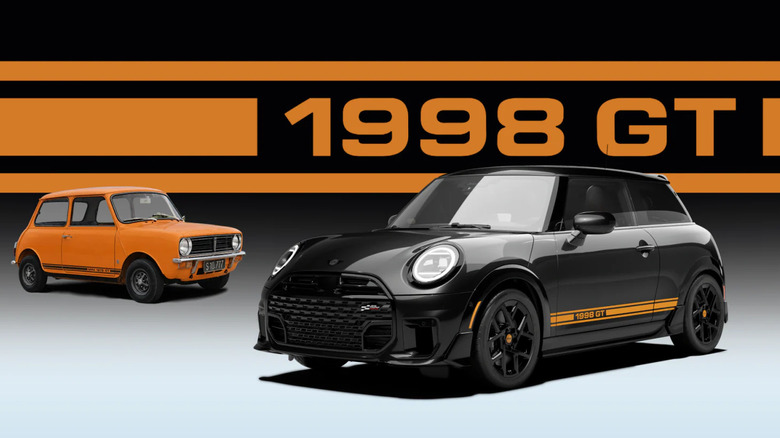
Aesthetically and aerodynamically, the vehicle is distinguished by a comprehensive JCW bodykit that includes aggressive front and rear fascias, specialized aerodynamic winglets, and a prominent rear diffuser. The exterior is anchored by 17-inch black-painted alloy wheels that fill the wheel arches neatly, contrasting against the exclusive Midnight Black Metallic exterior paint. The entire package is framed by striking orange side decals and matching graphics that pay direct homage to the color palettes of the 1970s 1275 GT and the 2020 1499 GT.
Stepping inside the cabin reveals a similarly hybridized approach, blending entry-level interior volumes with high-end sports trim. The driver is greeted by a heated, three-speed JCW sport steering wheel complete with integrated paddle shifters and dedicated badging. Seating is handled by supportive JCW sport seats upholstered to provide superior lateral bolstering during cornering. To reinforce the limited-edition status of the vehicle, Mini has incorporated GT-specific floor mats, bespoke door sill plates, specialized key fob covers, and an individualized serial badge mounted on the center console box.
Pricing Realities and Market Positioning
The introduction of the Mini Cooper C 1998 GT Edition into the North American market has ignited considerable debate regarding automotive pricing structures and value propositions. With a Manufacturer’s Suggested Retail Price (MSRP) of $38,225 including destination and handling fees, the 1998 GT occupies a peculiar and expensive tier within the compact performance-lifestyle segment.
To contextualize this price point, one must examine the internal pricing hierarchy of Mini’s current lineup. The standard Cooper C serves as the entry point to the brand, offering a more accessible financial barrier to entry for buyers seeking classic British styling combined with modern German engineering. Conversely, the Cooper S provides a significantly enhanced powertrain, delivering notably higher horsepower and torque figures that translate into genuinely brisk straight-line performance. Surprisingly, the base price of the more powerful Cooper S two-door undercuts the new 1998 GT Edition by a margin of $4,075.
This pricing inversion means that prospective buyers are essentially paying a substantial financial premium—over $4,000 above the price of a faster car—purely for the exclusivity of the JCW aesthetic upgrades, the historical GT nomenclature, and the specialized Midnight Black and orange color scheme. Industry analysts note that this strategy relies heavily on the willingness of brand enthusiasts to pay for visual differentiation and rarity rather than raw horsepower-per-dollar metrics.
Furthermore, the decision to offer the 1998 GT exclusively in the traditional two-door body style narrows its target demographic even further, appealing primarily to driving purists and collectors who prioritize classic Mini proportions over the practical utility of the four-door variants or the upcoming fully electric models.
Broader Industry Implications and Future Outlook
The launch of the Mini Cooper C 1998 GT Edition highlights a broader, industry-wide trend toward utilizing cosmetic heritage packages to sustain interest in aging or static internal combustion engine (ICE) platforms. As major automotive manufacturers channel the vast majority of their research and development budgets into electrification, software architecture, and autonomous driving systems, internal combustion portfolios often rely on creative marketing exercises—such as specialized colorways, limited production runs, and historical callbacks—to stimulate showroom traffic.
From an engineering and manufacturing perspective, the 1998 GT Edition demonstrates the high degree of modularity inherent in BMW’s current front-wheel-drive vehicle architecture. By mixing and matching components from the base Cooper C engine catalog with high-performance chassis components from the John Cooper Works division, Mini is able to create a unique product variant with minimal incremental tooling or development costs. This modular approach allows low-volume, high-margin special editions to be brought to market rapidly, catering to niche consumer segments that demand personalization and exclusivity.
However, the vehicle also underscores the ongoing tension between heritage-inspired branding and contemporary performance expectations. While the original 1275 GT occupied a specific, purposeful niche in the British market of the 1970s, modern consumers are increasingly accustomed to high levels of performance commensurate with premium price tags. Asking nearly $40,000 for a 161-horsepower hatchback—regardless of how well it stops or how striking its orange decals appear—tests the limits of brand loyalty in an increasingly competitive global marketplace.
Ultimately, the Mini Cooper C 1998 GT Edition will likely find a receptive audience among dedicated marque enthusiasts, collectors, and design-conscious urban drivers who prioritize aesthetic distinctiveness and historical connectivity over sheer acceleration figures. As Mini continues to roll out the remaining installments of its "Icon Drops" calendar throughout the year, the market reception of the 1998 GT will serve as an important barometer for how effectively traditional automotive heritage can be leveraged in a rapidly evolving, cost-conscious, and electrified future.