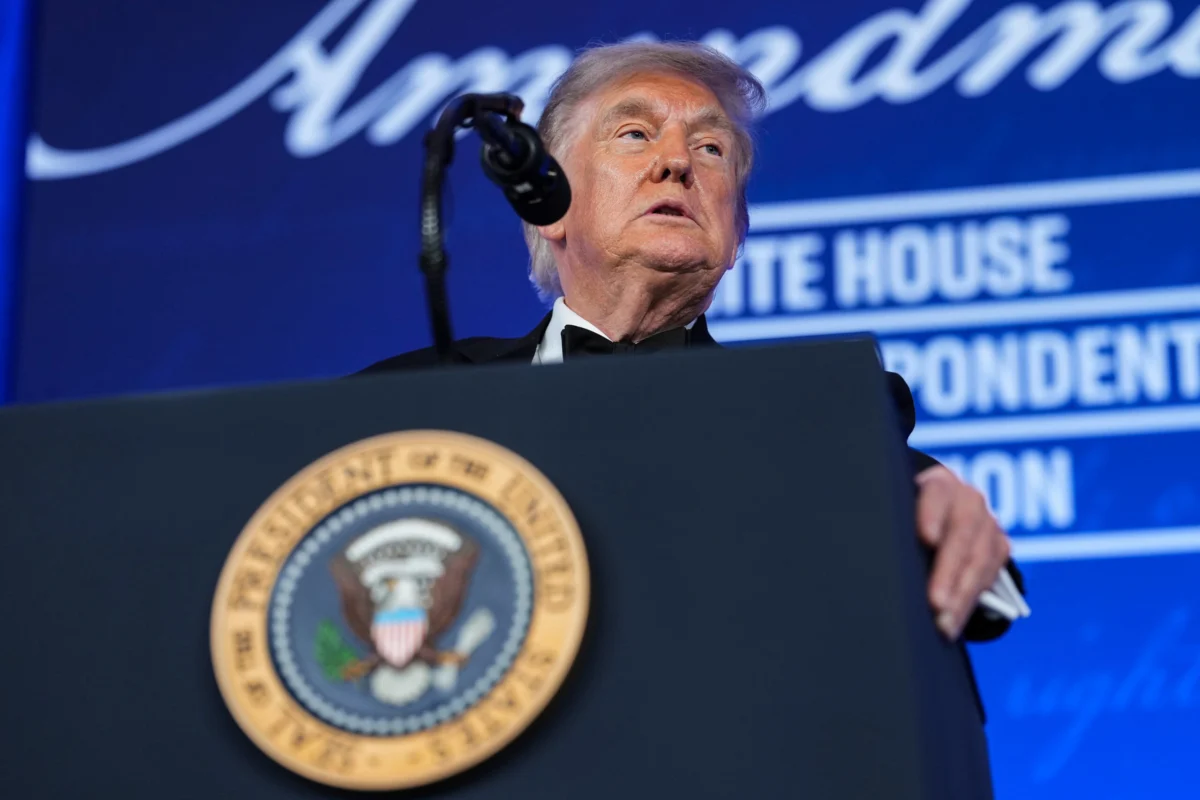
President Donald Trump addressed the rescheduled White House Correspondents’ Association Dinner on Friday evening, delivering a speech that spanned nearly an hour and was characterized by a blend of familiar campaign rhetoric and a series of attempts at humor that largely failed to resonate with the audience. This marked Trump’s first appearance at the annual event as president, an occasion that had been postponed from its original April date following a security incident where an individual attempted to breach the ballroom. Historically, presidents have utilized this keynote address to engage in lighthearted, often pointed, banter with the press. However, Trump’s address leaned heavily into his characteristic rally-style delivery, interspersed with personal criticisms directed at journalists, sometimes referencing their physical appearance.
The dinner, held at the Waldorf-Astoria’s ballroom, a venue that previously operated as a Trump hotel, was a stark contrast to the April event at the Hilton, which was significantly smaller in scale. The atmosphere throughout the evening was palpably subdued, with long stretches of silence punctuated by sporadic, muted reactions. This lack of enthusiastic engagement from the attendees, a mix of journalists, administration officials, and their guests, underscored the challenging reception of the President’s remarks. The event itself has a long-standing tradition of presidents using the platform for a blend of levity and acknowledgment of the press corps’ role, yet Trump’s approach deviated significantly from this established norm.
The Speech: A Deviation from Tradition
While presidents have historically used the White House Correspondents’ Dinner as an opportunity for playful jabs at the press, President Trump’s address took a decidedly different turn. Instead of the expected repartee, he largely reverted to themes commonly heard at his political rallies. The few instances where he attempted humor often fell flat. One notable example involved a joke about an elderly U.S. senator’s sex life, which was met with silence, eliciting a candid, almost bewildered, reaction from the President himself. "Does anybody get that? I thought that was actually great," Trump remarked, expressing his surprise at the lack of laughter. "That was actually the only thing I thought was good in this whole frickin’ stupid speech. It was the only good one, and that went down with not exactly great laughter."
The extended nature of the speech, which observers described as meandering, suggested that even the President might have sensed the disconnect with his audience. The stream-of-consciousness style saw him transition between disparate topics, from familiar political attacks, such as those directed at the appearance of figures like Congressman Adam Schiff, to detailed descriptions of his envisioned renovations for the White House ballroom. He even pointed out specific details on the chandeliers at the Waldorf-Astoria, highlighting his past involvement with the venue. The overall impact of his critiques of the press, while present, was somewhat diluted by the sheer length and the breadth of subjects covered.
A Rescheduled Event with a Troubled Past
The rescheduling of the White House Correspondents’ Dinner was a direct consequence of a serious security incident. In April, an individual attempted to rush the ballroom at the Washington Hilton, an event that was quickly thwarted by the Secret Service. The proximity of the disturbance, with shots reportedly audible to guests, led to the immediate evacuation of President Trump and Vice President Mike Pence from the dais. The incident cast a somber shadow over what is typically a celebratory occasion for journalists and underscored the volatile security environment.
Despite the unsettling circumstances, President Trump had reportedly encouraged the White House Correspondents’ Association (WHCA) to reschedule. The subsequent arrangements placed the event at the Waldorf-Astoria, a venue with a personal connection to the President. New security protocols were implemented for the rescheduled dinner. However, the shadow of the April incident and the ongoing tensions between the President and the news media remained a significant undercurrent throughout the evening.
The Press and the President: A Contentious Relationship
The White House Correspondents’ Dinner has long been a focal point for discussions surrounding the relationship between the presidency and the press. In recent years, this relationship has been particularly strained. President Trump has frequently engaged in public criticism of news organizations, labeling some as "fake news" and "enemies of the people." His administration has also been characterized by legal actions against media outlets, including a $20 billion lawsuit filed by Trump against The Wall Street Journal over its reporting on a letter he allegedly sent to Jeffrey Epstein. The President denied sending the letter.
During the dinner, The Wall Street Journal reporters were recognized with an award for their investigative work, including the story concerning the letter. As they accepted their honor, President Trump offered a handshake, followed by a gesture of his hands in the air and a smile, a moment noted by observers as potentially loaded given the ongoing legal dispute. Wolf Blitzer, who was presenting the award, publicly acknowledged Trump’s lawsuit against the publication.
Further personal barbs were directed at specific journalists. Josh Dawsey of The Wall Street Journal and CNN host Kaitlan Collins were singled out for pointed remarks, though these attempts at humor were met with silence, underscoring the audience’s discomfort. Weijia Jiang, the outgoing president of the WHCA, maintained a stoic demeanor as these digressions occurred. In response to the personal attacks on its journalists, CNN issued a statement during the proceedings, defending its reporting staff.
A Political Landscape Marked by Legal Challenges and Subpoenas
The broader context of the President’s relationship with the press includes a history of legal challenges and government actions. Beyond the lawsuit against The Wall Street Journal, the administration has faced scrutiny over its use of subpoenas to obtain reporters’ sources. This issue came to the forefront again recently when the Department of Justice announced it would withdraw subpoenas issued to New York Times reporters. These subpoenas were related to their reporting on security features of the new Air Force One. The decision to withdraw followed criticism from a federal judge regarding the manner in which the subpoenas were issued.
These actions, coupled with threats to revoke broadcast licenses, paint a picture of a presidency that has often been at odds with the established norms of press freedom and access. The President’s decision to attend the WHCA dinner, after skipping it in his first term and sometimes holding counter-programming events, was therefore seen as significant. It placed him directly at an event that celebrates the very journalists he has frequently criticized.
Notable Attendees and Undercurrents
The rescheduled dinner saw a significant presence of Trump administration officials. Cabinet members such as Pete Hegseth and presidential advisor Stephen Miller, along with his wife Katie Miller, were in attendance. Chief Legal Officer Makan Delrahim was present just hours after a significant corporate development: the decision to postpone the planned merger between Paramount and Warner Bros. Discovery due to antitrust challenges. Other high-ranking officials at the event included Secretary of Health and Human Services Robert Kennedy Jr. and his wife Cheryl Himes, Commerce Secretary Howard Lutnick, Department of Homeland Security Secretary Markwayne Mullin, and Acting Attorney General Todd Blanche. Blanche was notably part of a mentalist act performed by Oz Pearlman later in the evening.
The presence of these officials, alongside journalists and industry figures, highlighted the complex and often intertwined nature of politics, media, and business. The fact that the dinner was held at a venue with direct ties to the President added another layer of symbolism to the occasion.
A Lingering Impression and Future Prospects
As President Trump concluded his remarks, the audience’s reaction remained largely muted. The hour-long speech tested the patience of many, with only the most ardent supporters in attendance showing significant enthusiasm. Once the President left the stage, mentalist Oz Pearlman took over. Pearlman lightheartedly alluded to Trump’s speech, noting, "Tonight’s event is even crazier than the last time. It’s so successful that I’ve been informed by CBS News’ David Ellison (Ellison is CEO of CBS parent Paramount) that next year, they’re going to call it the Trump White House Correspondents’ Dinner. Changing the name is the only way you’re going to get me back here." This quip, while intended humorously, also highlighted the President’s past hesitations about attending the event.
Following Trump’s speech, a notable number of guests were observed departing the ballroom before the program concluded, suggesting the impact of the President’s lengthy and, for many, unengaging address. The event, therefore, concluded not with widespread applause, but with a sense of relief for some and perhaps a quiet resignation for others. The experience underscored the ongoing challenges in bridging the divide between the presidency and the press, even in a forum traditionally designed for dialogue and a degree of shared understanding. The future of President Trump’s participation in such events, and the nature of his engagement with the press corps, remains a subject of considerable interest and speculation.