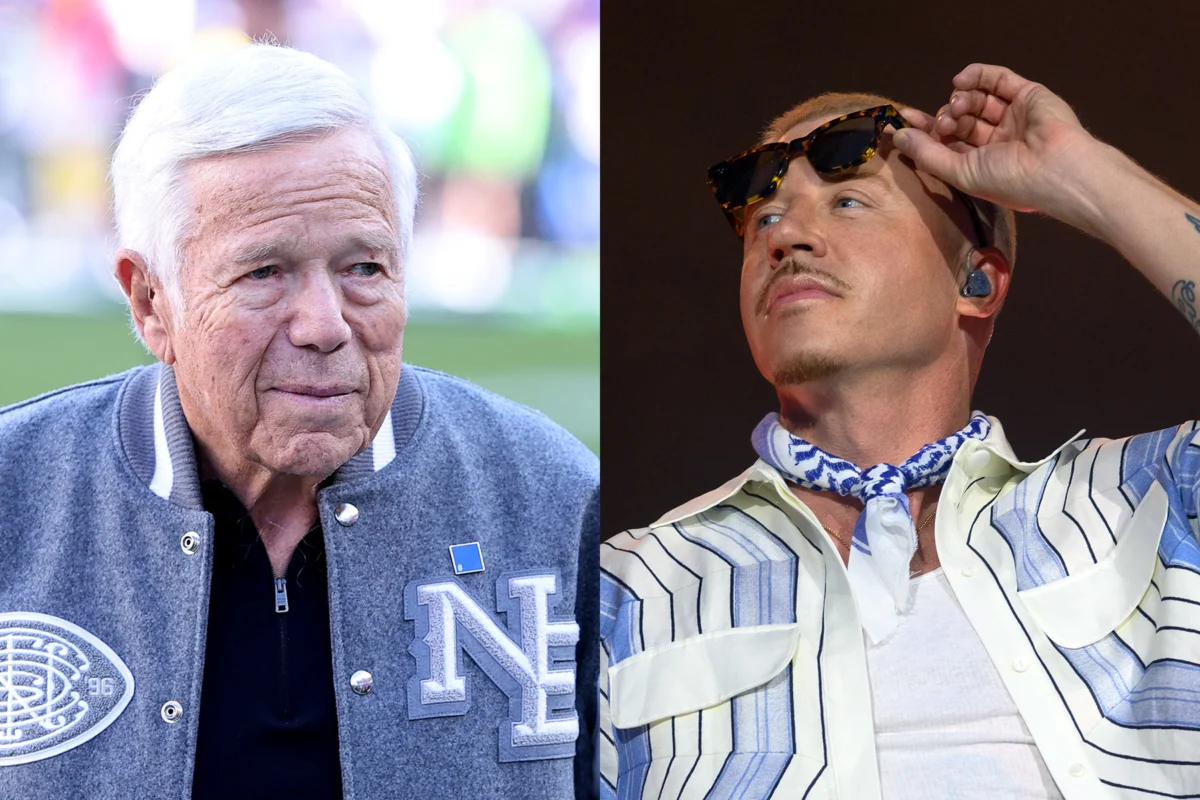
The intersection of professional sports, high-profile music tours, and international geopolitical discourse has reached a flashpoint, resulting in the removal of Seattle-based rapper Macklemore from the remainder of Ed Sheeran’s "Loop" tour. At the center of the conflict is New England Patriots owner Robert Kraft, who confirmed that he personally intervened to prevent the artist from performing at Gillette Stadium in Foxborough, Massachusetts. The decision, which has sparked a broader debate regarding the boundaries of free speech, the definition of antisemitism, and the responsibility of venue owners, highlights the increasing pressure on cultural figures to navigate the volatile landscape of the Israel-Hamas conflict.
The Catalyst: September Stage Statements
The controversy originated in early September during Ed Sheeran’s tour stops at MetLife Stadium in East Rutherford, New Jersey. Macklemore, serving as an opening act, used his platform to deliver explicit support for the Palestinian cause. During his set, the rapper addressed the audience directly, stating, "A big part of the reason why I wanted to do this tour in the first place is so I could stand up in stadiums like this and say two words that are very near and dear to my heart: ‘Free Palestine.’"
In addition to these remarks, Macklemore performed "Hind’s Hall," a protest song released earlier this year that references pro-Palestinian encampments at Columbia University. Throughout the performance, he displayed visual imagery depicting the destruction in Gaza. These actions, which the artist characterized as a humanitarian plea, were perceived by others as inflammatory and crossing the line into antisemitic rhetoric.
Chronology of the Dispute
The escalation from a stage statement to a tour-wide removal occurred rapidly over the following weeks:
- Early September: Macklemore performs at MetLife Stadium, utilizing his stage time to call for a "Free Palestine" and highlight the humanitarian crisis in Gaza.
- Mid-September: Reports emerge suggesting that pressure is mounting on tour organizers regarding the rapper’s presence.
- Late September: Robert Kraft confirms that he informed Ed Sheeran’s team that Macklemore would not be permitted to perform at Gillette Stadium.
- Early October: It is confirmed that Macklemore has been removed not only from the Gillette Stadium dates but from the entirety of the remainder of Sheeran’s tour.
- Post-Removal: Both parties issue public statements clarifying their positions, with Macklemore alleging that a coordinated effort by venue owners led to his dismissal, a claim that has yet to be formally substantiated by the stadium consortium.
The Position of Robert Kraft and The Kraft Group
Robert Kraft, a prominent Jewish philanthropist and longtime supporter of Israel, issued a formal statement to Rolling Stone to address the rationale behind the ban. Kraft asserted that his decision was based on a combination of Macklemore’s recent onstage conduct and a perceived "broader history of antisemitic rhetoric and imagery." Specifically, Kraft pointed to a 2014 incident in which the rapper was heavily criticized for wearing a costume that was widely described as an antisemitic caricature. Although Macklemore issued an apology at the time, insisting the costume was intended as a disguise, Kraft cited the event as evidence of a pattern.
"Gillette Stadium is committed to providing a welcoming environment for all guests and ensuring that all events held at our venue do not provide a platform for hate speech," Kraft stated. He emphasized that his opposition to the rapper’s rhetoric was not an attempt to silence advocacy for Palestinians, but rather a reaction to the specific framing used by the artist.
"Standing with the Palestinian people and standing against Hamas, antisemitism, and hate should not be mutually exclusive," Kraft argued. He further noted that he has spent decades directing philanthropic resources toward athletic and entrepreneurial initiatives for Palestinians, maintaining that his critique is directed at the exclusion of Hamas’s role in the current conflict.
Macklemore’s Rebuttal and the Definition of Antisemitism
In his own response to the situation, Macklemore rejected the characterization of his speech as antisemitic. He argued that the current geopolitical climate has seen the term "antisemitism" weaponized to deflect from legitimate criticism of Israeli state policies.
"Antisemitism is real," the rapper wrote. "And that is exactly why the word matters too much to be used as a shield against criticism of the Israeli state. When criticizing Israel, opposing Zionism or saying ‘Free Palestine’ gets conflated with hatred of Jewish people, it doesn’t protect Jewish people. It protects Israel from accountability."
The rapper’s perspective reflects a growing movement within the arts and entertainment sector, where performers increasingly view their platforms as essential tools for political commentary. However, this stance faces significant pushback from institutional stakeholders—such as stadium owners and corporate sponsors—who argue that the venue acts as a private space where they have the legal and ethical right to regulate the nature of the content being presented.
The Allegation of Collective Pressure
A critical component of the ongoing narrative is Macklemore’s allegation regarding the nature of his termination. The rapper claimed that Kraft did not act in isolation but instead "rallied some of the other stadium owners" to issue a collective ultimatum to Ed Sheeran: either remove Macklemore, or face a ban from performing at major venues across the country.
While a spokesperson for the Kraft Group did not address this specific allegation, the claim touches upon the concentrated nature of the live music industry. Major stadiums, often owned by billionaire sports magnates or corporate conglomerates, exercise significant control over the touring ecosystem. If such an informal "blacklist" or coordination exists, it could set a profound precedent for how political speech is managed in the live music industry.
Fact-Based Analysis: The Implications for Live Entertainment
The removal of an artist for their political speech creates a complex legal and cultural landscape. From a contractual standpoint, stadium owners typically hold broad "morality clauses" or "discretionary control" over the acts that perform in their facilities. These clauses are designed to protect the venue’s brand and ensure public safety, but they are increasingly being invoked in the context of political, rather than strictly criminal or moral, disputes.
Data from the live event industry suggests that artists are feeling the squeeze of a bifurcated audience. According to industry analysts, touring acts are facing increasing pressure from both their fanbases—who are often younger and more politically active—and their financial backers, who are often risk-averse regarding political controversy.
This incident also underscores the broader impact of the Israel-Hamas conflict on American public discourse. Since the escalation of the conflict on October 7, 2023, universities, corporate boardrooms, and artistic venues have struggled to balance the rights of free expression with the mandate to prevent the fostering of a hostile environment. The debate over whether "Free Palestine" constitutes a political slogan or an antisemitic dog whistle remains one of the most contentious fault lines in modern society.
Moving Forward: The Search for Resolution
In the closing of his statement, Robert Kraft extended a diplomatic olive branch, suggesting that he would be open to a direct conversation with the rapper to "discuss the facts." Kraft reiterated his ultimate goal of peace and the cessation of suffering for all parties involved.
As of this writing, there has been no indication of a meeting between the two parties. Ed Sheeran’s tour continues, albeit without its original supporting act, and the industry is left to grapple with the fallout. For artists, the message is clear: the stadium stage, once considered a neutral ground for entertainment, is increasingly governed by the personal values and political commitments of those who own the infrastructure.
The incident serves as a stark reminder of the limitations of the "platform" in the modern era. As the line between private property rights and the public square continues to blur, the music industry is likely to face more, not fewer, of these confrontations. Whether this will lead to a standardizing of speech policies in performance contracts or a deepening of the divide between performers and venue operators remains to be seen. For now, the case of Macklemore and the Gillette Stadium ban stands as a defining moment in the current cultural climate, illustrating the high stakes of political expression in an increasingly polarized world.