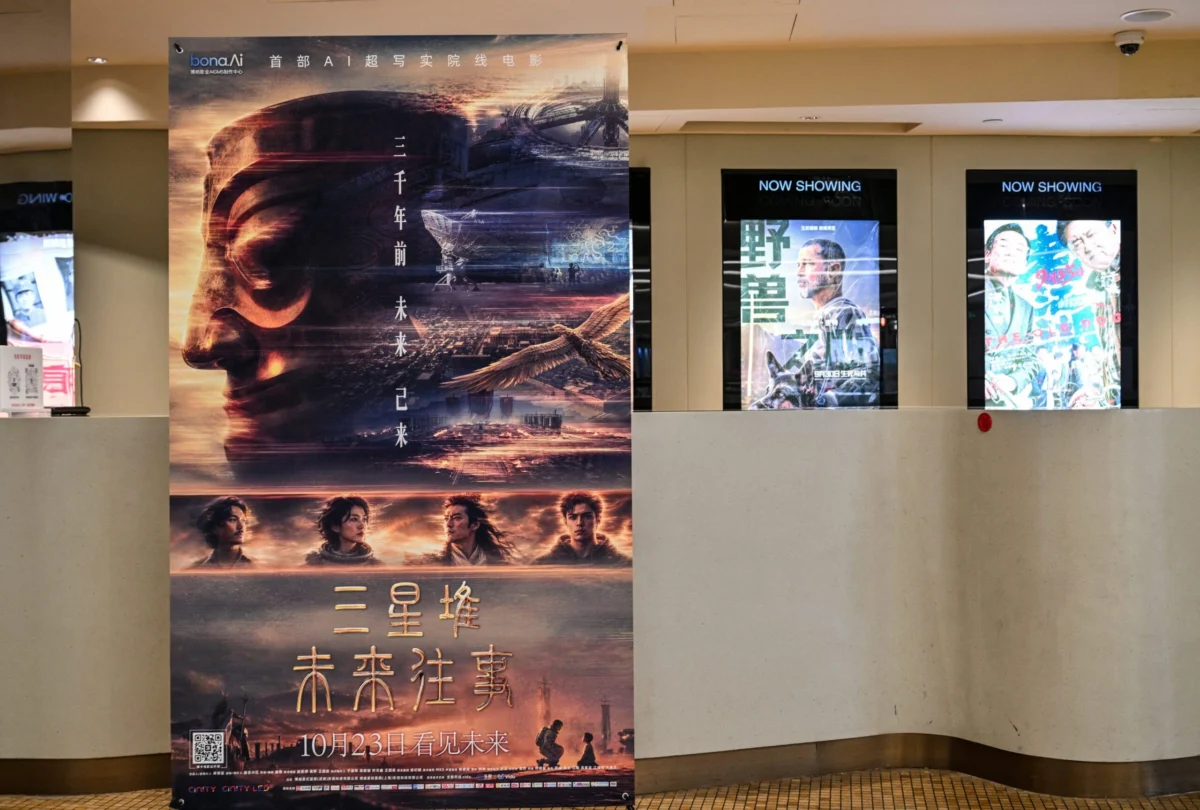
The debut of China’s first fully AI-generated feature film, the sci-fi thriller Sanxingdui: Future Past, has served as a sobering reality check for the global film industry, highlighting a significant disconnect between the rapid adoption of synthetic media in short-form content and the expectations of audiences in a traditional cinema setting. Produced by the Bona Film Group, the project was intended to be a watershed moment for artificial intelligence in narrative storytelling. However, the film’s lackluster financial performance—garnering a mere $180,000 against a $1.5 million budget—underscores the complex challenges of scaling AI technology from digital scraps to high-fidelity, long-form entertainment.
A Chronology of a High-Stakes Cinematic Gamble
The journey of Sanxingdui: Future Past began as an ambitious venture to integrate generative AI across the entire production pipeline, from conceptualization and scriptwriting to visual effects and scene rendering. For the Bona Film Group, the goal was to leverage AI as a tool for cost efficiency and creative liberation.
The project’s timeline saw an accelerated production schedule that would have been impossible with traditional animation or live-action techniques. By early 2026, the studio was already touting the film as a pioneer in the industry. Upon its theatrical release, it became the first production of its kind to secure an official permit in China, a regulatory milestone that signaled the government’s willingness to experiment with the medium.
However, the period following its release was marked by rapid disappointment. While microdramas—short, episodic narratives optimized for mobile consumption—have seen explosive growth in the Chinese market, the transition to the big screen proved jarring for viewers. By the first Monday of its run, the box office figures provided by the ticketing platform Maoyan confirmed the industry’s worst fears: the public was not ready to pay for a full-length, AI-generated theatrical experience.
The Paradox of Microdramas vs. Feature Films
To understand the failure of Sanxingdui, one must examine the vastly different landscapes of digital content consumption. The surge in AI-generated microdramas has been nothing short of meteoric. According to data from the financial news outlet Caixin, the first quarter of 2026 saw over 120,000 microdramas released in China, with AI-driven production accounting for more than 95% of that volume. Just one year prior, this figure was virtually non-existent.
The economic incentive is clear: the cost of producing these short-form episodes has plummeted to as little as $3,000 per production. In this ecosystem, AI is not expected to deliver cinematic perfection; it is expected to deliver speed, quantity, and "hook-heavy" narratives that keep viewers scrolling on platforms like TikTok or Douyin.
When that same generative logic is applied to a 90-minute feature film, the expectations shift dramatically. In a cinema, the audience pays for an immersive experience, high-fidelity visual consistency, and deep emotional resonance—elements that current generative AI models still struggle to maintain over extended durations. The "trauma" described by social media users on platforms like Xiaohongshu likely stems from the "uncanny valley" effect, where AI-generated characters or environments appear just human enough to be unsettling, but not realistic enough to feel authentic.
Official Perspectives and Industry Reaction
Jiang Defu, the Chief Operating Officer of Bona Film Group, has adopted a defensive but pragmatic stance regarding the film’s reception. In an interview with the Chinese film publication Yuli, Jiang emphasized that the project was never strictly about immediate profitability. Instead, he framed it as a necessary, high-risk R&D exercise.
"We are the first to try it, the first to get a theatrical release permit, and the first to be tested by the audience," Jiang stated. "I think that is not easy at all."
This sentiment is echoed by industry analysts who view the film as a "proof of concept" rather than a commercial product. However, the silence from other major studios suggests that the industry is taking a "wait and see" approach. The financial loss is a powerful deterrent, and companies that were previously eyeing AI as a way to slash production budgets for major releases are now reconsidering the potential for brand damage.
The Global Context: AI in Hollywood and Beyond
The skepticism surrounding AI in cinema is not unique to China. In the United States, the role of AI has been a central point of contention in the labor disputes that rocked Hollywood throughout 2023. Screenwriters and actors have engaged in prolonged negotiations to establish legal protections against the replacement of human creativity with machine-generated content.
Despite these tensions, the use of AI in Hollywood is increasingly pervasive, albeit often kept behind the curtain. The October 2026 release of the Netflix thriller Animals, directed by Ben Affleck, brought this to the forefront of the public consciousness. During a Bloomberg event, Affleck admitted that he utilized AI throughout the production, though he was hesitant to disclose specifics. His reasoning—that movies are designed to "foster the illusion of reality"—hints at a future where AI is used as an invisible assistant rather than a primary creator.
Unlike the Chinese experiment with Sanxingdui, which was marketed as a "first AI film," Hollywood’s current strategy appears to be one of integration rather than replacement. By using AI to handle background assets, lighting corrections, or complex VFX, filmmakers can enhance the "reality" of a film without forcing the audience to grapple with the technology’s limitations.
Implications for the Future of Filmmaking
Stanley Rosen, a professor at the University of Southern California and an expert on Chinese film and society, suggests that the path forward for AI in movies is likely restricted to specific formats. "The public is highly skeptical about AI use in major feature films, despite their general acceptance of short-form films," Rosen notes.
He argues that for AI to gain traction in the theatrical space, it must reach a level of quality comparable to blockbuster benchmarks like Avatar or the domestic Chinese hit Nezha 2. Until then, AI-generated feature films will likely be relegated to streaming platforms like Netflix or Amazon Prime Video, where the barrier to entry is lower and the audience is more accustomed to diverse—and sometimes experimental—visual styles.
The failure of Sanxingdui: Future Past will almost certainly slow the pace of "AI-first" theatrical releases. It serves as a reminder that while generative AI is a powerful tool for synthesis, it currently lacks the nuanced human touch required to sustain a narrative across a feature-length runtime. For now, the "freedom" of AI storytelling, praised by some early adopters for its low cost and ease of production, remains a double-edged sword. It allows for limitless imagination but often fails to provide the narrative glue that keeps an audience engaged for more than a few minutes.
Conclusion: A Turning Point for Digital Storytelling
As the dust settles on the theatrical run of Sanxingdui, the industry faces a crossroads. The economic argument for AI—reducing budgets from millions to thousands—remains incredibly attractive to studios struggling with rising production costs. However, the artistic argument is currently failing to meet the market’s demand for quality.
The lesson for the coming years is clear: technology can automate the mechanics of filmmaking, but it cannot yet replicate the resonance of human-driven cinema. Producers will likely move toward a hybrid model, treating AI as a sophisticated assistant rather than an autonomous creator. While the dream of a fully AI-generated blockbuster remains a goal for some, the reality of the 2026 box office proves that, at least for now, audiences are not yet willing to trade the human experience for the convenience of an algorithm. The experiment was a failure in financial terms, but as an industry case study, it has provided a vital map of the limits of artificial intelligence in the creative arts.