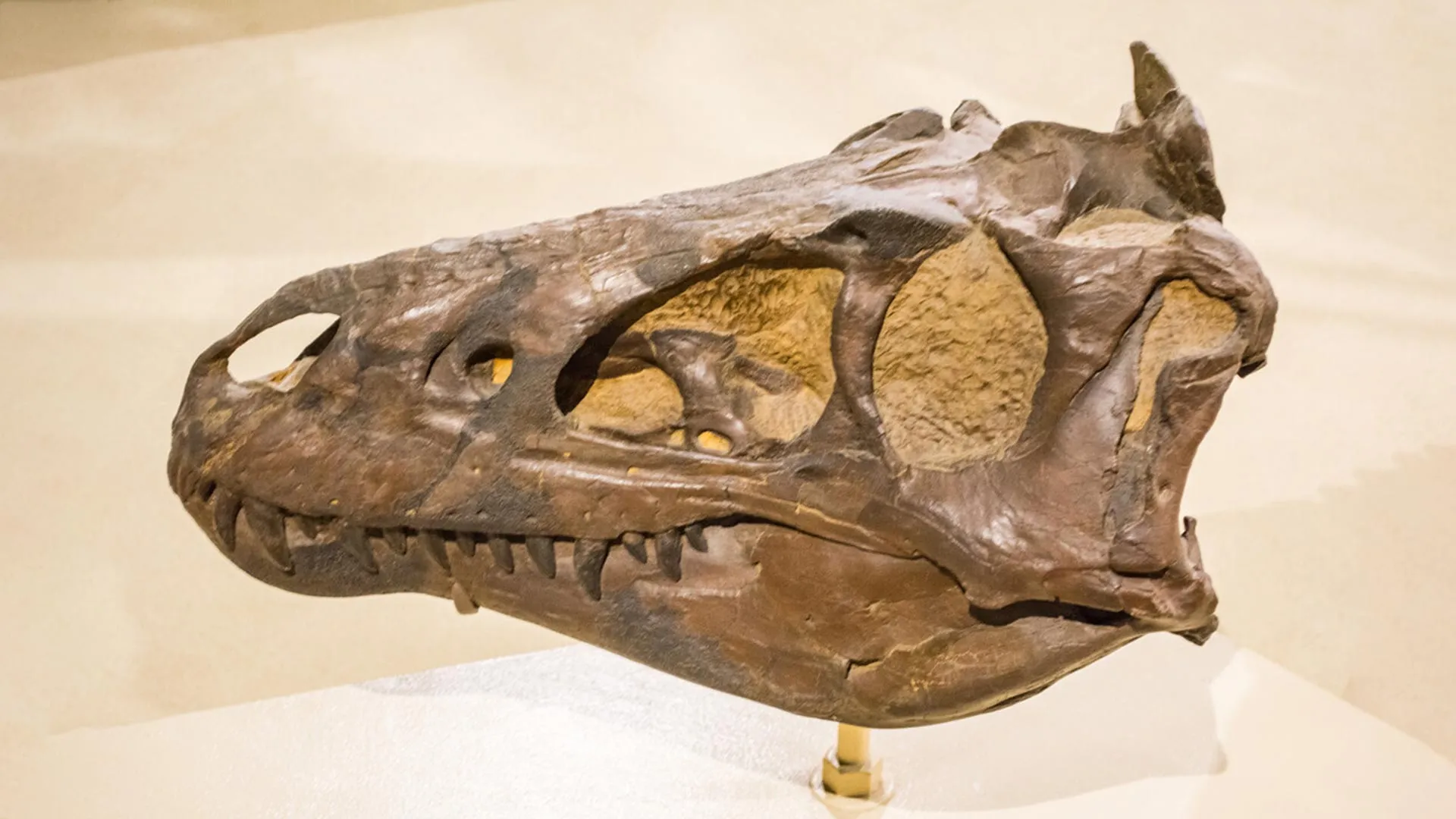
A scientific quandary that has occupied paleontologists for decades may finally be moving toward a definitive answer. New research, spearheaded by a team including Ashley Poust from the University of Nebraska State Museum, offers compelling evidence that Nanotyrannus, a dinosaur frequently depicted as a diminutive relative or juvenile form of the iconic Tyrannosaurus rex, was, in fact, a distinct and separate species. This groundbreaking study, published in the prestigious journal Science, utilizes a novel approach to bone histology, examining a rarely studied bone to unlock crucial insights into the age and maturity of the fossil in question.
The Crucial Fossil and the Hyoid Bone’s Secret
At the heart of this renewed investigation lies a single fossil specimen: the skull of Nanotyrannus, meticulously preserved at the Cleveland Museum of Natural History. For years, the debate surrounding this specimen has centered on its age at the time of death. The prevailing hypothesis among many scientists was that this skull belonged to a juvenile T. rex, still in its rapid growth phase, and thus not a unique species.
The research team, led by Christopher Griffin, an assistant professor of geosciences at Princeton University, challenged this long-held assumption by focusing on a small, often overlooked bone: the ceratobranchial, commonly known as the hyoid bone. This bone, which forms part of the hyoid apparatus in the throat, was preserved alongside the skull, providing a unique opportunity for detailed analysis.
Through the application of bone histology, a specialized technique that involves studying the microscopic structure of fossilized bone, the researchers meticulously examined the growth patterns within this small throat bone. Their analysis revealed distinctive features that strongly indicated the animal had reached or was very close to its full adult size. This finding is of paramount importance because it directly contradicts the notion that the specimen was a young T. rex still undergoing significant growth.
Ashley Poust, the Voorhies Endowed Curator of Vertebrate Paleontology at the University of Nebraska State Museum and a key contributor to the study, elaborated on the significance of these findings. "This small-bodied—in relation to T. rex—meat-eater’s hyoid bone showed growth patterns that suggest maturity or approaching maturity," Poust stated. "This lets us be confident in keeping the name Nanotyrannus, because this animal is clearly not on a growth path to becoming a Tyrannosaurus rex."
A Significantly Smaller Predator: Distinguishing Features
The size disparity between Nanotyrannus and Tyrannosaurus rex is a significant factor supporting the argument for a separate species. Current estimates suggest that Nanotyrannus reached an approximate length of 18 feet. In stark contrast, a fully grown T. rex could dwarf this creature, exceeding 40 feet in length. This substantial difference in adult size strongly argues against Nanotyrannus being merely a juvenile stage of T. rex. The ecological niches and predatory roles of two such differently sized theropods would likely have been distinct, further bolstering the case for their separate evolutionary trajectories.
A Fossil’s Tumultuous History
The Nanotyrannus fossil has a history marked by classification shifts and scientific contention. The skull was initially unearthed in 1942 and, at that time, was classified as belonging to the genus Gorgosaurus. It wasn’t until 1988 that further detailed study prompted scientists to propose a new classification: Nanotyrannus lancensis. However, this reclassification did not settle the matter. In the subsequent years, a significant portion of the scientific community began to advocate for the alternative interpretation, arguing that the skull was, in fact, that of a juvenile T. rex. This divergence in opinion ignited a debate that has persisted for over three decades, shaping much of the discourse surrounding tyrannosaurid evolution.
The recent findings directly challenge this long-standing assumption of immaturity. Christopher Griffin explained the team’s initial mindset and subsequent shift in perspective. "At the time, the prevailing consensus was that the Nanotyrannus holotype skull represented an immature Tyrannosaurus rex, and was not a separate species," Griffin remarked. "Our expectations were simply following along with that consensus, but once we sampled the hyoid and saw features that strongly indicated maturity, we knew that we had to examine that idea more skeptically."
A Novel Approach to Dinosaur Growth Studies
To solidify their conclusions and provide a robust framework for future research, Poust and his colleagues embarked on a comparative analysis. They meticulously compared the hyoid bones of Nanotyrannus with those from a diverse array of species. This included modern-day relatives of dinosaurs, such as ostriches, alligators, and various lizard species, as well as other fossilized specimens.
This pioneering approach, applying hyoid bone histology to dinosaur fossils for age determination, had not been widely explored previously. The success of this method holds the potential to revolutionize how paleontologists study fragmentary fossil remains, opening up new avenues for understanding the life history of extinct creatures, especially when larger, more conventionally used bones are absent or incomplete.
"It’s expanding, in a small way, the ability to learn about animals’ past lives," Poust commented on the broader implications of their methodological innovation. "It was exciting to show that the growth signal is so conserved across the body. Maybe this is a tiny wedge to start investigating that in some different ways."
Poust further noted his initial surprise at the hyoid bone’s efficacy as an age indicator. Traditionally, scientists have relied on larger skeletal elements like ribs or femurs for such analyses. However, the consistent results obtained from the hyoid bone suggest that it may be an equally, if not more, reliable indicator of maturity and growth patterns in certain fossil contexts.
Resolving a Decades-Long Debate and Paving the Way for New Questions
The current study appears to have largely settled the contentious question of whether Nanotyrannus existed as a distinct species. This research follows closely on the heels of another significant study, published in the journal Nature, which also examined a potential Nanotyrannus fossil. This other specimen, discovered in Montana and now housed at the North Carolina Museum of Natural Sciences, further contributed to the growing body of evidence supporting Nanotyrannus‘s distinctiveness.
Griffin emphasized the definitive nature of their findings regarding the holotype specimen. "We investigated the holotype specimen because it is the one fossil that formally defines the species—any other specimens that are called Nanotyrannus lancensis are being referred to this one specimen, which holds the species name," he explained. "Since this specimen is mature, this definitively shows that Nanotyrannus is distinct from Tyrannosaurus."
Implications for Dinosaur Ecosystems and Evolutionary Understanding
While the debate over Nanotyrannus‘s species status may be drawing to a close, its resolution opens up a new vista of questions concerning the structure and dynamics of prehistoric ecosystems. The confirmation that Nanotyrannus and T. rex coexisted during the Late Cretaceous period suggests a far more complex ecological landscape than previously understood, with multiple large predatory dinosaurs sharing the same environments.
"You’re left with at least two different sized meat-eaters in the same environment, which has some big implications for ecology and the extinction of dinosaurs," Poust observed. The presence of different-sized apex predators would have undoubtedly influenced prey selection, hunting strategies, and interspecies competition. Understanding these intricate relationships is crucial for reconstructing accurate models of ancient food webs and understanding the pressures that shaped dinosaur evolution and eventual extinction.
"Knowing more about what existed gives us a sense of how big the fossil record is and how species change through time," Poust added. "And understanding the complexities of an ecosystem is important." The discovery and validation of Nanotyrannus as a distinct species contribute to a more nuanced picture of the biodiversity that thrived millions of years ago, underscoring the ongoing process of scientific discovery and the ever-evolving nature of our understanding of Earth’s ancient past. This research not only resolves a long-standing debate but also provides a valuable new tool for paleontologists and enriches our appreciation for the intricate tapestry of life that once roamed our planet.