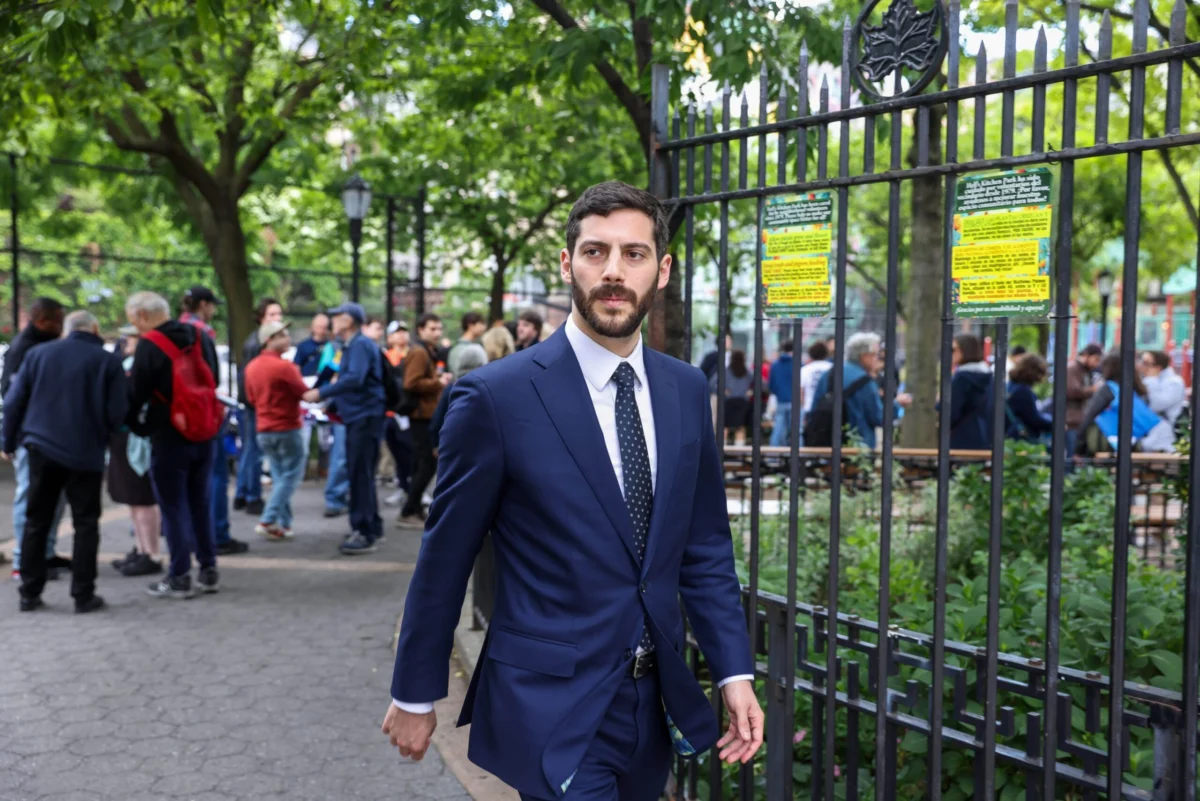
The landscape of artificial intelligence policy in the United States is shifting from a quiet, technical discourse to a high-stakes arena of campaign finance and ideological warfare. At the center of this transition is Alex Bores, a former Palantir engineer turned New York state Assemblymember, whose recent unsuccessful bid for Congress has catalyzed a new, well-funded effort to consolidate AI advocacy. Following a primary race that shattered spending records, Bores has launched "Who Decides," a nonprofit organization aimed at unifying a fractured coalition of AI safety advocates and establishing a baseline legislative agenda for the next three years.
The genesis of this movement lies in the bitter, $40 million Manhattan congressional primary—the most expensive House primary of the 2026 cycle. Bores, a proponent of the RAISE Act, which established New York as a pioneer in frontier AI safety legislation, found himself pitted against both political rivals and the concentrated financial might of Silicon Valley. Despite Bores’ own background in the tech sector, he became a primary target for "Leading the Future," a super PAC bolstered by significant contributions from OpenAI president Greg Brockman and venture capital firm Andreessen Horowitz. This group spent over $7.6 million to oppose Bores, citing his legislative history as a threat to technological innovation. Conversely, "Public First Action," supported by $20 million in funding from Anthropic, campaigned in his favor, illustrating the deep, corporate-backed divisions within the AI industry regarding the scope of government oversight.
A Chronology of Escalating Regulatory Tensions
The conflict surrounding Bores’ campaign is merely one symptom of a broader, long-term struggle between state-level innovation and federal preemption. The following timeline tracks the progression of these tensions:
- May 2023: OpenAI CEO Sam Altman testifies before the Senate Judiciary Committee, publicly advocating for a regulatory framework to govern AI development.
- Late 2025: The New York State Assembly passes the RAISE Act after a complex lobbying effort involving 55 distinct organizations. The bill initially included robust whistleblower protections and mandatory third-party audits.
- May 2026: In a significant reversal, Sam Altman informs the Senate Commerce Committee that federal government mandates requiring pre-approval for AI models would be "disastrous," signaling a shift in industry sentiment.
- June 2026: The Manhattan primary reaches a boiling point, with total outside spending exceeding $40 million. Bores loses the primary, marking a decisive victory for the anti-regulation wing of Silicon Valley donors.
- September 2026: Jacob Coxon resigns from Anthropic, a move that triggers renewed scrutiny from federal lawmakers and accelerates the push for federal AI safety legislation in Washington.
- October 2026: Bores launches "Who Decides," a nonprofit dedicated to raising $30 million by 2028 to counter industry-led deregulation efforts and unify Democratic advocacy groups.
The Disconnect Between Public Sentiment and Legislative Action
Data indicates that the political gridlock surrounding AI is not a reflection of public opinion, but rather a result of concentrated lobbying. Independent polling confirms that a substantial majority of the American public supports more stringent AI regulation, yet this consensus has failed to translate into effective, long-lasting policy.
A survey conducted by the Annenberg Public Policy Center between February and March 2026 found that 65% of Americans believe the government has done "too little" to regulate AI. This sentiment is broadly distributed across the political spectrum: 77% of Democrats, 72% of independents, and 53% of Republicans support increased government oversight. Despite this, the legislative trajectory has been characterized by "watered-down" bills, such as the final version of the RAISE Act, which saw critical components—including whistleblower protections—stripped away before passage.
Bores draws a parallel between AI regulation and the long-standing debate over gun control. Despite consistent polling—such as Pew Research data indicating near 90% support for universal background checks—Congress has historically struggled to enact meaningful reforms. "The basics of this issue, while the urgency has changed a lot in the past week, the basics have not," Bores noted. "80% of Americans want there to be more regulation on AI, and that’s across parties."
The "Who Decides" Strategy
The nonprofit "Who Decides," co-founded by Bores and his former chief of staff Anna Myers, is designed to avoid the pitfalls of past advocacy efforts. With $10 million already secured and an additional $20 million goal for 2027, the organization is eschewing a direct "arms race" of spending against industry-funded super PACs. Instead, it aims to act as a force multiplier for existing organizations across 11 battleground states.
Bores views the current political moment as a "limited time" window. He argues that with issues like Medicare or the Green New Deal, the public has a pre-existing "answer key" regarding policy preferences. With AI, however, the very questions being asked are still under contestation. "We’re in this limited time where it’s not even just the answers that are up for grabs, but even the questions that are being asked are up for grabs," he said. By helping advocacy organizations build their own agendas rather than imposing a top-down strategy, Bores hopes to establish a "shared floor" for AI safety that can withstand the influence of deep-pocketed donors.
Federal Implications and the Risk of Preemption
The battle has now shifted to Washington, where a new federal AI safety bill—co-sponsored by Senators Ted Cruz, Amy Klobuchar, and Majority Leader John Thune—is gaining momentum. While the bill is framed as a necessary step for safety testing and incident reporting, critics suggest it may contain "poison pill" provisions that could mirror a previous attempt by Senator Cruz to bar states from enforcing any AI laws for a decade.
Bores, in his analysis of the current federal climate, views this development with caution. He argues that industry proponents are attempting to use the urgency of the moment to "shut down the real power people have to regulate" at the state level. If the federal bill passes in its current form, it could potentially nullify the hard-won gains made by state-level legislatures like New York’s, effectively wiping out the "strongest AI safety bill in the country."
Addressing the "Circular Firing Squad"
Beyond the threat of industry lobbying, Bores acknowledges an internal challenge within the Democratic Party and the broader progressive coalition: the tendency to prioritize sub-issues over a unified front. He describes this as a "circular firing squad," where activists and policymakers allow minor differences in approach to derail broader legislative goals.
"Democrats are very passionate about making a difference, and that passion is usually well placed," Bores said. "But that occasionally gets misdirected into saying, ‘No, my sub-issue is more important than your sub-issue.’" By centralizing resources and fostering a collaborative environment, the "Who Decides" initiative seeks to remind these stakeholders that their opposition—a small, highly motivated subset of Silicon Valley mega-donors—is unified in its goals.
Future Outlook and Policy Impact
The implications of this movement extend far beyond the immediate legislative battles. If Bores and his allies succeed in creating a sustainable, nationwide infrastructure for AI advocacy, it could mark a turning point in how technological regulation is negotiated in the United States. The success of "Who Decides" will depend on its ability to navigate the complex interests of various stakeholders—ranging from school districts concerned about AI in the classroom to national security experts worried about frontier model risks.
As states like Illinois and Massachusetts move to introduce their own safety frameworks, the tension between state-led innovation and federal preemption will likely remain the defining feature of AI policy. For now, Bores’ transition from elected official to nonprofit advocate represents a broader trend: the realization that in the age of AI, the fight for regulation is as much about campaign finance and coalition building as it is about the code itself. The coming two years, leading up to the 2028 election cycle, will determine whether a "shared floor" for AI safety can truly be established, or if the influence of the industry will continue to define the parameters of the digital future.