The End of an Era: The Socio-Economic Climate of 1971
To understand the rise and fall of the Boss 351, one must first look at the environment into which it was released. By 1971, the "horsepower wars" that had defined the 1960s were under siege. The United States government had begun implementing the first significant waves of the Clean Air Act, which mandated reductions in tailpipe emissions. This forced engineers to begin detuning engines, lowering compression ratios to accommodate lower-octane unleaded fuel. Simultaneously, the National Highway Traffic Safety Administration (NHTSA) was pushing for increased safety features, which added weight to vehicle frames and bumpers.
Perhaps more damaging to the muscle car market than government regulation was the reaction of the insurance industry. By the early 1970s, actuarial data had linked high-performance "supercars" to increased accident rates. In response, insurance providers levied massive surcharges on any vehicle with a high power-to-weight ratio. For many young buyers—the primary demographic for the Mustang—the annual insurance premium for a Boss or Mach 1 could equal a significant portion of the car’s actual purchase price.
Within Ford, internal priorities were also shifting. The company had spent the late 1960s dominating tracks from Le Mans to the local drag strip, but the costs were astronomical. Under new leadership and facing a cooling economy, Ford drastically scaled back its factory racing programs, pulling support from NASCAR and the SCCA Trans-Am series. This withdrawal meant that the "homologation specials"—cars built specifically to qualify parts for racing—no longer had a corporate raison d’être.
The Genesis of the "Boss" and the Shinoda Legacy
The "Boss" moniker remains one of the most evocative names in the Ford pantheon, and its origin is a testament to the personality-driven design era of the 1960s. The name is attributed to Larry Shinoda, a visionary designer who had been recruited from General Motors by Ford President Semon "Bunkie" Knudsen. Shinoda, who had previously penned the legendary 1963 "split-window" Corvette Sting Ray, was tasked with giving the Mustang a more aggressive, track-ready aesthetic to compete with the Chevrolet Camaro.
When asked by colleagues what project he was working on in the top-secret design studios, Shinoda famously replied, "the boss’s car," referring to Knudsen. The name was eventually adopted for the production models, beginning with the Boss 302 and Boss 429 in 1969. While those earlier models were built to satisfy racing requirements—the 302 for Trans-Am and the 429 for NASCAR—the 1971 Boss 351 was a different breed. It was designed as a "street boss," utilizing the lessons learned from racing to create a high-performance grand tourer that didn’t require a professional pit crew to maintain.
Engineering the Heart of the Beast: The 351 Cleveland
At the center of the Boss 351’s appeal was its power plant. While Ford offered several 351-cubic-inch engines during this era, the Boss utilized the "Cleveland" architecture, named for the Cleveland Engine Plant where it was manufactured. The Cleveland engine was distinct from the more common 351 "Windsor" V8, featuring a different block casting and, most importantly, superior cylinder head technology.
The Boss 351 engine was a masterpiece of small-block engineering. It utilized a computer-designed block with thin-wall casting techniques to save weight without sacrificing structural integrity. The cylinder heads featured large, canted valves (2.19-inch intake and 1.71-inch exhaust), which allowed the engine to breathe with the efficiency of a much larger big-block motor. To earn the "Boss" designation, Ford engineers went several steps further than the standard 351 Cleveland:
- Bottom End Strength: The engine featured four-bolt main bearing caps to ensure the crankshaft remained stable under high-RPM stress.
- Rotating Assembly: It was equipped with a forged steel crankshaft and forged aluminum pistons, providing a high 11.7:1 compression ratio—one of the highest ever offered in a production Ford.
- Induction and Ignition: A specific Autolite 4300-D four-barrel carburetor sat atop an aluminum intake manifold, while a dual-point distributor handled the spark.
- Valvetrain: Solid lifters were used instead of hydraulic ones, requiring more frequent maintenance (valve lash adjustments) but allowing the engine to rev safely past 6,000 RPM.
The result was an engine rated at 330 horsepower and 370 lb-ft of torque. In an era where "net" horsepower ratings were beginning to replace "gross" figures, these numbers were exceptionally stout. On the road, the Boss 351 was capable of sprinting from 0 to 60 mph in roughly 5.8 seconds, a figure that remains respectable even by modern standards.
Performance Analysis: The "Giant Killer"
One of the most enduring legacies of the Boss 351 is its reputation as a "giant killer." In 1971, Ford also offered the Mustang with the massive 429-cubic-inch Cobra Jet engine. On paper, the 429 was the king of the hill, but in real-world testing, the Boss 351 often proved to be the superior all-around performer.
Contemporary road tests by magazines such as Motor Trend and Car and Driver revealed that the Boss 351 could cover the quarter-mile in approximately 13.8 to 14.1 seconds at speeds exceeding 100 mph. This was often faster than the 429 Cobra Jet Mustangs, which suffered from excessive front-end weight that hampered traction and handling. The Boss 351 benefited from a much better weight distribution, allowing it to navigate corners with a level of agility that the big-block cars could not match.
Furthermore, the Boss 351 came standard with a host of performance upgrades that made it a cohesive package. This included a "Competition Suspension" with staggered rear shocks to mitigate wheel hop, power front disc brakes, and a four-speed manual transmission with a Hurst shifter. Unlike many muscle cars of the era that were only good for straight-line speed, the Boss 351 was a balanced performance machine.
The 1971 Redesign: A Controversial Transformation
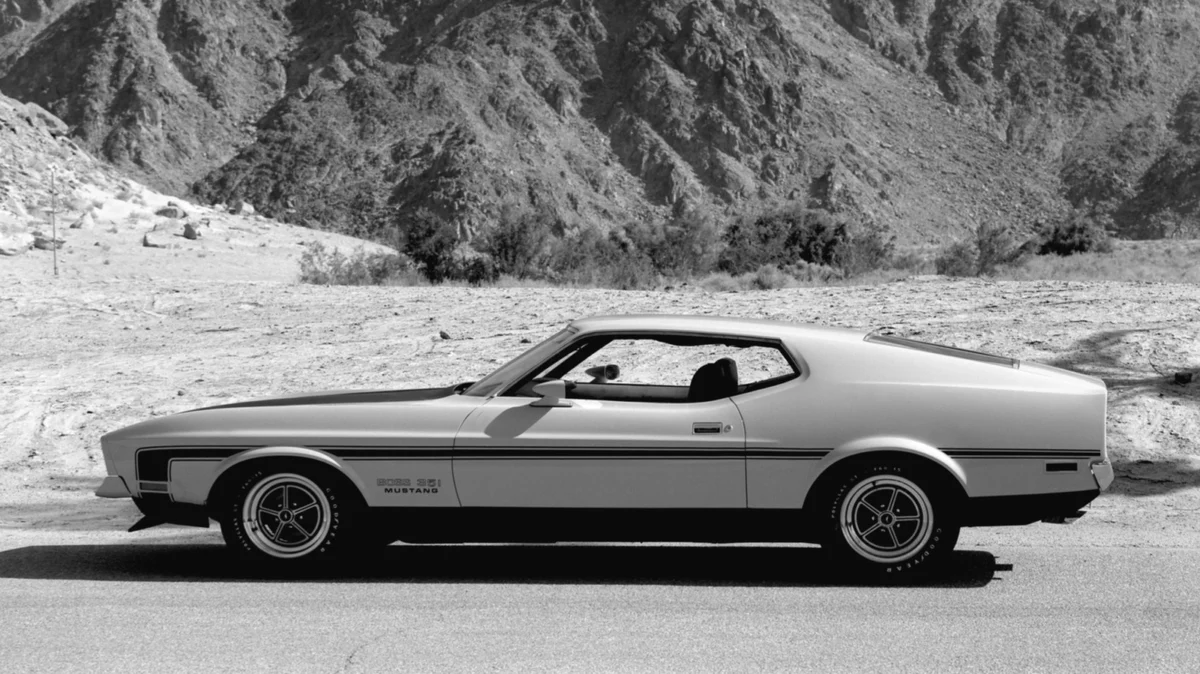
While the mechanical components of the Boss 351 were highly praised, the vehicle’s exterior design was met with mixed reviews. The 1971 Mustang represented a significant departure from the original "pony car" proportions. It was nearly 3 inches wider and 2 inches longer than the 1970 model, with a wheelbase that had grown to accommodate the massive 429 engine.
The "SportsRoof" (fastback) body style featured a nearly horizontal rear window, which created a striking, futuristic profile but resulted in abysmal rearward visibility for the driver. Inside, the cockpit was criticized for being cramped despite the car’s larger exterior dimensions. The dashboard was deep, and the auxiliary gauges were often difficult to read at a glance.
Bunkie Knudsen had pushed for this larger Mustang, believing that the market wanted more "presence" and more room for big-block engines. However, the timing was poor. As the public began to favor smaller, more fuel-efficient cars in the face of rising gas prices, the "Big Mustang" felt out of step with the zeitgeist. This disconnect is reflected in the sales figures: while the original 1964.5 Mustang was a runaway success, the 1971-1973 generation saw a steady decline in popularity.
Production and Rarity
The Ford Mustang Boss 351 was produced for the 1971 model year only. During its brief production run, only 1,806 units were manufactured. This low production volume was not due to a lack of capability, but rather the aforementioned perfect storm of high insurance rates, new emissions standards, and the general decline of the muscle car market.
By 1972, Ford had replaced the Boss 351 with the "351 HO" (High Output), but the compression ratio had been slashed to 8.8:1 to meet new regulations. The era of the high-compression, solid-lifter Boss was over.
Impact and Legacy in the Collector Market
Today, the 1971 Ford Mustang Boss 351 is recognized as one of the most desirable collector cars of the 1970s. For decades, it was overshadowed by the 1969-1970 Boss 302 and the legendary Boss 429. However, as enthusiasts and historians have revisited the performance data, the 351 has gained a cult following.
Collectors prize the Boss 351 for its unique "one-year-only" status and its mechanical purity. It represents the final iteration of Ford’s "Total Performance" philosophy before the industry transitioned into the "Malaise Era" of the mid-1970s, characterized by low power and heavy smog equipment.
In the current classic car market, a well-preserved or correctly restored Boss 351 can command prices significantly higher than standard Mach 1 models of the same year. Its rarity, combined with its legitimate performance credentials, ensures its place as a cornerstone of the Mustang legacy. The car serves as a reminder of a specific moment in time when engineering excellence and raw power collided with a rapidly changing world, resulting in a machine that was, for one brief year, the undisputed "Boss" of the road.