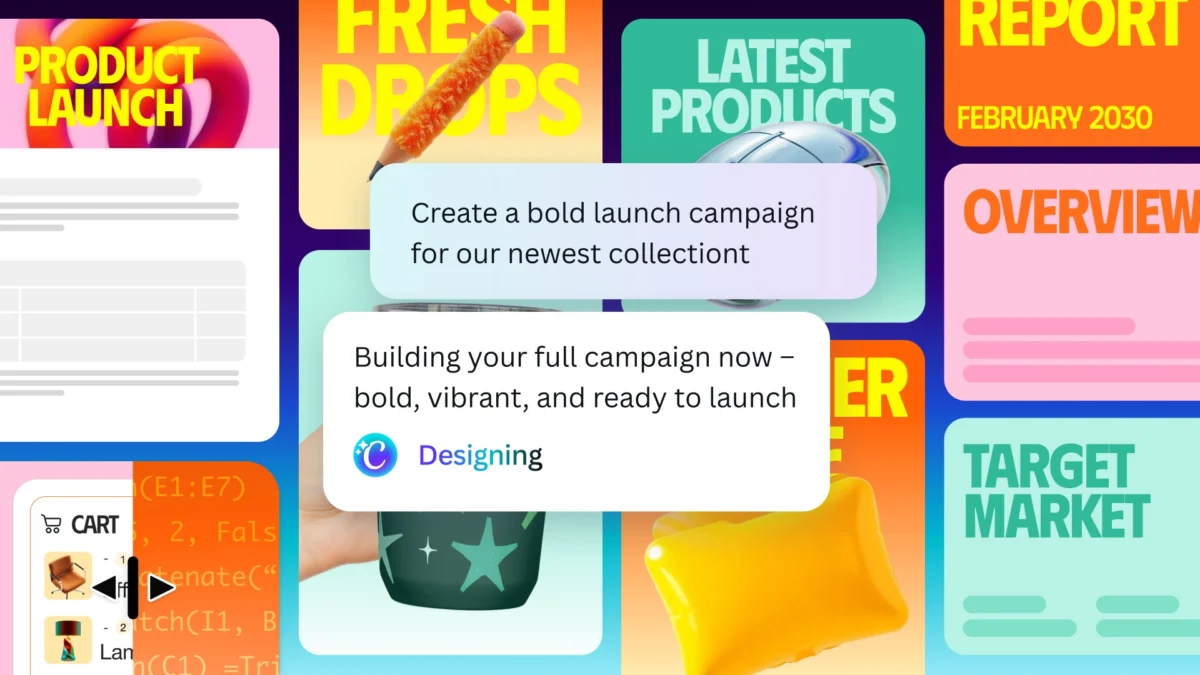
Canva, the global visual communication platform, has launched its significantly enhanced AI Assistant 2.0, marking a pivotal shift towards an "agentic orchestration" paradigm in creative design. This latest iteration empowers users to articulate their design needs through natural language prompts, allowing the AI assistant to autonomously plan, execute, and leverage a suite of relevant tools to generate fully editable designs. This strategic move is particularly critical for design professionals and small businesses who increasingly seek predictable, automated workflows for creating high-quality content and media assets efficiently.
At its core, the promise of modern AI platforms lies in their ability to understand complex tasks, break them down into manageable steps, and then orchestrate the necessary tools to achieve the desired outcome, all while learning and adapting to user preferences. Canva’s AI Assistant 2.0 fully embraces this vision, utilizing its sophisticated AI model to translate user descriptions into tangible, layered designs. Users can simply describe their desired output, and the assistant will intelligently call upon Canva’s extensive toolkit, presenting several design options that retain full editability, offering unparalleled flexibility for subsequent refinements. The use of distinct layers in the generated designs ensures that users can meticulously tweak individual elements, text, and imagery, maintaining creative control over the final product.
The introduction of AI Assistant 2.0 represents a significant milestone in Canva’s ongoing commitment to integrating artificial intelligence deeply into its user workflows. This commitment has been evident in a series of prior updates, including the introduction of robust image generation and website creation capabilities powered by AI. These incremental advancements have steadily positioned the AI assistant not merely as a supplementary feature but as a central component of the design process, streamlining content creation from ideation to execution.
The Paradigm Shift: Agentic AI in Creative Tools
The concept of "agentic orchestration" is rapidly transforming the landscape of digital tools, particularly within creative industries. Unlike earlier generations of AI that performed specific, isolated functions (e.g., image upscaling, background removal), agentic AI aims to mimic a human assistant by understanding broader objectives, proactively selecting and deploying various tools, and even anticipating user needs based on past interactions and contextual information. For creative professionals, this translates into a profound leap in productivity. Instead of manually navigating through multiple tools and processes, they can delegate complex, multi-step tasks to an intelligent agent, freeing up valuable time for more strategic and conceptual work. The demand for such capabilities stems from the ever-increasing volume of content required across marketing, social media, and digital communications, necessitating tools that can accelerate creation without sacrificing quality or customization.
Canva’s foray into this advanced AI domain reflects a broader industry trend where design platforms are evolving beyond mere editors to become intelligent co-creators. This shift is crucial for empowering users who may not possess formal design training but need to produce professional-grade visuals, as well as for seasoned designers looking to automate repetitive tasks and scale their output.
Canva’s Enhanced AI Assistant 2.0: A Deep Dive into Features
The latest update brings a comprehensive suite of features and refinements designed to bolster the AI Assistant’s capabilities and seamlessly integrate it into a user’s digital ecosystem.
- Core Design Capabilities: The ability to generate editable, layered designs directly from text prompts is arguably the cornerstone of AI Assistant 2.0. This feature democratizes design, allowing anyone to conceptualize and realize complex visuals without needing to master intricate software interfaces. The layered output is a critical differentiator, moving beyond static AI-generated images to provide fully functional design files.
- Expanded Contextual Understanding through Integrations: A significant enhancement is the addition of deep integrations with popular productivity and communication platforms such as Slack, Gmail, Google Drive, Calendar, and Zoom. Users can now grant the AI bot permission to access and analyze data from these sources – including emails, conversations, files, and meeting data. This contextual awareness allows the AI assistant to generate more relevant, personalized, and informed design suggestions, understanding the user’s current projects, communication style, and scheduling needs. For instance, an AI assistant could draft a presentation slide based on the key points discussed in a recent Zoom meeting or suggest social media graphics aligned with an upcoming calendar event.
- Web Research and Automation: To further augment its intelligence, the AI Assistant 2.0 gains a "web research" skill, enabling it to browse the internet to gather information pertinent to a design task. This means users can ask the AI to create a graphic about a trending topic, and the AI can pull relevant data and imagery from the web. Complementing this is a new scheduling feature, allowing users to instruct the AI bot to perform repeatable tasks in the background, such as generating weekly social media posts or monthly newsletters. While these scheduled tasks will initially produce drafts for user review and approval, it significantly reduces manual effort for routine content creation.
- Refinements to Existing AI Tools: Canva is not just adding new features but also refining its existing AI toolkit. The AI code generator now supports HTML import, allowing users to bring in existing code and modify it using text prompts. Similarly, the spreadsheet generator has been enhanced, enabling users to describe the kind of spreadsheets they need, which the AI then generates, pre-populated with relevant structures and formulas.
- Performance Breakthroughs: Underlying these feature enhancements are significant improvements in Canva’s proprietary AI models. The company reports that its Lucid Origin image-generation model is now five times faster and 30 times cheaper to operate. Furthermore, its 12V image-to-video model has seen a sevenfold increase in speed and a 17-fold reduction in cost. These efficiency gains translate directly into faster processing times for users and enable Canva to scale its AI services more economically.
A Strategic Vision: The "Final Mile" Advantage
Canva’s co-founder and COO, Cliff Obrecht, articulated the company’s strategic positioning amidst a rapidly evolving AI landscape. He emphasized that while many companies are striving to merge workflows and develop comprehensive AI agents, businesses, particularly small and medium-sized enterprises (SMBs), consistently prefer to finalize the critical steps of editing, collaboration, and publishing within the Canva platform.

"I think a lot of small businesses start and end their day, and they’ll do a lot of their workflows completely, in Canva," Obrecht stated. He also highlighted Canva’s strong interoperability with other leading AI models and platforms, including Anthropic, Google, and OpenAI. "We also work incredibly well with Anthropic, Google and OpenAI, so if someone is doing their agentic workflows in those products, they can call Canva, get content, and they can get it back into those LLMs. But they always need to end up doing the final mile of editing, collaboration and deployment. That’s where we really are strong," Obrecht added. This "final mile" strategy positions Canva as the indispensable hub for execution, ensuring that even if initial ideation or complex data processing occurs elsewhere, the ultimate creative output and distribution pipeline funnels through Canva. This approach capitalizes on Canva’s established user base and its reputation for intuitive editing and seamless sharing capabilities.
Competitive Landscape and Industry Dynamics
Canva’s advancements occur within a highly competitive and dynamic market for creative software, where major players are all heavily investing in AI. Just this week, Adobe launched its Firefly AI assistant, designed to integrate seamlessly with its Creative Cloud suite of applications, enabling users to execute tasks across Photoshop, Illustrator, and other professional tools. Similarly, Figma, a dominant force in collaborative design, introduced support for AI agents on its platform last month, leveraging an MCP server to facilitate AI-driven design processes.
This intense competition underscores the industry-wide recognition of AI’s transformative potential. While Adobe caters primarily to high-end professional designers with deep feature sets, and Figma excels in collaborative UI/UX design, Canva has historically carved out a niche by prioritizing accessibility and ease of use for a broader audience, including non-designers, small businesses, and marketing teams. Canva’s "final mile" strategy, combined with its new agentic capabilities, aims to solidify its position as the go-to platform for rapid content creation and deployment, regardless of whether the initial AI-driven ideation happens within Canva or another ecosystem. The ability to integrate with external LLMs while retaining core editing and publishing within Canva could be a crucial differentiator.
Canva’s Growth Trajectory and Future Outlook
Beyond its technological advancements, Canva continues to demonstrate robust financial health and ambitious growth plans. While a substantial portion of its revenue traditionally stems from individual users and small teams, the company’s enterprise business segment is experiencing remarkable expansion, boasting a promising 100% year-on-year growth. This indicates a successful penetration into larger organizations that require scalable, AI-powered design solutions for their diverse teams.
Most recently valued at $42 billion, according to PitchBook, Canva is also on a clear path towards a public offering. Obrecht indicated that the company is likely to go public next year, signaling a significant milestone that would bring increased scrutiny and expectations for sustained growth and profitability. An IPO would provide Canva with substantial capital to further accelerate its AI research and development, expand its global footprint, and potentially acquire complementary technologies. The company’s consistent innovation, coupled with its strong market position and financial performance, sets the stage for a compelling entry into the public markets. Looking ahead, Canva’s presence at industry events, such as the TechCrunch event in San Francisco in October 2026, further emphasizes its commitment to showcasing its evolving platform and engaging with the broader tech and creative communities.
Broader Implications for Creative Professionals and Businesses
The advent of AI Assistant 2.0 and similar agentic AI tools carries profound implications for the creative industry and the broader business landscape.
- Empowering Non-Designers: The most immediate impact is the further democratization of design. Individuals and small businesses without dedicated design teams can now produce sophisticated, professional-quality content with unprecedented ease. This lowers the barrier to entry for effective visual communication, allowing startups, solopreneurs, and non-profits to compete more effectively in visually-driven markets.
- Boosting Productivity for Professionals: For established creative professionals and agencies, these tools offer immense productivity gains. Repetitive tasks, initial ideation, and variations of designs can be automated, allowing human designers to focus on higher-level creative strategy, client interaction, and the nuanced refinement that only human intuition can provide. It transforms the designer’s role from a manual laborer to a strategic orchestrator of AI tools.
- Ethical Considerations and Future of Work: As AI takes on more complex creative tasks, discussions around the ethics of AI-generated content, copyright, and the evolving nature of creative jobs become more pertinent. While AI automates certain functions, it also creates new roles in AI prompting, oversight, and ethical guidelines. The emphasis shifts towards human-AI collaboration, where the AI handles the heavy lifting, and the human provides the vision, critique, and final polish.
- Accessibility and Scalability: AI-powered design tools enhance accessibility for users with varying skill levels and enable businesses to scale their content production dramatically. Marketing campaigns requiring hundreds of variations for different platforms or audience segments can now be executed in a fraction of the time, allowing for more dynamic and personalized engagement.
Canva’s AI Assistant 2.0 is launching in research preview this week, with a broader rollout planned for all users in the coming weeks. This phased approach allows for crucial user feedback and iterative improvements before general availability. By embracing agentic orchestration and integrating deeply into user workflows, Canva is not just updating its product; it is actively shaping the future of creative work, making sophisticated design more accessible, efficient, and integrated than ever before. The platform’s strategic focus on the "final mile" of creation, coupled with its impressive growth and impending IPO, positions it as a formidable force in the evolving digital creative ecosystem.