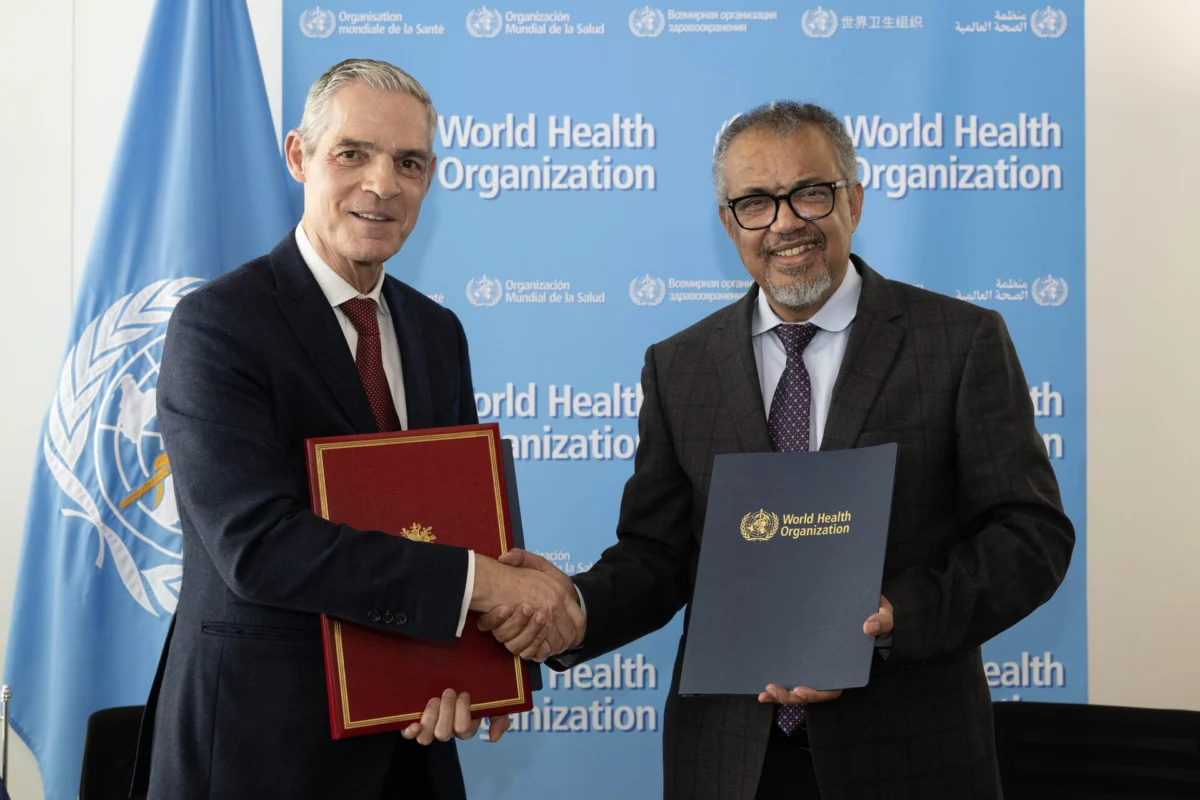
GENEVA — In a significant bolstering of multilateral health diplomacy, France and the World Health Organization (WHO) formally cemented a renewed financial and strategic commitment on Thursday, October 17, 2024. During a high-level ceremony at the WHO headquarters in Geneva, His Excellency Mr. Jérôme Bonnafont, Permanent Representative of France to the United Nations and other international organizations in Geneva, met with WHO Director-General Dr. Tedros Adhanom Ghebreyesus to sign seven pivotal contribution agreements.
The comprehensive funding package, totaling €24 million, is channeled through the French Ministry of Europe and Foreign Affairs. It operates directly under the umbrella of the overarching France-WHO Framework Agreement spanning from 2020 to 2025. This bilateral framework serves a dual purpose: it aligns France’s external health contributions with the strategic priorities of the global health body, while simultaneously providing the robust legal, administrative, and financial mechanisms required to operationalize complex health interventions across the globe.
A central highlight of the newly signed agreements is a contribution of €4.5 million allocated to the Core Voluntary Contributions Account (CVCA). Unlike strictly earmarked funding, which restricts how international organizations can deploy capital, fully flexible voluntary funds are invaluable to the WHO. They allow the agency to allocate resources rapidly to overlooked crises, fill critical operational gaps, and maintain institutional agility in the face of sudden public health emergencies.
Beyond the core voluntary funds, the €24 million injection will target a diverse array of pressing global health initiatives. These encompass the prevention and management of non-communicable diseases (NCDs), the development of innovative urban health laboratories, the advancement of the "One Health" approach—which recognizes the interconnectedness of human, animal, and environmental health—and crucial replenishments for the WHO Contingency Fund for Emergencies (CFE).
Furthermore, specific geographic and thematic crises will directly benefit from the French funding. This includes sustained support for the WHO’s emergency health operations in Gaza, targeted responses to dangerous cholera outbreaks globally, and vital mental health and psychosocial support programs in Ukraine, where conflict has severely fractured healthcare infrastructure.
The funding package also ensures the continued operational resilience of the WHO emergencies center located in Lyon, France. The Lyon hub has long served as a cornerstone for international epidemic preparedness and response, equipping public health professionals with the logistical and operational capabilities needed to contain infectious disease threats before they cascade into widespread global pandemics.
The Institutional Architecture of the France-WHO Partnership
To fully understand the weight of the October 2024 agreements, it is necessary to examine the broader historical and strategic context of cooperation between Paris and the Geneva-based health agency. France has historically positioned itself as a staunch advocate for robust multilateralism, viewing international organizations not merely as service providers, but as indispensable guardians of global stability and human rights.
Over the past decade, the landscape of global health financing has shifted dramatically. Traditional donor funding models have frequently been criticized for being overly fragmented, heavily earmarked, and reactive rather than proactive. In response, France has consistently championed the philosophy of fully and flexibly financed international institutions. By increasing its assessed contributions—the mandatory dues calculated based on a country’s wealth—and supplementing them with flexible voluntary grants, France has sought to provide the WHO with predictable revenue streams.
This philosophy culminated in France agreeing to co-host the WHO’s inaugural Investment Round. Designed to mobilize predictable and flexible resources, the Investment Round supports the implementation of the Fourteenth General Programme of Work (GPW 14) for the years 2025 through 2028. Approved by the World Health Assembly earlier in 2024, the GPW 14 outlines the strategic roadmap for the global health community as it confronts a rapidly changing epidemiological landscape marked by climate change, demographic shifts, and geopolitical instability.

The France-WHO Framework Agreement for 2020–2025 provides the legal scaffolding that makes these ambitious multi-year programs possible. By streamlining bureaucratic hurdles and establishing transparent accountability metrics, the framework ensures that every euro contributed by French taxpayers is tracked, optimized, and deployed in alignment with the highest standards of international development aid.
Chronology of Cooperation: Key Milestones (2020–2024)
The signing ceremony on October 17, 2024, was not an isolated event, but rather the latest chapter in a carefully orchestrated trajectory of bilateral collaboration.
In 2020, as the world plunged into the unprecedented crisis of the COVID-19 pandemic, France and the WHO formalized their structured engagement by launching the 2020–2025 Framework Agreement. This pact established a predictable channel for French development assistance, focusing heavily on health systems strengthening in low- and middle-income countries.
Throughout 2021 and 2022, as the acute phase of the pandemic gradually gave way to the complex task of global recovery, French contributions were instrumental in supporting the Access to COVID-10 Tools Accelerator (ACT-A) and bolstering the WHO’s regional hubs. The emergency hub in Lyon, in particular, received continuous operational backing to manage logistics, supply chains, and technical training for medical personnel across Francophone Africa and beyond.
By 2023, the scope of the partnership expanded significantly beyond infectious diseases. Recognizing the mounting global burden of chronic ailments, French funds began flowing into initiatives targeting cardiovascular diseases, cancer, diabetes, and mental health. The collaboration also embraced the "One Health" paradigm, institutionalizing joint approaches among human health, veterinary, and environmental sectors to preempt zoonotic spillover events.
In early 2024, the World Health Assembly’s adoption of the Fourteenth General Programme of Work (2025–2028) set the stage for a new financial architecture. France stepped forward as a global leader by co-hosting the WHO Investment Round, pushing other member states and private philanthropies to commit to sustainable, predictable financing. The October 17 signing of the seven contribution agreements represents the immediate operationalization of these broader commitments, translating high-level diplomatic pledges into concrete financial allocations on the ground.
Voices from Geneva: Official Reactions and Statements
The strategic importance of the funding package was underscored by the remarks delivered by both leaders during the official signing ceremony at WHO headquarters.
Ambassador Jérôme Bonnafont, Permanent Representative of France to the United Nations in Geneva, emphasized his nation’s steadfast dedication to the multilateral health architecture.
"France remains deeply committed to supporting the World Health Organization in its efforts to tackle critical global health challenges," Ambassador Bonnafont stated. "These agreements reflect our shared priorities of promoting health equity, responding to emergencies, and strengthening healthcare systems worldwide. In an era marked by converging crises—from violent conflicts to climate-induced health emergencies—the international community needs a strong, agile, and well-resourced WHO more than ever."

Dr. Tedros Adhanom Ghebreyesus, Director-General of the WHO, expressed profound appreciation for the enduring partnership between Geneva and Paris.
"We are immensely grateful to the French Government for its steadfast support to WHO, continued partnership, and leadership in global health," Dr. Tedros remarked. "This contribution will enable us to address key health threats, from non-communicable diseases to emergency response, helping to save lives and protect the most vulnerable populations. The flexibility provided within these agreements is particularly vital, as it allows us to deploy resources precisely where the need is greatest and without administrative delay."
Fact-Based Analysis: Implications for Global Health
The timing and composition of France’s €24 million funding package carry significant implications for the broader ecosystem of international public health governance. Analysts note several key takeaways from the October 2024 agreements:
-
The Power of Flexible Funding: For decades, the WHO has been hamstrung by the reality that a vast majority of its budget is tightly earmarked by donors for specific diseases or regions. While earmarked funds are necessary, they create structural rigidities, making it difficult for the agency to pivot when unforeseen crises emerge. France’s allocation of €4.5 million to the Core Voluntary Contributions Account directly addresses this vulnerability, enhancing the WHO’s institutional resilience.
-
A Holistic Approach to Disease Burden: While emergency response often commands the lion’s share of media attention, non-communicable diseases remain the leading cause of mortality globally, accounting for nearly 74% of all deaths. By explicitly earmarking funds for NCDs alongside acute crises like cholera outbreaks in developing nations and emergency medical responses in Gaza and Ukraine, the France-WHO agreements validate a dual-track strategy: preparing for the unexpected while managing the chronic.
-
Strengthening Regional and Local Infrastructure: Support for the WHO emergencies center in Lyon highlights the critical shift toward decentralized preparedness. Rather than managing every global health threat from Geneva headquarters, empowering regional hubs ensures that specialized training, laboratory diagnostics, and logistical stockpiles are positioned closer to potential flashpoints, drastically reducing response times during disease outbreaks.
-
Catalytic Leadership in Multilateral Fundraising: As the WHO rolls out its Fourteenth General Programme of Work (2025–2028), the agency faces the daunting task of securing predictable, long-term financing from a donor community that is increasingly fatigued by overlapping geopolitical and economic crises. By acting as a co-host for the inaugural Investment Round and consistently increasing its financial commitments, France is setting a benchmark for other donor nations, encouraging burden-sharing and reinforcing the legitimacy of global health governance.
Conclusion and Future Outlook
The signing of the seven contribution agreements on October 17, 2024, marks a defining moment in the contemporary history of international health cooperation. By aligning financial commitments with strategic frameworks, France and the WHO have demonstrated that multilateral institutions can remain effective, adaptable, and responsive when backed by reliable political and financial partnerships.
As the international community looks ahead to the implementation of the GPW 14 strategy through 2028, the collaborative efforts anchored in Geneva and Lyon will serve as a vital bulwark against future health shocks. Through targeted investments in emergency preparedness, chronic disease prevention, and flexible operational funding, France and the WHO have reaffirmed their shared vision: a safer, healthier, and more equitable world for all populations, particularly the most vulnerable.