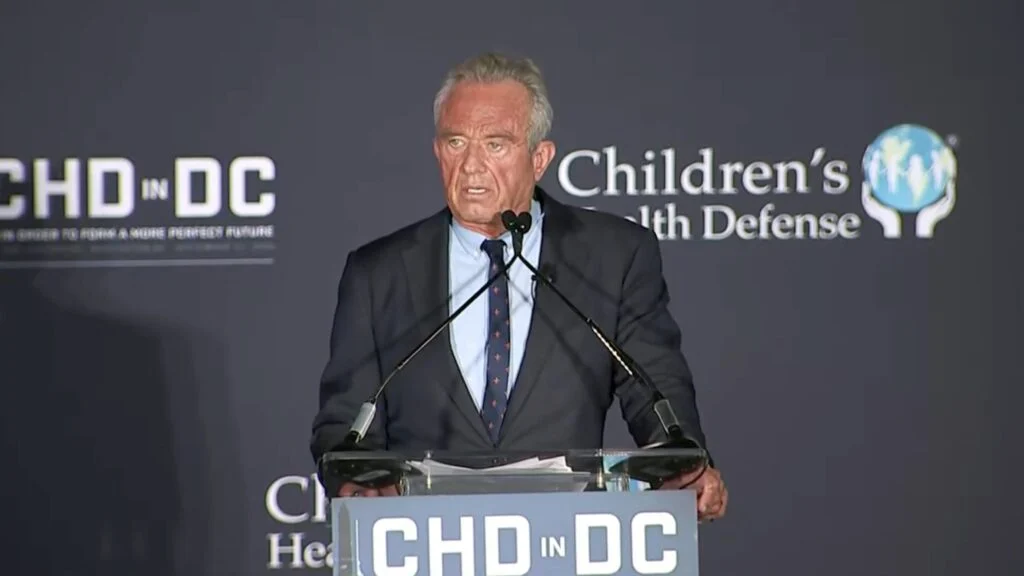
Health Secretary Robert F. Kennedy Jr. returned to the ideological bedrock of his political career on Thursday, delivering a keynote address at a conference hosted by Children’s Health Defense (CHD). The organization, a nonprofit focused on vaccine skepticism that Kennedy helped establish, served as the stage for a speech that functioned simultaneously as a victory lap for the Make America Healthy Again (MAHA) movement and a bold, controversial declaration of intent ahead of the upcoming midterm elections. As the nation prepares for a referendum on the current administration’s health care reforms, Kennedy’s remarks underscored a pivot from his earlier attempts to moderate his image to a full-throated embrace of his long-standing skepticism regarding vaccine safety.
The setting was emblematic of the administration’s shifting priorities. While the first half of Kennedy’s address focused on his broader administrative agenda—including initiatives to overhaul the American food pyramid, restrict chemical additives in consumer goods, and reform nutritional standards in hospitals—the tone shifted abruptly midway through. After touching upon ongoing agency investigations into electromagnetic frequency exposure and the phenomena of "chemtrails," Kennedy pivoted to address the core concerns of his base: the safety and regulatory standards of the childhood immunization schedule.
A Challenge to Established Regulatory Science
Kennedy’s critique centered on the clinical trial process used to approve vaccines. Projecting an image of a hepatitis B vaccine package insert onto the ballroom screens, he questioned the rigor of the data supporting its approval. "The question is: Should we be looking at the potential that some of these chronic illnesses are associated with vaccines?" Kennedy asked the audience. He highlighted that the original trial for the hepatitis B vaccine involved only 147 healthy infants and children and lasted for a period of five days without a placebo control group.
This argument, a staple of anti-vaccine rhetoric, ignores the broader context of vaccine regulatory science. At the time of the hepatitis B vaccine’s approval, the Food and Drug Administration (FDA) evaluated the small-scale clinical trial alongside extensive historical data from millions of children who had received earlier iterations of the shot. Furthermore, decades of post-market surveillance and subsequent large-scale trials have consistently demonstrated the efficacy and low risk profile of the vaccine. Since the implementation of universal newborn vaccination policies, the United States recorded a 99% reduction in chronic hepatitis B infections among children and teenagers. Despite these clinical outcomes, the current administration moved to end the universal vaccination policy last year, a decision that has sparked significant debate within the pediatric medical community.
The VAERS Debate and Data Interpretation
A significant portion of the Secretary’s address was dedicated to the Vaccine Adverse Event Reporting System (VAERS). Kennedy characterized the existing reporting system as inadequate, suggesting that the government has failed to capture the true risk profile of widely administered vaccines. He proposed an overhaul of the system, including the automation of data collection and the introduction of financial incentives for physicians to report potential side effects.
However, public health experts emphasize that VAERS is a passive surveillance system designed to detect early warning signs, not to establish causality. Vaccine manufacturers are required by law to report any adverse events occurring after vaccination, regardless of whether a causal link exists. The very package inserts Kennedy cited explicitly state: "It is not possible to reliably estimate their frequency or establish a causal relationship to a vaccine exposure." By presenting a list of hundreds of reported conditions—ranging from autoimmune diseases to Sudden Infant Death Syndrome (SIDS)—as evidence of vaccine harm, the Secretary is drawing a correlation that the scientific community maintains is not supported by rigorous, peer-reviewed evidence.
Chronology of the MAHA Movement
The trajectory of the MAHA movement, which has found a powerful patron in the current White House, can be traced through several key administrative actions:
- September 2025: The federal government initiates a shift in newborn vaccination protocols, sparking initial concern among infectious disease specialists.
- December 2025: The administration officially ends the universal recommendation for newborn hepatitis B vaccination, citing concerns over "over-vaccination."
- January 2026: The Centers for Disease Control and Prevention (CDC) releases a modified childhood immunization schedule, reducing the number of recommended shots.
- April 2026: A lawsuit is filed challenging the administration’s changes to the immunization schedule, alleging that the decisions bypassed standard advisory committee protocols.
- August 2026: President Trump issues an executive order reinforcing his administration’s support for the HHS vaccine reform agenda.
- September 2026: A measles outbreak in Pennsylvania leads to four reported deaths, reigniting the national conversation on the necessity of vaccination coverage.
Implications for Public Health Policy
The policy shifts championed by Kennedy have sent shockwaves through the medical and biotech sectors. Critics argue that the administration’s skepticism toward established vaccine science threatens to dismantle the infrastructure of public health. The recent measles outbreak in Pennsylvania serves as a sobering case study for many; public health officials suggest that falling vaccination rates, fueled by misinformation, have left vulnerable populations at risk. When questioned on the recent measles-related deaths, the Secretary noted that his agency cares about "every child who dies," but he did not pivot back to the importance of immunization, focusing instead on the potential for rare adverse reactions.
The Department of Health and Human Services (HHS) is currently conducting a massive research initiative, evaluating over 150 serious adverse events reported in VAERS. This task force, alongside a broader project analyzing health data from Medicare, Medicaid, and private insurers, aims to determine if specific timing or sequences of childhood vaccines contribute to long-term health issues. While supporters view this as a necessary investigation into "long-ignored" data, the mainstream scientific establishment views it as a costly pursuit of unfounded theories that could erode trust in safe, life-saving medical products.
Political Solidarity and Future Outlook
The speech was not merely a scientific argument; it was a political statement. By explicitly stating that the audience has a "strong and steadfast friend at the White House," Kennedy signaled that the administration has no intention of pivoting away from its current trajectory. The alignment between the President and the Secretary suggests that vaccine policy will remain a cornerstone of the administration’s platform throughout the midterm cycle.
As the event concluded, the atmosphere was one of celebration. The transition to the next speaker, Andrew Wakefield, provided a striking coda to the afternoon. Wakefield, whose work was retracted by The Lancet and who was stripped of his medical license in the UK, has been a central figure in the anti-vaccine movement for nearly three decades. His presence at the podium, immediately following the Secretary of Health and Human Services, highlighted the extent to which fringe medical perspectives have moved from the periphery to the highest levels of the American executive branch.
For the medical community, the path forward remains fraught. Biotech companies and medical associations are closely monitoring the ongoing lawsuits regarding the immunization schedule. Meanwhile, the administration continues to press forward with its plans to restructure the nation’s health reporting systems. The outcome of the upcoming midterms will likely serve as a definitive indicator of whether the American public supports this fundamental re-evaluation of health care policy or if the medical establishment will successfully push back against these systemic changes. As the country approaches this electoral crossroads, the debate over vaccine safety has evolved from a scientific discourse into a central pillar of national political identity, with consequences that will likely resonate for a generation.