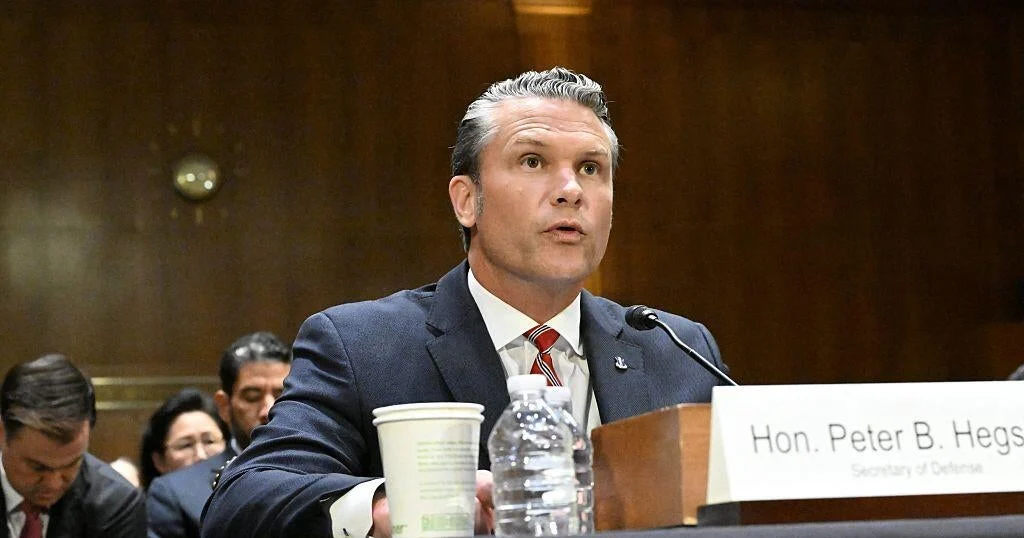
Washington D.C. – Defense Secretary Pete Hegseth testified before the Senate Appropriations Committee on Tuesday, informing lawmakers that the ongoing U.S.-Iran conflict has already incurred costs estimated at $37.5 billion. This disclosure comes as the Trump administration seeks tens of billions in additional Pentagon funding to sustain military operations and replenish critical supplies, alongside a substantial request for the department’s next fiscal year budget. The hearing was marked by fierce criticism from Senate Democrats regarding the administration’s strategy in a war that has seen a recent, significant escalation.
Mounting Costs and Urgent Funding Requests
During the session, Secretary Hegseth and General Dan Caine, Chairman of the Joint Chiefs of Staff, presented the administration’s supplemental funding request totaling $67 billion. This emergency allocation is primarily aimed at covering the escalating expenditures of the Iran conflict and replenishing vital military resources depleted during recent engagements. In addition to this immediate wartime funding, the administration is simultaneously asking for a staggering $1.5 trillion to finance the Department of Defense for the upcoming fiscal year, underscoring the immense financial strain placed on the nation’s defense apparatus.
"Rest assured that every dollar appropriated to the Department of War will be focused on building the lethality of our joint force, and reinforcing peace through strength," Hegseth stated in his opening remarks, framing the requests as essential for national security. While he refrained from explicitly naming Iran in his initial statement, he confirmed that the supplemental request includes $21 billion specifically earmarked for readiness, which encompasses the replacement of "much of the equipment utilized during recent operations."
Under direct questioning from Illinois Democratic Senator Richard Durbin, Hegseth provided the $37.5 billion figure for the conflict’s cost to date. This estimate, he clarified, includes projected expenditures through the end of the current fiscal year on September 30. The updated figure represents a notable increase from the approximately $29 billion cited by a Pentagon official just mid-May, highlighting the accelerating financial burden of the war. However, precise details regarding what specific costs are encompassed within the $37.5 billion, particularly whether it accounts for repairs to U.S. bases damaged by Iranian strikes, remained unclear.
Escalation and Human Cost of the Conflict
The Senate hearing unfolded against a backdrop of heightened tensions and a renewed surge in hostilities between the United States and Iran. The long-standing, albeit "shaky," ceasefire between the two nations effectively collapsed in recent days, giving way to a continuous exchange of strikes. For over a week, U.S. and Iranian forces have engaged in nightly retaliatory actions. Adding to the volatility, Iran has targeted several commercial vessels navigating the critical Strait of Hormuz, raising concerns about global energy supplies and maritime security.
The human toll of the conflict was a somber point of discussion. Just last Friday, at least two U.S. soldiers were killed in an Iranian attack, with another service member perishing in Iraq during a controlled explosion of an Iranian drone. These casualties pushed the total number of American service members killed since the war’s commencement in February to 17. Furthermore, officials confirmed to CBS News that nearly 100 American service members have sustained injuries in various Iranian strikes on U.S. and allied bases across the Middle East this month alone. In response to these aggressions, the U.S. military executed its tenth consecutive night of strikes on Iranian military infrastructure on Monday, signaling a sustained and robust counter-response.
Committee Chair Senator Susan Collins of Maine opened the hearing by acknowledging the fallen service members, honoring those who "made the ultimate sacrifice while serving our nation." General Caine echoed this sentiment in his testimony, dedicating his opening remarks to the three service members killed over the weekend. He then pivoted to frame the extensive funding request as a necessity to address a multitude of global threats.
Strategic Imperatives and Global Challenges
General Caine underscored the urgency of the funding, emphasizing the transient nature of strategic opportunities. "I’ve come to you today to request the necessary funds while in the window of opportunity, while time is still on our side," Caine implored senators. He painted a comprehensive picture of global military challenges, identifying hotbeds of instability and potential conflict across the Middle East, Europe, and Asia, suggesting that the requested funds are not solely for the Iran conflict but for maintaining a robust global defense posture.
The administration’s supplemental funding package, as initially requested last month, amounted to $88 billion. While the bulk of these funds were indeed earmarked for the Iran conflict – including $21 billion for munitions, $17.3 billion for operational costs, and $12.1 billion for classified programs – the comprehensive package also included critical allocations for other pressing national and international needs. Notably, it sought funds for global efforts to combat a burgeoning Ebola outbreak in several African countries and an additional $11.1 billion for farm aid. Agriculture Secretary Brooke Rollins was scheduled to testify alongside Hegseth and Caine on Tuesday, making a joint appeal for the diverse components of the supplemental funds.
Both Hegseth and Caine had previously testified before House and Senate Appropriations subcommittees in May, advocating for the administration’s fiscal year 2027 budget proposal of $1.5 trillion. During Tuesday’s hearing, they reiterated their unwavering position that the $1.5 trillion annual budget, combined with the supplemental wartime funding, is absolutely essential for the department to be fully resourced and effectively address military requirements worldwide.
Democratic Opposition and Tense Exchanges
The Democratic leadership on the committee voiced strong opposition to the administration’s approach. Senator Patty Murray of Washington, the top Democrat on the committee, highlighted the substantial cost of the war for American taxpayers in her opening statement, cautioning that the conflict was "spiraling out of control again."
"My colleagues and I cannot and will not support rubber-stamping a request to bankroll this war and whatever other misadventures Trump wants to get us into next," Murray declared, reflecting a widespread sentiment among her party. "The American people want to see a quick and strategic end to this war, not $70 billion of their tax dollars sent to keep it going." Her comments underscored the growing impatience within Congress regarding the lack of a clear exit strategy and the open-ended nature of the financial commitments.
Several Democrats challenged the administration’s assertions regarding the conflict’s effectiveness, questioning whether its stated goals – particularly the decimation of Iran’s conventional military capabilities and the prevention of its nuclear program’s resurgence – had been achieved. This skepticism was amplified by Iran’s successful attacks on U.S. bases in Jordan and the Gulf region, which seemed to contradict claims of a severely degraded adversary. Hegseth conceded that some of Iran’s ballistic missiles had indeed survived U.S. bombing campaigns, primarily due to their storage in deep underground facilities. Nevertheless, he maintained that Iran’s overall military capacity had been significantly diminished.
"The Iranian defense industrial base is effectively gone, but they do have underground facilities because they’re the world’s leading state sponsor of terrorism, and they’ve spent 47 years trying to hide their missiles under mountains, just like their nuclear capabilities," Hegseth asserted, attempting to reconcile the administration’s claims of success with the ongoing threat.
A particularly tense exchange erupted toward the conclusion of the hearing when Democratic Senator Gary Peters of Michigan characterized the administration’s Iran strategy as an outright "failure." Hegseth reacted sharply, labeling Peters’ remarks as "reckless," "irresponsible," and "smears" against the dedication and sacrifice of service members.
"Shame on you and others who call this a quagmire and a failure, and then you want to turn around and say you support the warfighter. Either you do or you don’t," Hegseth retorted, his voice rising in frustration.
Peters, equally incensed, shot back, "You, sir, are the failure. Not the men and women who are on that frontline… If there’s a lack of a winning strategy, they’re in harm’s way, their leaders have failed them." The heated exchange highlighted the deep partisan divide and the emotional intensity surrounding the war’s conduct and its perceived effectiveness.
Bipartisan Skepticism and Legislative Hurdles
While the most vocal opposition emanated from Democrats, there has been increasing skepticism regarding the war even among some Republicans. Senator Collins, the committee chair, has been among a handful of Republicans who have previously crossed the aisle to support resolutions aimed at reining in President Trump’s war powers concerning Iran. Similarly, Senator Lisa Murkowski of Alaska, who also sits on the committee, has voted with Democrats on these war powers resolutions, signaling a bipartisan concern about the executive branch’s authority in deploying military force.
Collins acknowledged the "divergent views on this committee about the decision to use military force against Iran" in her opening statement. However, she underscored the non-negotiable imperative of funding the military regardless of political disagreements on the war itself. "But irrespective of our differing views about the military operations, the fact remains that there are must-pay bills and urgent requirements facing the department that affect the ability of our troops to be well-trained, and more broadly, of the U.S. military to deter and defend against potential aggressors worldwide," Collins stated. "We should not undermine the readiness of our service members for any engagement, or refuse to rebuild critical capabilities." Her remarks attempted to bridge the ideological gap by emphasizing the practical necessities of military readiness.
House Republicans have indicated a preference for pursuing the Pentagon’s funding requests through the budget reconciliation process. This legislative maneuver allows the majority party to approve measures with direct budgetary consequences with a simple majority vote, bypassing the Senate’s typical 60-vote threshold for most legislation. This approach could potentially circumvent Democratic opposition to the war funding.
However, several Democrats in the hearing pointed out that the Pentagon has approximately $75 billion from a previous reconciliation package that remains unspent, raising questions about the urgency and necessity of additional funds. Hegseth countered this criticism by stating that 95% of that previously allocated reconciliation money is projected to be fully allocated by the end of September.
The prospects for a third reconciliation bill in the Senate, however, face significant hurdles. Key Republican senators, including Collins and Murkowski, have expressed doubts. Majority Leader John Thune, a South Dakota Republican, has also remained noncommittal, highlighting the complexities involved.
Last week, Thune noted that reconciliation "is very different in the House than it is in the Senate," alluding to the stricter rules and traditions of the upper chamber. He pointed to several potential obstacles, including disagreements over the overall figures for the Defense and Agriculture departments, the need for possible offsets to cover the new funds, and the Senate’s stringent restrictions on what can be included in a reconciliation package. "I’ve said all along… that it’s an option," Thune concluded, "But it’s not, certainly, the only option." His comments underscore the challenging legislative path ahead for the administration’s ambitious funding requests and the ongoing political battle over the future of the U.S.-Iran conflict.