Pope Leo XIV touched down at Paris-Orly Airport on Friday morning, marking the commencement of a four-day apostolic journey to France. This milestone event represents the first official state visit by a pontiff to the country in 18 years. Greeted by French President Emmanuel Macron and First Lady Brigitte Macron upon his arrival, the Pope was welcomed against a backdrop of church bells ringing simultaneously across the nation for seven minutes—a symbolic gesture organized by the Conference of Bishops of France to signal the start of the historic visit without disrupting civic life.

Despite France’s deeply ingrained tradition of public secularism (laïcité) and statistics indicating that only about 5% of the country’s 69 million citizens regularly attend Catholic services—though roughly 40% self-identify as Catholic—the visit has drawn an unprecedented level of public interest. Organizers project that over a million people will turn out across Paris, Lourdes, and Metz during the course of the weekend. For President Macron, whose tenure is drawing to a close, hosting the pontiff on an official state visit is regarded as a significant diplomatic and domestic success, particularly given that his predecessor, Pope Francis, never undertook a full state visit to France despite traveling there on three separate occasions.
Chronology of the Four-Day Apostolic Itinerary
The itinerary for Pope Leo XIV’s four-day visit is intensive, blending high-level political engagement with monumental cultural stops and pastoral gatherings:
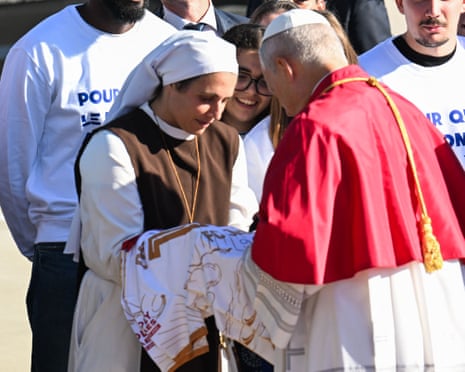
- Friday, September 25 (Paris): Following his arrival at Orly Airport and the official welcoming ceremony, the Pope traveled to the Élysée Palace for bilateral discussions with President Macron. In the afternoon, he is scheduled to visit UNESCO headquarters to deliver a major address focused on the ethical implications of artificial intelligence. Later, he will tour the newly restored Notre-Dame Cathedral, participate in a public street walk in central Paris, and conclude the evening by addressing an estimated 80_000 young people during a prayer vigil at the Stade de France.
- Saturday, September 26 (Paris): The pontiff’s schedule features visits to the Maison Bakhita social support and integration center, meetings at the Catholic Institute of Paris, and a massive open-air holy mass held at the historic Place de la Concorde and Avenue des Champs-Élysées, before departing for Lourdes.
- Sunday, September 27 (Lourdes): Pope Leo XIV will spend the day in the Sanctuary of Lourdes, presiding over Sunday Mass. Later that day, he is scheduled to hold a private, closed-door meeting with victims of clerical sexual abuse—a crucial pastoral engagement aimed at addressing the historical scandals that have severely impacted the Church’s standing in France.
- Monday, September 28 (Metz): The final leg of the journey takes the Pope to Metz, where he will deliver a key address on the Christian and historical roots of a unified Europe, walk through the city streets, and celebrate mass at Metz Cathedral before boarding his return flight to Rome.
The Élysée Palace Dialogues: Secularism, Culture, and Modern Technology
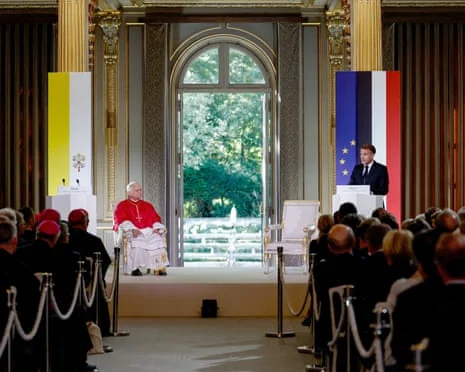
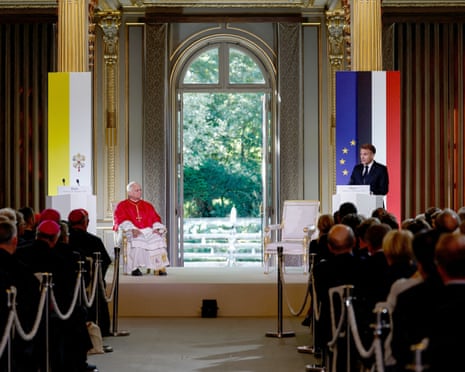
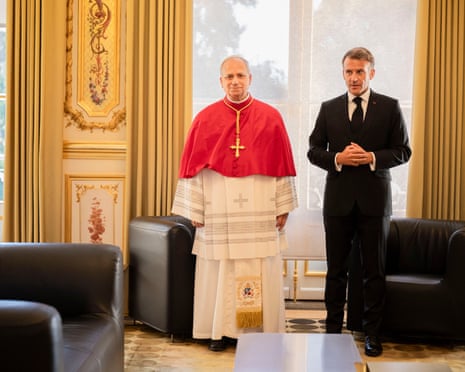
The diplomatic core of the visit unfolded at the Élysée Palace, where both leaders addressed an audience of civil authorities, diplomats, and societal representatives. President Macron opened the speeches by praising the pontiff’s message of hope and highlighting France’s 2,000-year history intertwined with Christianity, pointing to a landscape punctuated by cathedrals, basilicas, and historic monuments. He explicitly mentioned the meticulous reconstruction of Notre-Dame Cathedral, describing it as an architectural masterpiece restored "not only for Catholics, but all French people, and indeed, the entire world."
Crucially, Macron addressed the sensitive boundary between French public policy and religious expression. He emphasized that the French Republic’s strict secularism is not a "negation of religion," but rather a foundational legal and philosophical framework designed to protect freedom of conscience, enabling every individual to "think and express their views in all spheres of life, to believe or not believe." He also pledged intensified state protection for all places of worship amid a concerning rise in societal intolerance and anti-religious sentiment.
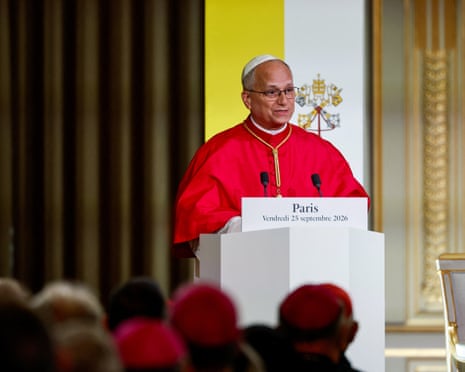
In response, Pope Leo XIV—speaking in French, a choice that visibly delighted his hosts—acknowledged his own paternal French ancestry and noted that France remains "often at the heart of his prayers." He lauded the nation as a historical beacon of art, culture, and spirituality, while drawing a direct line between the Gospel and the core French national motto: liberty, equality, and fraternity. The pontiff argued that these ideals find an "inexhaustible source of inspiration" within Christian teaching regarding the fundamental dignity of the human person.
Warnings Against a "Paradise of Machines"
A central pillar of the pontiff’s engagements on Friday was the rapid and unchecked advancement of artificial intelligence. In his remarks at the Élysée Palace and in preliminary texts released ahead of his keynote address at UNESCO, Pope Leo XIV acknowledged that technological development has significantly improved human living conditions. However, he issued a stern warning concerning the "ambiguous side of technology," which carries the potential for severe harm when decoupled from ethical governance.
Citing Georges Bernanos’s prophetic 1947 critique France Against the Robots, the Pope cautioned against the emergence of a "paradise of machines" that could dominate daily life and strip individuals of their agency. "There is an urgent concern that we do not lose our humanity amid the paradise of machines that are invading and conditioning our daily lives," Leo stated, stressing the imperative to train human minds in ethical discernment to differentiate between morally constructive and destructive uses of technology.
President Macron echoed these sentiments, aligning his administration’s digital policies with the pontiff’s warnings. Macron asserted that artificial intelligence must remain a servant rather than a master of humanity. "It is therefore our responsibility to prevent the most advanced models from falling into the hands of a few who would then decide for all of humanity," Macron declared, referencing recent French legislative efforts, including pioneering EU regulations restricting social media access for minors under 15.
Underlying Policy Divergences and Societal Context
While the atmosphere of the state visit has been overwhelmingly cordial, underlying policy tensions remain between the Holy See’s traditional doctrinal stances and France’s progressive secular legislation. Notably, France enshrined abortion as a constitutional right in 2024 and implemented a highly debated assisted dying law in August 2026—both of which were openly opposed by the French Catholic hierarchy. Political analysts note that while the pontiff is unlikely to directly confront the French government over these laws during formal addresses, his emphasis on human dignity subtly reinforces Catholic moral teachings in a secularized public square.
Furthermore, the visit carries significant domestic weight for the Catholic Church in France. The institution continues to grapple with the long-term fallout of historic clerical abuse scandals that devastated church attendance and public trust. Pope Leo XIV’s planned private meeting with abuse survivors in Lourdes is viewed by Vatican observers as an essential step toward accountability, reconciliation, and repairing the moral authority of the Church within the region.
As the state visit continues through the weekend, attention will pivot toward the UNESCO address, the massive public liturgy in Paris, and the eventual political dialogues on European unity in Metz, setting a definitive tone for church-state relations in contemporary Western Europe.