The United States housing market is currently undergoing a profound transformation characterized by a stark regional bifurcation, moving away from the uniform national trends that defined the post-pandemic boom. As inventory metrics fluctuate wildly across different geographies, the traditional "national" housing narrative is being replaced by localized realities where some markets face persistent shortages while others see a significant rebuilding of supply. This divergence is reshaping affordability, buyer leverage, and investment strategies as the market enters a complex recalibration phase. According to recent data and expert analysis, the current climate represents one of the weakest housing markets in the last three decades, yet it remains distinct from the systemic collapse seen during the 2008 Global Financial Crisis (GFC).
The State of the Market: A Historically Weak but Resilient Period
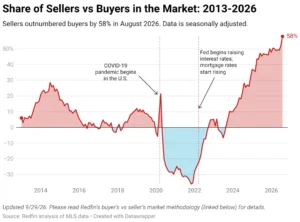
Current housing activity has settled into the bottom 25th percentile of historical performance, a metric that places the current era in league with the sluggish market of the early 1990s. Between 1990 and 1992, the U.S. experienced a similarly soft period where transactions stalled and price growth remained tepid. Today, the primary driver of this stagnation is the sudden disappearance of resale transactions, which began in earnest during the middle of 2022.
Lance Lambert, founder of Resi Club and former real estate editor at Fortune Magazine, notes that while the resale market has essentially frozen, the broader economy has been shielded by the resilience of the home-building sector. "We’ve lost a part of the cyclical element of housing," Lambert observed during a recent industry analysis. "We’ve gone down to historically low levels of resale transactions, but home building and residential construction employment has stayed resilient."
However, this resilience is fragile. Builders have engaged in significant margin compression—offering mortgage rate buy-downs and price incentives—to maintain volume. If the market were to weaken further, particularly in the core home-building hubs of the Sunbelt, a pullback in construction activity could trigger broader economic consequences. Residential construction has historically been a leading indicator for recessions; should employment in this sector begin to roll over, the "soft landing" sought by federal regulators could be jeopardized.
The Recalibration of Overvalued Markets
A critical component of the current market cycle is the correction of "frothy" valuations that peaked in the second quarter of 2022. During the pandemic housing boom, markets like Austin, Texas, and various coastal Florida cities saw home prices disconnect entirely from local income fundamentals.
Using data from Moody’s Analytics, analysts have tracked the "delta" between actual home prices and what incomes would historically support. In Q2 2022, Austin was estimated to be overvalued by approximately 55%. Nationally, that figure stood at 25%. Two years into the recalibration, the national overvaluation has dropped into the single digits, while Austin’s overvaluation has shrunk significantly, now estimated to be between 10% and 20%.
This recalibration has not been uniform. While the Sunbelt and the Mountain West have seen price "give-backs," Midwestern and Northeastern markets have remained more resilient. These older, more established markets lack "supply elasticity"—the ability to quickly build new housing to meet demand. In contrast, markets like Tampa and Nashville have high supply elasticity, meaning that when demand shocks occur, the influx of new construction (both single-family and multi-family) puts immediate downward pressure on prices.
Regional Bifurcation and the Migration "Hangover"
The regional split is most visible in net domestic migration patterns. Between the summer of 2021 and 2022, Florida saw a staggering net domestic migration of 300,000 people. In the most recent 12-month tracking period, that number has cooled dramatically. Texas has experienced a similar "pull-forward" effect, where the massive influx of residents during the pandemic years has led to a natural exhaustion of demand.
This slowdown in migration is compounded by the "lock-in effect." Homeowners who secured 3% mortgage rates during the pandemic are unwilling to sell and move if it means taking on a 7% rate. This creates a double-edged sword:
- Lost Sellers: In states like Illinois or California, potential movers stay put, keeping inventory low.
- Lost Buyers: Those same people fail to show up as buyers in Florida or Texas, causing demand in those destination markets to crater.
In some parts of Florida, such as Hillsborough County, net domestic migration has actually turned negative. This shift has led to a build-up of inventory in specific Sunbelt pockets, granting buyers more leverage for the first time in years. Conversely, in the Northeast and Midwest, inventory remains at crisis lows because the "lock-in effect" has effectively paralyzed the market.
The Role of the "Accidental Landlord"
As the market slows, a new phenomenon has emerged: the "accidental landlord." These are sellers who listed their homes but were unable to achieve their desired price. Rather than selling at a discount, they opt to delist and attempt to rent the property.
This trend is particularly prevalent in weakening markets. For real estate investors, these properties represent prime targets. If a property fails to sell after several price cuts, moves to the rental market, and then fails to rent, the owner often becomes a "highly motivated" seller. These "unsuccessful listings" are becoming a key data point for identifying distress in an otherwise equity-rich market. Unlike 2008, today’s sellers have significant equity, meaning "forced selling" due to foreclosure is rare; instead, the market is seeing "motivated selling" due to life changes and the failure of the rental fallback strategy.
Macroeconomic Risks: Oil, Inflation, and Unemployment
While the housing market appears to be stabilizing in a "soft" state, several external catalysts could trigger a further decline.
The Energy Shock Risk
Energy remains one of the most elastic costs in the global economy. Analysts warn that geopolitical instability in the Middle East could lead to a spike in oil prices. An oil shock would act as a regressive tax on consumers, potentially leading to job losses and a reduction in discretionary spending. For the housing market, the "bottom" (entry-level) segment is already feeling the squeeze of high credit card debt and the resumption of student loan payments. An energy-driven inflationary spike would likely prevent the Federal Reserve from cutting interest rates, creating a "stagflation" environment that would be toxic for real estate.
The Unemployment Threshold
Current unemployment rates remain historically low, hovering around 4%. Experts suggest that the housing market can withstand a minor increase in joblessness, but a jump to 7% or 8% would be catastrophic. At that level, the "lock-in effect" would be overridden by the necessity of selling, potentially leading to a surge in inventory that demand could not absorb, finally triggering the "crash" that many have predicted but has yet to materialize.
The Financial Mechanics of Mortgage Rates
A glimmer of hope for the housing market has been the narrowing spread between the 10-year Treasury yield and the 30-year fixed mortgage rate. Historically, this spread sits around 170 to 200 basis points. In 2022, as the Fed stopped purchasing mortgage-backed securities (MBS), the spread blew out to over 300 basis points, pushing mortgage rates higher than the Treasury yields alone would suggest.
Recently, the spread has begun to normalize, partly due to Fannie Mae and Freddie Mac increasing their retained holdings of MBS. However, analysts warn that the "easy gains" in mortgage rate reduction are over. Further drops in rates will now require either a significant cooling of inflation or a weakening of the overall economy. As of April 2024, inflation data showed a stubborn resilience, with the Consumer Price Index (CPI) rising to 3.5%, dashing hopes for immediate and aggressive rate cuts by the Federal Reserve.
Implications for Investors and Homeowners
As the market heads into the remainder of 2024, the "national" housing market is a misnomer. Investors are being urged to look at local supply elasticity and migration data rather than national averages.
In supply-elastic markets like Austin and Phoenix, the correction is well underway, and the "froth" has largely been removed, potentially creating a floor for prices. In supply-constrained markets in the Northeast, prices may remain artificially high due to the lack of inventory, but they are also more vulnerable to a sudden drop in demand if the local economy weakens.
The next phase of the housing cycle will likely be defined by a "slow grind." With inventory rebuilding in some regions and remaining tight in others, the era of rapid appreciation has ended. The market is now in a period of fundamental recalibration, where home prices must eventually realign with local wages, and the "lock-in effect" will only break when interest rates move significantly lower or the economy forces a change in the labor market. For now, the U.S. housing market remains a tale of two realities: a cooling Sunbelt and a frozen North.