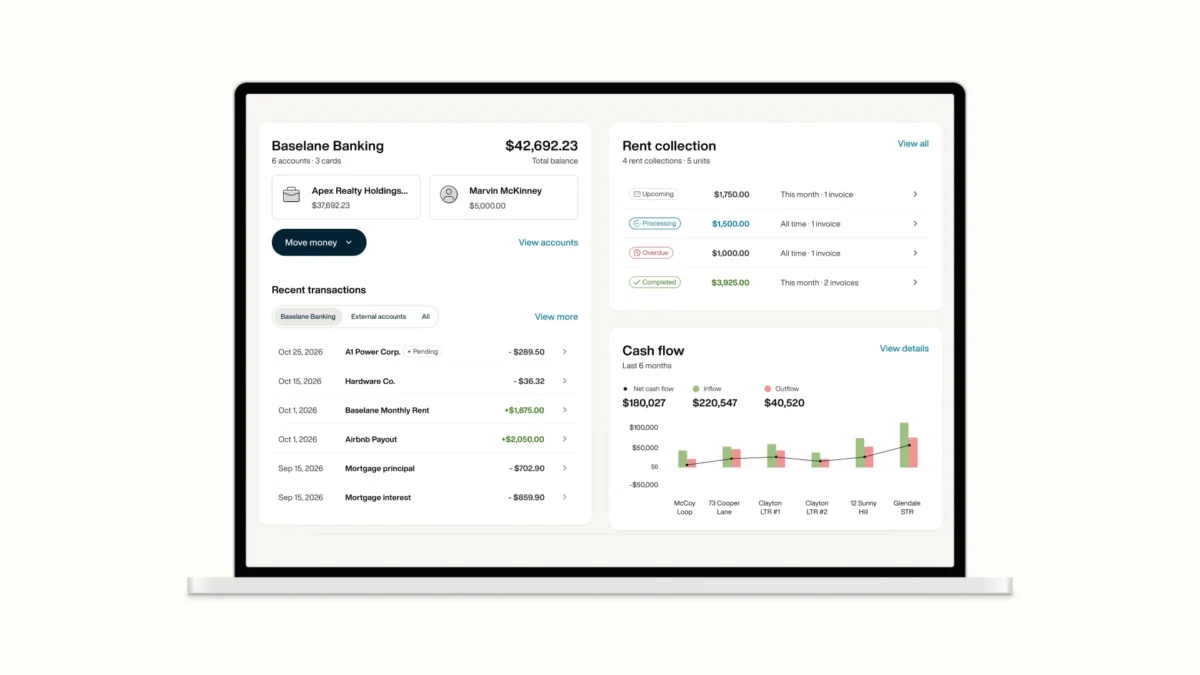
Managing rental properties across multiple LLCs, tracking income and expenses by property, and keeping security deposits organized requires significantly more robust infrastructure than a standard business checking account. For the modern real estate investor, the evolution of financial technology has transformed banking from a passive storage utility into an active component of property management. Investors today are increasingly moving away from traditional, siloed banking models toward integrated platforms that synthesize cash management, automated bookkeeping, and tax reporting. This shift is driven by the growing complexity of portfolios, where manual reconciliation across disparate bank accounts has become a primary bottleneck to scalability.
The Need for Specialized Financial Infrastructure
For years, the real estate industry operated on a fragmented financial model: rent was collected via one app, expenses were paid through a local bank account, and bookkeeping was performed in a third-party spreadsheet or accounting software. This "disconnected" approach often leads to data latency, where an investor does not have an accurate, real-time view of their net operating income (NOI) until weeks after the end of the month.
The core challenge for multi-property operators is the "entity-property mismatch." When an investor manages three separate LLCs, each with its own checking account, the overhead of managing those banking relationships—each with unique login portals, fee structures, and limited integration capabilities—consumes valuable hours that could otherwise be spent on acquisition or asset management. Data suggests that landlords who utilize integrated banking-to-bookkeeping workflows save an average of five to seven hours per month on administrative tasks, effectively lowering their operational cost per unit.
Evolution of Banking Platforms: A Comparative Overview
The current market landscape offers three distinct tiers of banking solutions: dedicated real estate fintechs, traditional commercial banks, and general-purpose digital business banks.
Baselane has emerged as a leader in the first category, specifically because it treats the bank account as an extension of the accounting system. By assigning transactions to specific properties and tax categories at the moment they occur, the platform eliminates the "year-end scramble" that often plagues independent landlords. Stessa, conversely, focuses on the portfolio tracking aspect, offering a robust suite of property management tools that include cash management.
Traditional institutions, such as Chase, Wells Fargo, and U.S. Bank, remain the industry standard for large-scale commercial real estate (CRE) financing. While these banks often lack the granular, property-level digital automation found in fintech solutions, they provide indispensable services for the institutional investor: branch access, high-touch treasury management, and competitive agency-backed lending programs (such as Fannie Mae or Freddie Mac multifamily loans).
Bluevine, Relay, and Mercury represent the mid-market digital tier. These platforms are lauded for their high-yield interest accounts and their ability to create multiple subaccounts, which is essential for investors practicing the "Profit First" methodology or those who need to maintain strict separation of security deposits. However, these platforms generally lack the specialized real estate categories—such as automated Schedule E reporting—that are baked into real estate-native platforms.
Chronology of Financial Tech Adoption in Property Management
The shift toward specialized banking began in earnest around 2020, as the pandemic forced property managers to digitize rent collection and remote payment systems. Before this period, the industry relied heavily on physical checks and manual ledger entries.
By 2022, the rise of "banking-as-a-service" (BaaS) allowed developers to embed financial functionality directly into property management software. This integration enabled the automatic tagging of expenses to specific properties, a feature that has become the benchmark for modern software in 2027. Investors who have adopted these technologies report a 30% increase in transparency regarding their portfolio’s cash flow, allowing for more agile decision-making regarding capital expenditures and maintenance.
Data and Implications for Portfolio Scalability

When evaluating a banking platform, investors must look beyond interest rates or sign-up bonuses. The primary metric for success is the "time-to-reconciliation." In a traditional banking environment, an investor might spend an entire weekend at the end of the year preparing a Schedule E form for their accountant. With an integrated platform, the data is typically ready for export or review in real-time.
Consider the implications of security deposit management. State laws regarding the handling of security deposits are stringent; funds must often be kept in separate, interest-bearing accounts. A platform that allows for the automated creation of subaccounts, specifically labeled by property and tenant, significantly reduces the compliance burden for landlords. Failure to properly segregate these funds is a leading cause of legal friction in landlord-tenant disputes.
Official Perspectives on Digital Banking Integration
Industry experts and financial analysts observe that the distinction between "banks" and "software companies" is blurring. According to recent white papers from the Mortgage Bankers Association, the future of real estate operations lies in "embedded finance."
"The goal is not to have a bank account," says one industry analyst. "The goal is to have a financial dashboard where every dollar coming in from a tenant and every dollar going out to a contractor is automatically mapped to a tax line item. The moment the bank account becomes an accounting entry, the investor wins."
However, this transition is not without risk. For instance, platforms like Mercury or certain digital-only banks operate on different deposit insurance models. Investors must conduct thorough due diligence, ensuring their chosen platform is FDIC-insured (or protected via a partner bank) and that it provides sufficient security for the scale of capital being held.
Strategic Considerations for Investors
For the investor operating a small portfolio, the priority should be simplicity and automation. The cost of a paid subscription for an advanced banking platform is often offset by the reduction in bookkeeping fees or the time saved on administrative labor. For the larger operator, the focus shifts to liquidity and lending. It is a common, and often recommended, strategy to "dual-track" banking: keeping a primary relationship with a large commercial bank for lines of credit and long-term financing, while utilizing a digital-first platform for daily operating expenses and property-level bookkeeping.
Key features to demand in 2027:
- Unlimited virtual and physical debit cards (assignable to contractors or co-hosts).
- Automated, real-time Schedule E categorization.
- Native, one-click rent collection and tenant payment portals.
- Tiered access levels for property managers or administrative staff.
- High-yield savings options that allow for rapid deployment of capital for acquisitions.
The Broader Economic Impact
The digital transformation of real estate banking has broader implications for the housing market. By lowering the barrier to entry for professionalized management, these tools allow smaller, independent landlords to compete more effectively with institutional players. This professionalization leads to better-maintained properties and more transparent financial records, which, in the aggregate, improves the quality of the rental housing stock.
As the industry moves toward 2030, we can expect even deeper integration with artificial intelligence. Future platforms will likely move beyond simple categorization to proactive financial advising—automatically identifying properties that are underperforming compared to market benchmarks or flagging maintenance expenses that are trending significantly higher than those of similar properties in the same zip code.
Conclusion
The choice of a banking platform is no longer a peripheral decision; it is a fundamental architectural choice for any real estate business. Whether an investor prioritizes the branch-based security of a traditional institution or the high-velocity automation of a digital-native platform, the criteria for selection must remain centered on operational efficiency. By selecting a partner that understands the nuances of property-level accounting, investors can minimize the drag of administrative work, allowing them to focus on the high-level strategy required to scale their portfolios in a competitive, capital-intensive market. As these tools continue to evolve, the most successful investors will be those who view their banking platform not as a static account, but as a dynamic engine for growth.