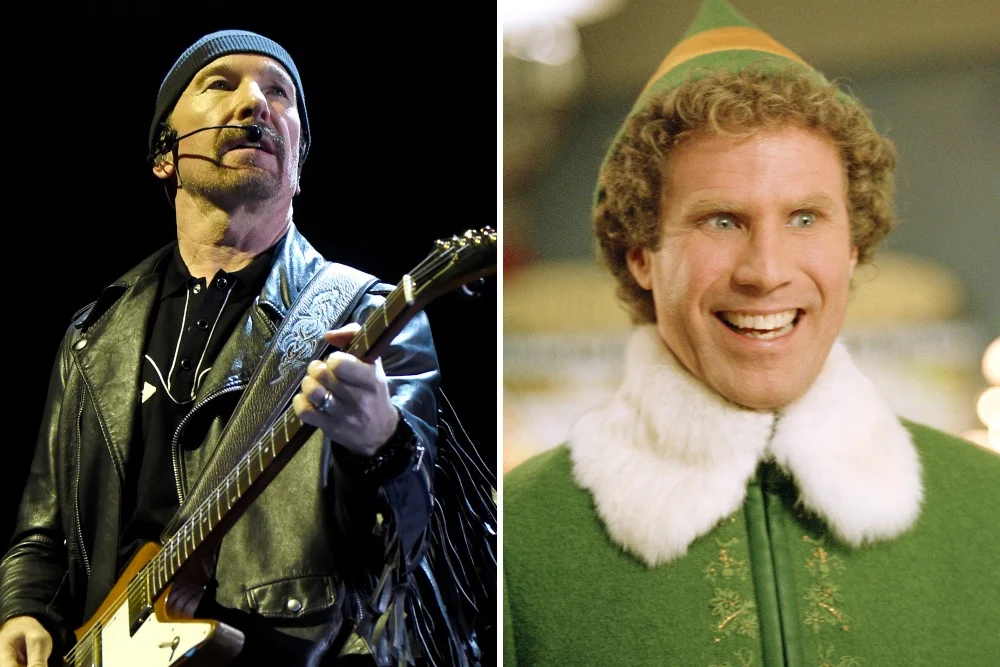
The 2003 holiday film Elf remains one of the most enduring and beloved modern Christmas classics, celebrated for its unique blend of innocent physical comedy, heartwarming family dynamics, and quotable dialogue. Directed by Jon Favreau and starring Will Ferrell as the lovable human-raised elf Buddy, the film grossed over $223 million worldwide against a modest production budget of $33 million. Despite its massive commercial success and widespread cultural footprint, a formal cinematic sequel has never materialized. However, behind-the-scenes revelations indicate that Hollywood came remarkably close to expanding the franchise, with unexpected creative figures—most notably David Howell Evans, better known as The Edge, the lead guitarist of the legendary rock band U2—drafting complete screenplays for an Elf follow-up that ultimately never saw the light of day.
The Secret U2 Script and Other Unrealized Sequel Pitches
The existence of these forgotten scripts came to light during an episode of the podcast Obsessed: The Podcast, featuring actor and comedian Andy Richter. Richter, who appeared in the original 2003 film as a coworker of Walter Hobbs, recently authored a behind-the-scenes companion book titled Elf Unwrapped: Behind_the_Scenes of a Modern Christmas Classic. During his podcast appearance, Richter shed light on the bizarre trajectory of various sequel attempts, revealing that Shauna Robertson, a prominent producer on the original film, was once approached by representatives of U2.
According to Richter, the inquiry came with a surprising revelation: The Edge had quietly written a full-length screenplay for a sequel titled Elf 2. Although Robertson agreed to a preliminary meeting to discuss the concept, the project quickly lost momentum and dissolved before any serious development could take place. Consequently, the script remains locked away, an obscure footnote in cinematic history.
The U2 guitarist was not the only prominent writer to take a stab at continuing Buddy the Elf’s adventures. Richter also disclosed that screenwriter Scot Armstrong—known for his work on comedies such as Old School and The Hangover Part II—penned an entirely separate sequel script. Armstrong had contributed uncredited writing to the original 2003 film due to Writers Guild of America regulations and procedural guidelines. His vision for Elf 2 reportedly took a much darker and more antagonistic narrative route, centering on a plot involving evil South Pole elves kidnapping Santa Claus.
A Retrospective Look at the Production of Elf
To understand why a sequel never moved forward, it is necessary to examine the serendipitous and difficult path the original film took to the screen. Written by David Berenbaum, Elf spent nearly a decade in development hell before finally securing financing and greenlight status at New Line Cinema. Initially conceptualized in the mid-1990s as a much darker, edgier satire tailored for a PG-13 or R rating with Jim Carrey in mind as the lead, the project shifted tone dramatically when Favreau boarded the production as director.
Favreau envisioned a whimsical, family-friendly holiday picture inspired by classic holiday stop-motion television specials produced by Rankin/Bass, such as Rudolph the Red-Nosed Reindeer and Santa Claus Is Comin’ to Town. The resulting film starred Ferrell alongside a stellar supporting cast, including James Caan as Walter Hobbs, Zooey Deschanel as Jovie, Mary Steenburgen as Emily Hobbs, Bob Newhart as Papa Elf, and Ed Asner as Santa Claus.
Despite initial skepticism from industry insiders regarding whether Ferrell’s manic comedic style could sustain a feature-length family film, Elf opened to glowing critical reviews and robust box office returns in November 2003. Its popularity has only compounded over the past two decades, transitioning from a seasonal theatrical release to a perennial television staple, a Broadway musical adaptation in 2010, and an animated television special in 2014.
The Case Against a Sequel: Preserving Artistic Legacy
While studio executives frequently seek to monetize proven intellectual property through franchises, spin-offs, and sequels, the creative team behind Elf—specifically Will Ferrell—has consistently resisted returning to the role. Over the years, Ferrell has famously turned down massive financial offers to reprise his role as Buddy, noting in past interviews that forcing a sequel simply for commercial gain would compromise the integrity and emotional resonance of the original story.
Andy Richter echoed these sentiments during his podcast discussion, arguing that audiences possess a collective wisdom when it comes to preserving the sanctity of beloved films. Richter noted that the passage of time has transformed Elf into a sacred cultural artifact, making contemporary viewers inherently hesitant to support sequels that risk tarnishing a flawless cinematic legacy.
"I’m on the side of ‘Let it stand,’" Richter stated during the interview. "Just let Elf be Elf. You don’t have to use every part of the animal… Now that time has passed, the movie has become so special that I think that people, rightfully so, are loath to mess with it because we all can think of movies that have been tarnished by their sequels. And this is so special and so perfect and so beloved… Why risk it?"
The Broader Implications of Hollywood’s Sequel Restraint
The refusal to produce Elf 2 stands as a notable exception in an entertainment landscape increasingly dominated by cinematic universes, reboots, and legacy sequels. In an era where intellectual property exploitation is standard operating procedure for major studios, the decision to leave Elf as a standalone cinematic work highlights a rare instance where artistic preservation superseded financial opportunism.
Economic analysts point out that while a theatrical sequel starring Ferrell would have guaranteed an enormous opening weekend box office haul, the long-term economic value of the original Elf lies precisely in its pristine, unadulterated status. As a self-contained holiday classic, it commands steady, evergreen streaming viewership, physical media sales, and broadcast licensing fees every winter season without the dilution that often accompanies poorly received franchise continuations.
Ultimately, the revelation that artists like The Edge and seasoned comedy writers like Scot Armstrong drafted complete screenplays for Elf 2 underscores the pervasive desire within the industry to revisit the North Pole. Yet, the fact that these scripts remain unproduced serves as a testament to the protective instincts of those who brought the original film to life. For millions of fans worldwide, Buddy the Elf’s journey will remain exactly where it left off in 2003: singing loud for all to hear, completely untainted by the machinery of a belated sequel.