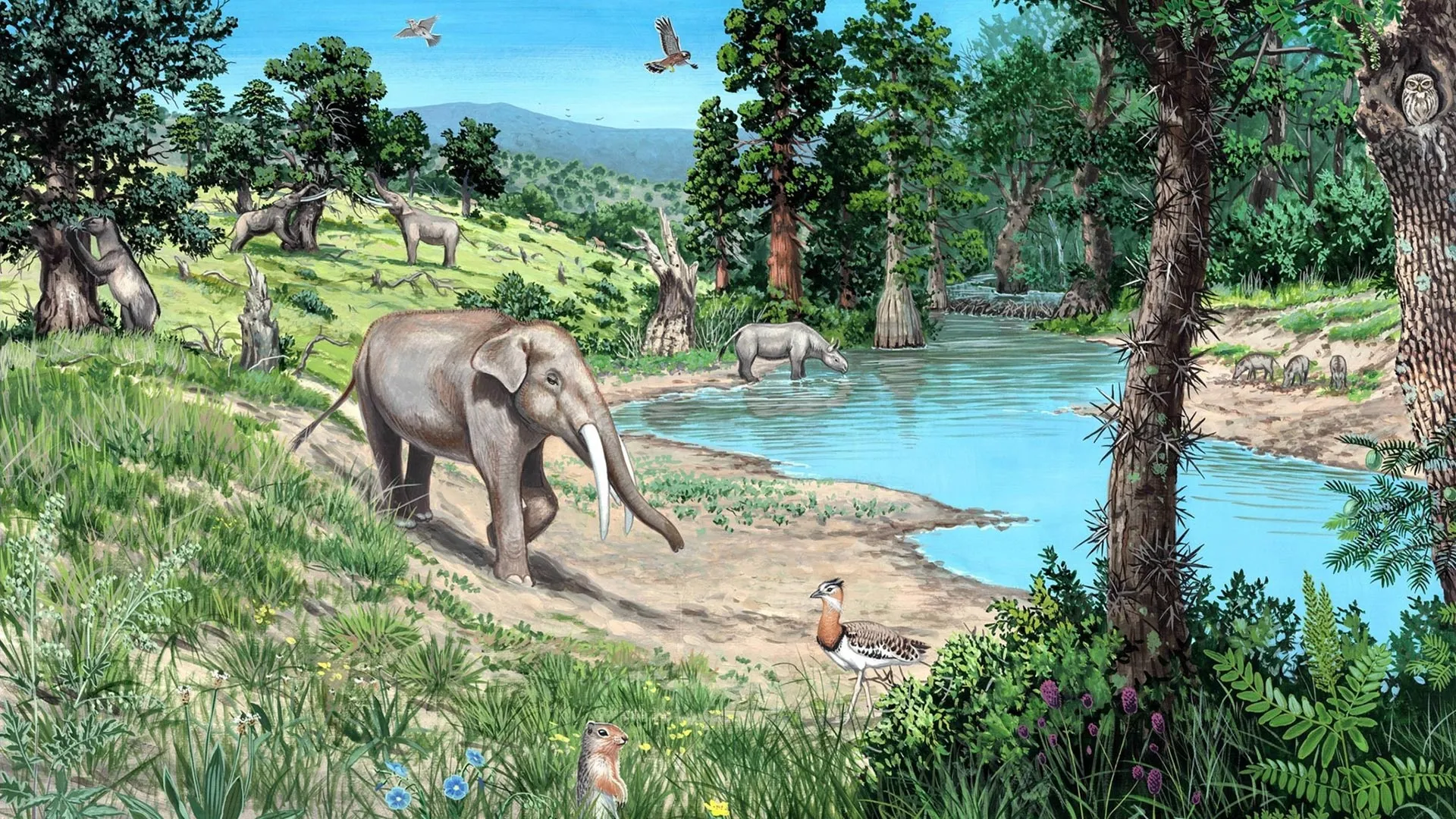
For generations, the popular imagination and even academic consensus have painted a picture of prehistoric Europe as a dark, impenetrable wilderness. It is a vision of an endless, unbroken canopy of ancient oak and beech trees, where sunlight rarely touched the forest floor and deep shade defined the ecological character of the continent. However, a groundbreaking multi-year study led by researchers at Aarhus University has shattered this "closed-forest paradigm," revealing that the Europe of the last 20 million years was far more luminous, diverse, and dynamic than previously believed.
According to the study, published in the journal Biological Conservation, the dense, uniform forests that characterize many modern European landscapes are a historical anomaly. Instead, the continent’s natural state for over two decades of millions of years was a shifting, vibrant mosaic—a complex interplay of scattered trees, sun-drenched wildflower meadows, shrublands, and open woodlands. This discovery not only rewrites the ecological history of Europe but also calls into question the contemporary strategies currently employed by governments across the continent to combat climate change and bolster biodiversity.
A Chronology of the European Landscape
To reconstruct the environmental reality of the distant past, the research team, led by Professor Jens-Christian Svenning and PhD student Szymon Czyzewski of the Center for Ecological Dynamics in a Novel Biosphere (ECONOVO), undertook an unprecedented temporal analysis. While previous studies have largely confined their focus to the post-glacial period—the last 10,000 to 12,000 years—this investigation spanned the entirety of the Miocene epoch, beginning approximately 23 million years ago, through to the pre-industrial era.
This 23-million-year timeline provides a robust dataset that captures Europe through various climatic shifts. The research team synthesized multiple independent proxies to verify their findings. By cross-referencing fossilized pollen records with charcoal deposits—which indicate the frequency and intensity of ancient wildfires—and analyzing the chemical signatures in the teeth and bones of prehistoric megafauna, the scientists were able to map the vegetation with high precision. Furthermore, the use of ancient environmental DNA (eDNA) extracted from sediments allowed the team to identify specific plant and animal species that once inhabited these regions, offering a level of resolution previously unattainable in paleoecological research.
The Role of Megafauna as Ecosystem Engineers
The study identifies a critical architect of the European landscape that has been largely overlooked in modern conservation: the large herbivore. For millions of years, the continent supported an array of megafauna, including straight-tusked elephants, rhinoceroses, aurochs, and ancient bison. These animals were not merely inhabitants of the environment; they were active engineers of it.
Through the continuous processes of grazing, browsing, and trampling, these animals prevented the unchecked expansion of trees and shrubs. By stripping bark, knocking over saplings, and clearing paths through the undergrowth, they maintained open patches that allowed grasses and heliophilic (sun-loving) wildflowers to thrive. This constant disturbance created a patchwork of habitats that supported a far greater variety of species than a dense, closed-canopy forest could ever sustain.
The decline of these large herbivores represents a profound shift in Europe’s ecological trajectory. The research notes that the most dramatic change has occurred within the last century, as traditional, extensive grazing practices—which once mimicked the natural behavior of wild herds—have largely vanished from the European countryside. The removal of this "grazing pressure" has triggered a natural succession, where trees have overtaken meadows, creating the dark, homogenous forests that conservationists today often mistake for "pristine" nature.
Challenging the Closed-Forest Paradigm
The "closed-forest paradigm" has long been the bedrock of European conservation policy. Under this assumption, the "natural" state of Europe is defined by dense woodland, and human impact is viewed as an intrusion that has fragmented this forest. Consequently, many reforestation initiatives are designed to close the canopy, prioritizing high tree density to sequester carbon and serve as a baseline for "rewilding."
However, the Aarhus University findings suggest that this policy is fundamentally misguided. By prioritizing dense forest cover, current practices may actually be harming the very biodiversity they aim to protect. Many of Europe’s native species, including specific birds like larks and jackdaws, the European hamster, and countless butterfly species, evolved specifically to occupy the open, light-filled spaces of these prehistoric mosaics.
"The study shows that current reforestation practices are on the wrong track," says Professor Jens-Christian Svenning. "This will not only be harmful for biodiversity; it will be in direct contradiction to the type of ecosystems that Europe’s species have evolved in over millions of years."
Implications for Modern Conservation and Climate Policy
The implications of this research extend into the heart of modern climate policy. As European nations pledge to increase forest cover as a means of capturing carbon dioxide, there is a risk that these efforts will result in the creation of ecological "deserts." A dense, uniform plantation of trees does not necessarily equate to a healthy, functioning ecosystem.
The researchers argue for a shift in perspective. Instead of viewing open habitats as "degraded" or "human-disturbed" land, policymakers should recognize them as essential components of Europe’s natural heritage. The restoration of European nature, they contend, should focus on creating and maintaining mosaics—landscapes where woodland, meadow, and scrub coexist.
A key recommendation from the study is the reintroduction of natural-living large herbivores. By allowing herds of large animals to roam in managed wilderness areas, conservationists can harness natural processes to maintain these mosaics without the need for intensive human intervention or mechanical land management. This approach would restore the ecological dynamism that allowed European biodiversity to flourish for over 20 million years.
Scientific Analysis: Why Biodiversity Needs a Mosaic
The study’s findings are supported by a growing body of evidence in landscape ecology. Biodiversity is typically highest in "ecotones"—the transition zones between different types of habitats. A landscape that alternates between deep woods, open thickets, and expansive meadows provides a higher number of "ecological niches." Each niche supports a different set of organisms, and the connectivity between them allows for the migration and interaction of species that rely on multiple types of environments throughout their life cycles.
For instance, the common poppy and other wildflowers often associated with agricultural fields are not purely "weeds" of human disturbance; they are remnants of a flora that evolved to exploit the soil disturbances caused by ancient megafauna. By misidentifying these open-habitat species as modern interlopers, conservationists have unintentionally prioritized the shade-loving forest species at the expense of the light-loving diversity that once defined the European continent.
Moving Forward: A New Vision for Europe’s Wilderness
The research serves as a stark reminder that history is often reconstructed through the lens of our own current environment. Because we have lived in a landscape altered by centuries of agriculture and industrial forestry, we have projected those conditions backward, assuming that the "natural" state was a dark, wooded expanse.
As Europe looks to the future, the challenge for environmentalists will be to move away from rigid, top-down models of forest management. The evidence provided by the Aarhus University team suggests that nature is not a static state of "forest" or "non-forest," but a fluid, living system that requires the presence of large animals to remain healthy and diverse.
The path forward, according to the researchers, is to embrace complexity. By fostering landscapes that mirror the structural diversity of the Miocene—the ancient mosaic of sun and shade, forest and meadow—Europe can create a more resilient natural world capable of weathering the challenges of a changing climate. The myth of the primeval, dark forest has been challenged; in its place stands a new, scientifically grounded vision of a bright, open, and undeniably wild Europe.