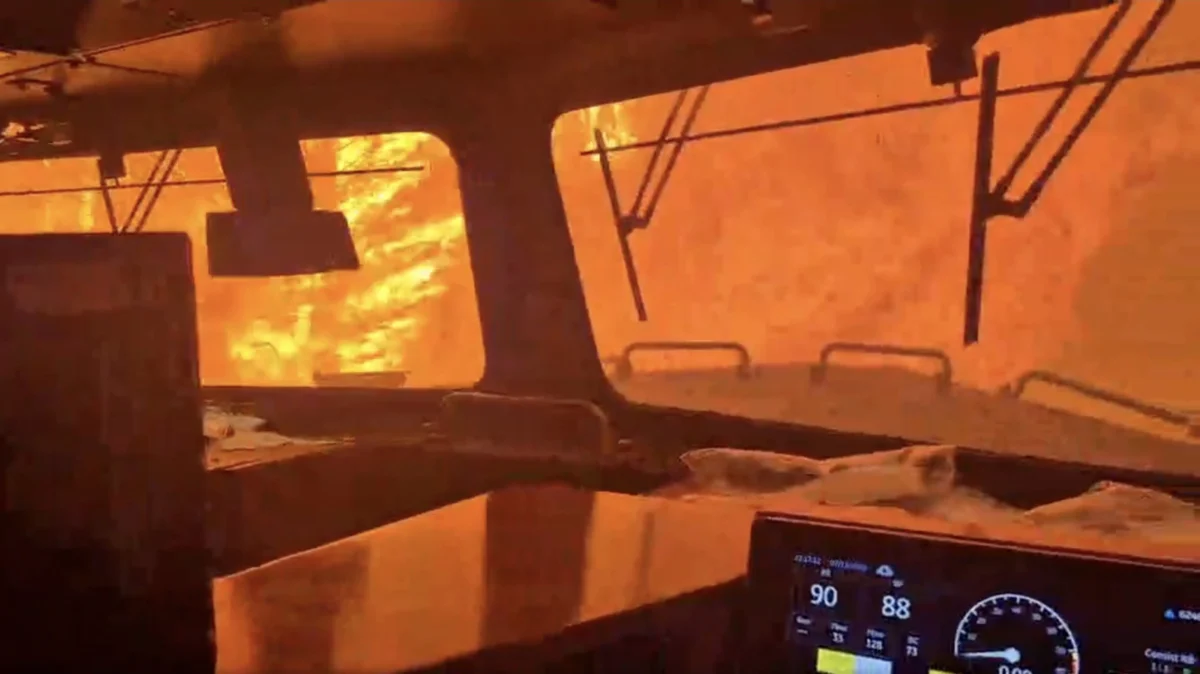
A harrowing incident in the remote wilderness of northwest Ontario has thrust Canadian National Railway (CN) into the spotlight after a train crew was forced to navigate a locomotive through an active wildfire. The incident, captured in a dramatic video that has since circulated widely on social media and news platforms, occurred near the town of Armstrong, Ontario, as the province grapples with a surge in wildfire activity. While the crew escaped without physical injury, the event has sparked a fierce debate regarding industrial safety protocols, the predictability of wildfire behavior, and the risks associated with maintaining rail operations in climate-stressed regions.
The video, recorded from within the locomotive cab, depicts a terrifying scene where the train is momentarily stationary on a siding, ostensibly to allow an oncoming train to pass. As the camera pans, the left side of the tracks is shown to be engulfed in a wall of orange flames and thick, black smoke. The heat and intensity of the fire are palpable even through the digital recording. The crew member filming the incident can be heard providing a chilling narration of the escalating danger, noting that the fire was rapidly overtaking their position. "This could potentially overtake us here. This has gotten a little scary," the employee remarked. As the fire licked at the front of the locomotive, a radio call was placed to dispatch or the passing train: "OK, y’all need to hurry up here, like, seriously. We’re encased in flames now."
The crew’s survival is largely attributed to the heavy steel construction of the locomotive and the functioning onboard air conditioning system, which provided a pressurized environment to keep toxic smoke and extreme heat at bay. Fortunately, the fire moved with high velocity, passing the train quickly enough to prevent the ignition of the locomotive’s exterior components or the stalling of its engines. Once the oncoming train cleared the track, the crew was able to proceed out of the immediate danger zone.
The Escalating Wildfire Crisis in Northern Ontario
The incident near Armstrong is not an isolated event but rather a symptom of a broader environmental crisis affecting Northern Ontario. According to data provided by the Ministry of Natural Resources and Forestry (MNRF), at least 134 wildfires have been burning across the northwest region this week alone. The fire near Armstrong is part of a cluster of blazes that have been fueled by a combination of prolonged drought, high temperatures, and lightning strikes.
In response to the deteriorating conditions, CN Rail issued a formal statement confirming that it has temporarily suspended operations in the Armstrong area. A company spokesperson told Global News that the decision was made as a precautionary measure to ensure the safety of personnel and the integrity of the rail line. "CN has temporarily suspended rail operations near Armstrong, ON as a precaution due to wildfire activity in the area. As a safety measure, CN employees in the area and residents of the Town of Armstrong were evacuated overnight Monday," the spokesperson stated.
The evacuation of Armstrong, a critical hub for rail and regional transport, underscores the severity of the situation. The MNRF has deployed hundreds of firefighters, supported by aerial water bombers and heavy equipment, to establish containment lines, but the sheer number of active fires has stretched provincial resources to their limits.
The Tragedy of Namaygoosisagagun First Nation
While the CN crew managed to escape, the nearby community of Namaygoosisagagun (Collins) First Nation was not as fortunate. Located approximately 20 miles west of Armstrong, the community was decimated by the same wildfire front. Reports from the Ontario Provincial Police (OPP) and local leaders indicate that the entire community essentially burned to the ground.
The evacuation was a desperate affair, with residents forced to abandon their homes with only the clothes on their backs. Because the wildfire had cut off road access, many residents fled by boat across Collins Lake to escape the advancing flames. This total loss of a community has sent shockwaves through the region and highlighted the extreme vulnerability of remote First Nations settlements to the increasing frequency of catastrophic wildfires.
Adding to the complexity of the situation near Collins, the OPP confirmed that three other trains were stranded in the vicinity of the burning community. These trains were reportedly carrying combustible and flammable materials, creating a high-stakes scenario for emergency responders. Had the fire reached these stationary tankers, the resulting explosions could have exacerbated the disaster significantly. The presence of these hazardous materials in an active fire zone has raised serious questions about the timing of rail traffic management during environmental emergencies.
Labor Union Reaction and Safety Concerns
The Teamsters Canada Rail Conference (TCRC), which represents the affected rail workers, has been vocal in its criticism of CN’s decision to allow the train into the fire zone. Paul Boucher, President of the TCRC, commended the crew’s professionalism but leveled sharp accusations at the railway’s management.
"We commend the courage and professionalism of our members, who kept their composure in a terrifying situation. We are relieved that nobody was hurt," Boucher said in a formal statement. "But make no mistake, this incident should never have happened. CN should never have sent a train down those lines. The company knows exactly how bad the situation is in that region. That fire has been raging for five weeks."
The union argues that with modern satellite monitoring, heat-sensing technology, and constant communication with the MNRF, the railway had more than enough information to declare the tracks unsafe well before the train was "encased in flames." The labor dispute highlights a recurring tension in the industry: the balance between maintaining vital supply chains and ensuring the absolute safety of the workforce in the face of increasingly unpredictable natural disasters.
Broader Environmental and Health Implications
The impact of the Northern Ontario wildfires is being felt thousands of miles away from the flames. The massive plumes of smoke generated by the 134-plus fires have drifted south, leading to a significant degradation of air quality across the continent.
In Toronto, the smoke reached such concentrations that the city briefly recorded the worst air quality of any major metropolitan area in the world. Health officials issued "Special Air Quality Statements," advising residents—particularly the elderly, children, and those with respiratory issues—to remain indoors and use high-efficiency air filters. The atmospheric conditions created a surreal visual environment, with yellow and orange-hued skies reported as far south as the north-central and northeast United States, including cities like Chicago, Detroit, and New York.
This widespread environmental impact serves as a stark reminder of the interconnectedness of climate events. The Ontario wildfires are part of a larger trend of increasing fire intensity across Canada, following the record-breaking 2023 wildfire season. Climatologists point to rising global temperatures and shifting precipitation patterns as the primary drivers of these "megafires," which burn hotter and longer than historical norms.
Analysis: The Future of Rail Infrastructure in Fire Zones
The incident in Armstrong serves as a critical case study for the future of Canadian infrastructure. The national rail network is the backbone of the Canadian economy, transporting billions of dollars worth of goods, including grain, minerals, and consumer products, across vast distances. Much of this network passes through the "Boreal Shield," a region that is increasingly prone to fire.
From a regulatory perspective, this event may prompt Transport Canada to review its guidelines for rail operations during wildfire seasons. Currently, railways operate under strict safety management systems, but the decision to halt traffic often rests with the companies themselves unless a government emergency order is issued. The near-miss in Armstrong suggests that the threshold for suspending operations may need to be lowered.
Furthermore, the incident highlights the need for technological upgrades in rail safety. While the crew’s air conditioning saved them, future locomotives may require enhanced filtration systems specifically designed to handle the fine particulate matter of wood smoke, which can cause engine failure or health crises for crews.
Conclusion
As CN Rail works with the Ministry of Natural Resources to determine when it is safe to resume operations near Armstrong, the focus remains on the recovery of the displaced residents of Namaygoosisagagun First Nation and the safety of the emergency responders on the front lines. The dramatic footage of a train surrounded by fire is more than just a viral moment; it is a profound warning of the challenges facing the transportation sector in an era of environmental instability.
The investigation into why the train was permitted to enter a zone where a fire had been "raging for five weeks" will likely continue for months. For now, the priority remains containment and the protection of life, as the province of Ontario continues to battle one of its most challenging wildfire weeks in recent memory. The resilience of the rail crew and the tragic loss of the Collins community stand as two sides of the same coin—a testament to human composure under pressure and a reminder of the devastating power of nature.