WASHINGTON — A high-profile Veterans Day observance at Arlington National Cemetery took an unexpected turn on Wednesday, November 11, 2026, when Defense Secretary Pete Hegseth and members of his entourage were publicly reprimanded by a United States Army sentinel for violating the strict atmosphere of silence mandated at the Tomb of the Unknown Soldier.
The incident, which occurred shortly after a formal wreath-laying ceremony, drew immediate national attention and sparked a broader conversation regarding protocol, decorum, and the unyielding vigilance maintained by the elite soldiers tasked with guarding the nation’s most sacred military shrine. While high-ranking government officials frequently visit the hallowed grounds, the swift and public rebuke of a cabinet secretary underscored that the rules of the plaza apply equally to all individuals, regardless of their rank or political office.
The Chronology of Events
The morning of November 11 began with traditional solemnity. Defense Secretary Hegseth, accompanied by his wife, chief of staff Ricky Buria, and several senior defense aides, arrived at Arlington National Cemetery to participate in Veterans Day commemorations. The schedule included a high-profile wreath-laying ceremony at the Tomb of the Unknown Soldier, an event that drew heavy security and media presence.
President Donald Trump and First Lady Melania Trump were also in attendance, participating in a subsequent commemorative ceremony at the nearby Memorial Auditorium. The morning events were designed to honor the millions of American service members who have worn the uniform, paying specific tribute to those who made the ultimate sacrifice in defense of the nation.
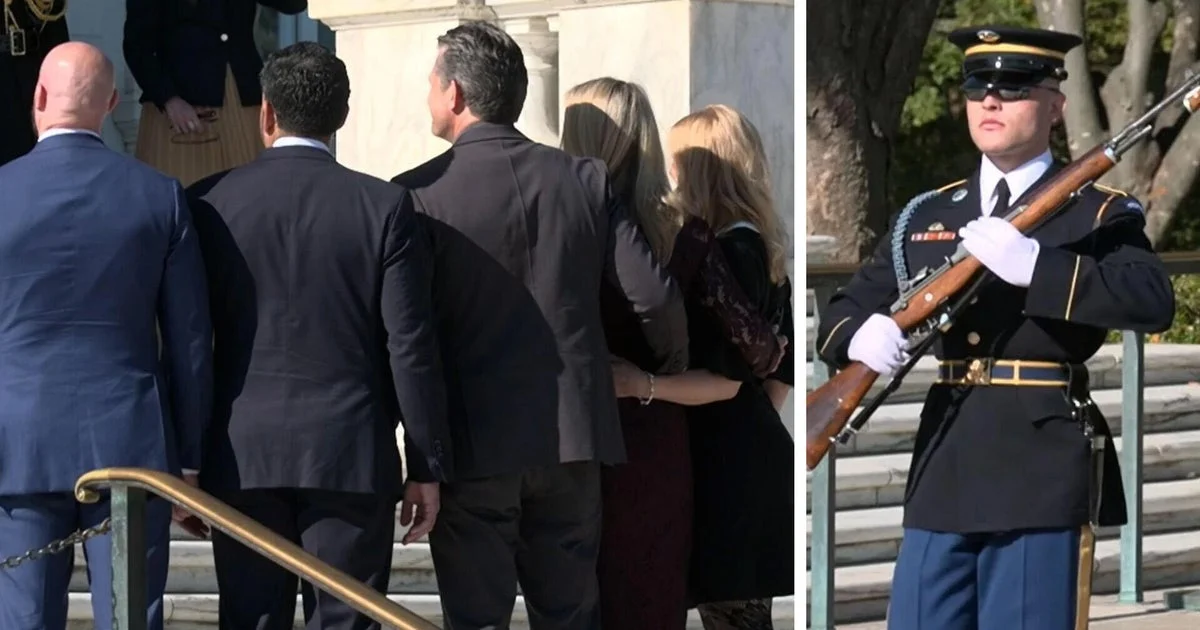
Following the formal wreath-laying at the tomb, Hegseth and his internal delegation paused to pose for a commemorative photograph on the plaza. Witnesses and video footage indicate that as the defense secretary and his aides concluded the photo opportunity and began walking away from the immediate vicinity of the monument, a member of the official party audibly laughed.
The reaction from the post was instantaneous. A U.S. Army sentinel—a member of the prestigious 3rd U.S. Infantry Regiment, known as "The Old Guard"—immediately stepped forward and projected a loud, authoritative warning across the hallowed marble plaza.
"All visitors will maintain an atmosphere of silence and respect at all times," the sentinel commanded, cutting through the murmurs of the surrounding crowd.
Media outlets, led by initial reporting from CNN and subsequent confirmation by CBS News, quickly circulated video of the incident, which highlighted the crisp discipline of the guard and the abrupt halt in the delegation’s movement.
Official Responses and Damage Control
As the video gained traction across digital and social media platforms, Pentagon officials moved quickly to address the incident and prevent any narrative from overshadowing the broader significance of Veterans Day.
Chief Pentagon Spokesman Sean Parnell issued a formal statement addressing the matter later that afternoon.
"The Secretary and the entire Department have always honored—and will always honor—the sacrifices our military men and women have made to keep America safe," Parnell stated. "While commemorating this solemn day, a soldier correctly and respectfully reminded everyone to maintain decorum."
The Pentagon’s swift acknowledgment sought to diffuse potential controversy by praising the sentinel’s adherence to duty rather than disputing or minimizing the reprimand. Observers noted that the Department of Defense’s strategy was designed to reinforce respect for military protocols, validating the sentinel’s authority over civilian leadership in matters concerning the sanctity of the memorial.
Neither Hegseth nor his chief of staff released a separate personal statement regarding the incident, choosing instead to let the spokesman’s remarks stand. It remains unclear from available footage and official accounts which specific individual within the entourage emitted the laughter that triggered the response, and whether Hegseth himself was personally aware of the noise before the guard intervened.
Historical Context and the Strict Decorum of the Tomb
The Tomb of the Unknown Soldier is one of the most revered sites in the United States. Established in 1921 with the interment of an unidentified World War I service member, the memorial has since expanded to include unidentified remains from World War II, the Korean War, and, previously, the Vietnam War (though the Vietnam Unknown was later identified through DNA testing and reinterred).
The sentinels who guard the tomb 24 hours a day, 365 days a year—through all weather conditions—are selected through an intensely rigorous training and evaluation process. Guarding the tomb is considered one of the most prestigious assignments in the United States Army, with fewer than 20 percent of applicants earning the right to wear the coveted Tomb Guard Identification Badge.
Because the plaza serves as an outdoor crypt for fallen service members whose identities are known only to God, absolute silence and respect are legally and culturally enforced. Sentinels are authorized to address any individual—tourist, civilian dignitary, or foreign head of state—who disrupts the solemnity of the site.
Contrary to the belief that such public reprimands are rare, historians and military insiders note that sentinels frequently intervene when crowds fail to maintain appropriate behavior. Army Staff Sgt. Chadwick Winget, a former member of the regiment, noted in a 2022 U.S. Army interview that guards typically have to issue verbal warnings to the public two or three times every single day. These interventions usually address unauthorized photography using flash, talking too loudly, failing to remove hats, or laughing and joking near the sacred grounds.
Implications for Civilian-Military Protocol
While the incident at Arlington National Cemetery was relatively minor in terms of security breaches, political analysts and military culture commentators have pointed out several broader implications.
First, the event highlights the uncompromising nature of military discipline. Even the civilian head of the armed forces—a cabinet secretary appointed by the president to oversee the entire Department of Defense—is subject to the operational authority of an enlisted soldier when that soldier is executing official guard duties at a designated memorial site. The sentinel’s prompt action demonstrated that the boundaries of military tradition do not bend for political power.
Second, the episode serves as a high-profile reminder of public etiquette at national monuments. In an era dominated by social media, photo opportunities, and continuous digital documentation, public figures and ordinary citizens alike occasionally struggle to balance personal documentation with solemn remembrance. The viral nature of the video serves as a public service announcement regarding the expected standard of conduct at Arlington and similar memorials across the nation.
Finally, the incident tested the communication reflexes of the Pentagon’s public affairs team. By immediately siding with the sentinel and framing the moment as an appropriate enforcement of tradition rather than an embarrassment for the cabinet secretary, the Department of Defense successfully neutralized potential political fallout.
As the nation moves past the Veterans Day holiday, the brief yet striking exchange at Arlington National Cemetery will likely be remembered not for the political standing of those involved, but as a textbook illustration of the unwavering dedication of the sentinels who protect the unknown dead, ensuring that the atmosphere of profound respect remains unbroken.