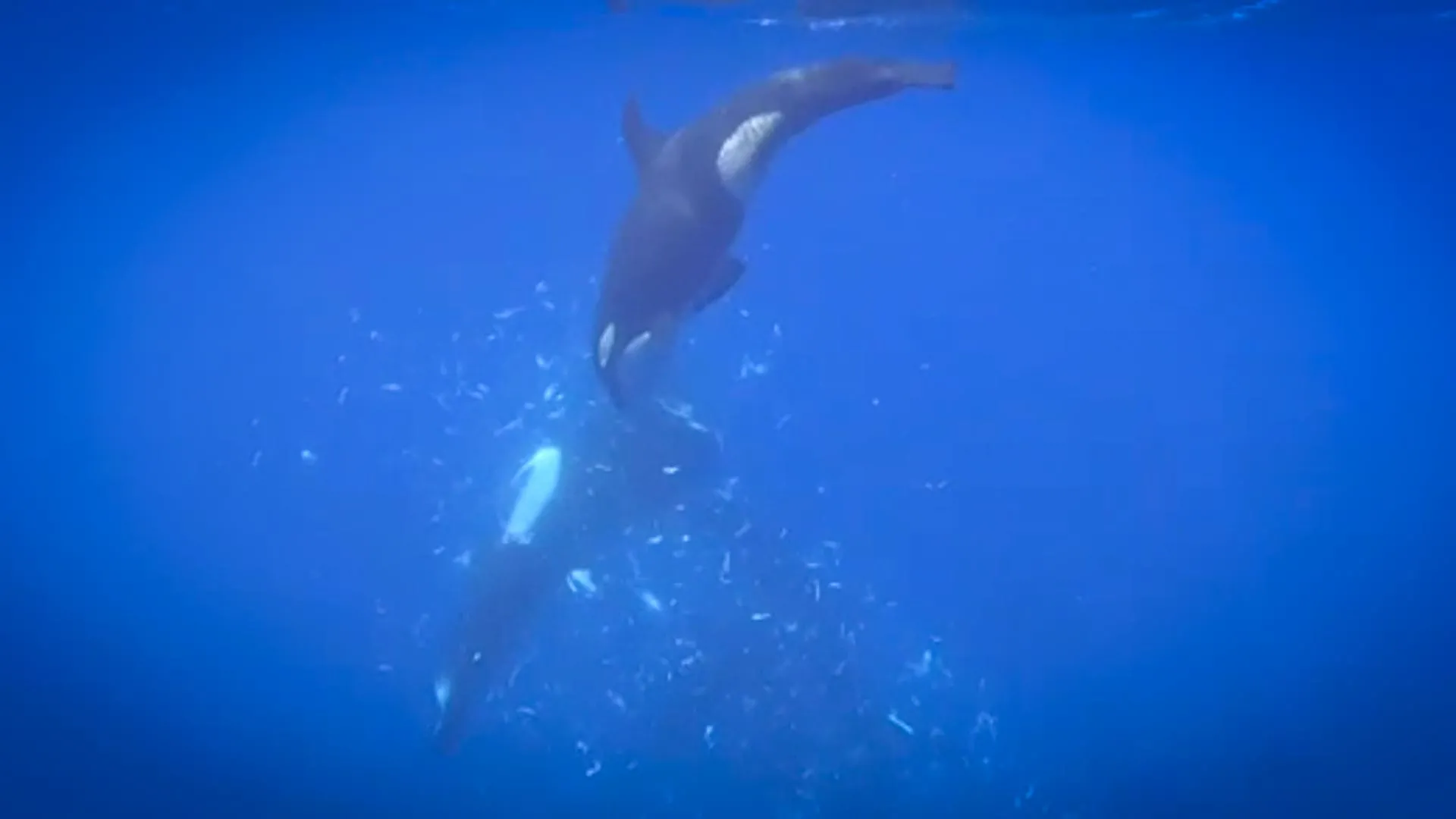
Researchers in the pristine waters of the Gulf of California have documented a previously undescribed and startling hunting strategy employed by orcas, the ocean’s apex predators. In a behavior that has left marine biologists astounded, these highly intelligent marine mammals have been observed using a powerful, coordinated ramming technique to shatter sunfish, a process that breaks the large fish into thousands of pieces. This groundbreaking discovery, detailed in a recent publication in the journal Frontiers in Ethology, offers new insights into the complex predatory repertoire of orcas and potentially sheds light on their social dynamics and feeding adaptations.
The newly identified behavior involves a remarkable level of cooperation and precision. According to lead author Dr. Kathryn Ayres, a scientist at the non-profit organization Beneath The Waves, one orca holds the large sunfish, typically by its tail fin, providing a stable anchor. Just moments before impact, this orca releases its grip, allowing a second, high-speed orca to collide with the prey. The sheer force of this collision causes the sunfish’s tissue to disintegrate, scattering fragments throughout the water column.
"We document how one orca holds the sunfish and lets go just before another orca hits it at high speed, causing the tissue to break apart into thousands of pieces," Dr. Ayres explained in a statement. The purpose behind this elaborate method remains a subject of scientific inquiry, with researchers proposing several compelling hypotheses. "We think this may help younger orcas feed more easily or it could also just be for fun. Orcas are known for playing with their food."
A Calculated Collision: The Mechanics of Sunfish Disintegration
The sunfish, particularly the sharp-tail sunfish (Mola alexandrini) observed in these incidents, are formidable prey. These fish are among the largest bony fish in the ocean, capable of exceeding three meters in length and weighing up to 2,000 kilograms. While they inhabit various ocean depths, they are known to ascend to the surface for thermoregulation, to bask, or to have parasites removed by cleaner fish. This behavior inadvertently makes them vulnerable to predators, and in the Gulf of California, they are a frequent target for orca pods.
The newly documented ramming behavior was observed on two distinct occasions, separated by approximately a year. The first incident occurred in July 2024, captured by Dr. Ayres herself. She witnessed a group of orcas, including a juvenile, interacting with a dead sharp-tail sunfish they had already successfully hunted. The coordinated action involved a female orca firmly gripping the sunfish’s tail fin, ensuring a secure hold. Simultaneously, a male orca positioned itself, gathering speed before launching a powerful ramming attack. The female released the sunfish precisely as the male struck, leading to the spectacular fragmentation of the prey. Following the impact, the juvenile orca was observed consuming the smaller, dispersed pieces, while the adult orcas focused on the larger remaining carcass, leaving the scattered fragments behind.
A second, remarkably similar event was filmed by Héctor Franz in September 2025. This footage corroborated the initial observations, clearly depicting the same sequence of holding, releasing, ramming, and subsequent feeding. The consistency across these two events, occurring over a significant time span and likely involving different individuals or pods, strongly suggests that this is a deliberate and established hunting or prey-processing technique.
Beyond the Kill: A Novel Food Processing Strategy
The researchers emphasize that this ramming behavior appears to be a sophisticated method of processing prey rather than a means of killing it, given that the sunfish were already deceased when the ramming occurred. This represents a departure from commonly understood orca hunting tactics, which often focus on overwhelming larger, live prey through coordinated attacks.
The disintegration of the sunfish’s tissue is of particular interest. Sunfish possess a gelatinous outer layer known as a capsule, and both this layer and their skin host a diverse microbiome. When the tissue is forcefully broken apart, these microbial communities are released into the surrounding water, significantly altering its nutrient composition.
One intriguing implication of this fragmentation is the potential for increased interaction between the sunfish and orca microbiomes. Researchers speculate that this exposure could confer nutritional advantages or offer other benefits, possibly including immune system modulation. The complex interplay between predator and prey microbiomes is an emerging area of scientific study, and this orca behavior may provide a unique window into such dynamics.
Facilitating Feeding for the Young and Social Bonding
Another significant hypothesis revolves around parental investment and the facilitation of feeding for younger orcas. By breaking down the large sunfish carcass into smaller, more manageable pieces, adult orcas may be making it considerably easier for calves and juveniles to consume their meal. This aligns with known orca behaviors, where adults often share prey with their offspring and other members of the pod.
"Orcas often tear apart prey and share it with other members of the group, including calves and juveniles," Dr. Ayres noted. This behavior could therefore be a crucial component of social learning and skill development for young orcas, allowing them to practice feeding independently on smaller, less challenging portions.
However, the researchers do not rule out other motivations. The energetic and visually striking nature of the ramming could also serve a social function within the pod, fostering group cohesion and communication. Furthermore, the playful aspect of orca behavior is well-documented; they are known to engage in complex interactions with their environment and prey, and this could be another manifestation of their innate curiosity and inclination towards play.
Unique Prey Adaptations: The Case of the Sharp-Tail Sunfish
The observations also offer potential clues about the specific characteristics of the sharp-tail sunfish species. The fact that this particular method of tissue fragmentation has only been documented with this species suggests that sharp-tail sunfish may possess tissue properties that respond uniquely to powerful impacts. It is plausible that other, larger species of sunfish might be more resilient and less prone to breaking apart in such a dramatic fashion under similar conditions. This could mean that the orcas have evolved this specific technique to exploit the particular physical attributes of the sharp-tail sunfish, making them a more accessible food source.
While the current findings are highly significant, the research team acknowledges the need for further investigation. Scientists are eager to determine if the same orcas were involved in both observed events. Obtaining high-quality identification photographs, particularly of dorsal fins and eye patches – key features used to identify individual orcas – is crucial for future research.
"Collecting good identification photographs whenever possible is key: we are still seeing new techniques of how orcas hunt and process their prey," Dr. Ayres concluded. "They’re one of the most iconic marine predators in the world, yet they continue to surprise us."
The ongoing study of orca behavior in the Gulf of California underscores the vastness of our ocean’s unexplored territories and the intricate adaptations that marine life has developed. This newly documented ramming technique is a testament to the intelligence, adaptability, and complex social structures of these magnificent marine mammals, promising to unlock further secrets of their predatory prowess and ecological roles. The implications of this research extend beyond understanding orca hunting strategies, offering potential insights into marine food webs, microbial ecology, and the evolutionary pressures that shape predator-prey relationships in our oceans.