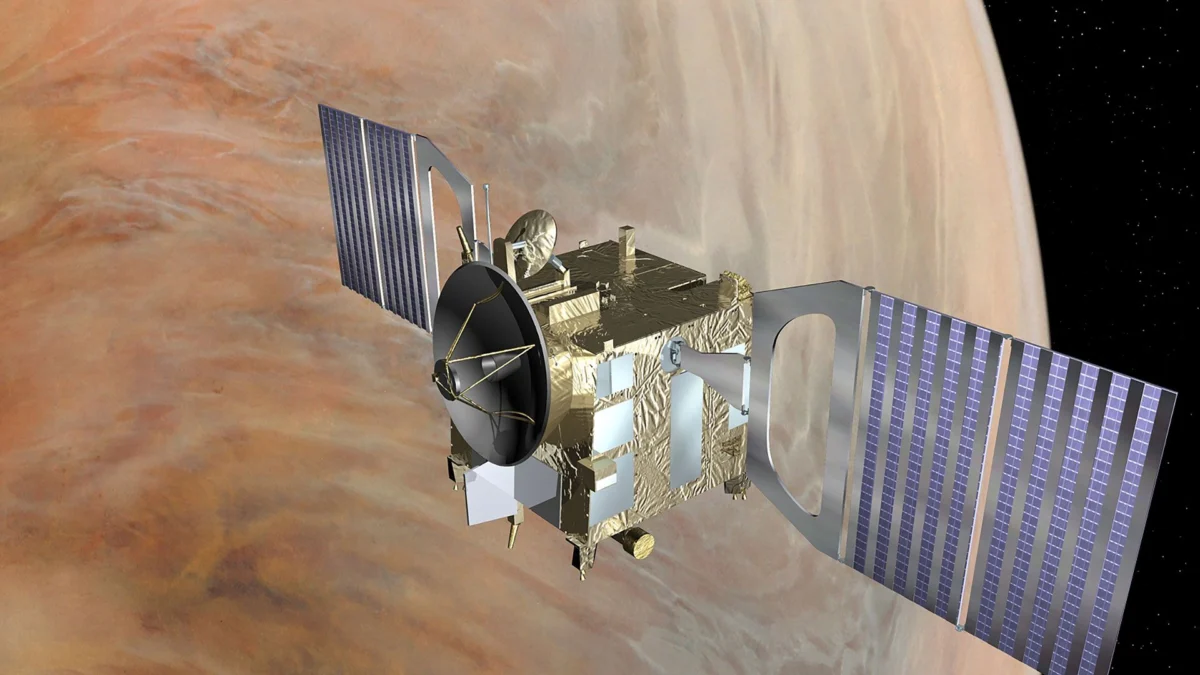
On November 8, 2005, the European Space Agency (ESA) officially inaugurated its maiden voyage to Earth’s most hostile planetary neighbor, launching the Venus Express spacecraft toward the second rock from the sun. Blasting off atop a Russian Soyuz-Fregat rocket from the Baikonur Cosmodrome in Kazakhstan, the mission marked a monumental milestone for European space exploration. For more than nine years, the resilient orbiter endured intense solar radiation, blistering temperatures, and punishing atmospheric pressures to fundamentally reshape our scientific understanding of Venus.
Before the arrival of Venus Express, Earth’s sister planet remained a persistent enigma. Often shrouded in impenetrable, sulfuric acid clouds, Venus presents a brutal environment capable of crushing unprotected machinery with an atmospheric pressure at the surface roughly 92 times that of Earth. Despite these staggering operational hazards, the Venus Express mission far exceeded its initial design life, offering unprecedented insights into planetary meteorology, volcanism, and atmospheric dynamics from orbit before its dramatic final plunge in January 2015.
The Genesis and Objectives of the Mission
Conceived on the heels of the highly successful Mars Express mission, Venus Express was developed on a remarkably fast track. By reusing much of the architectural design and engineering frameworks of its predecessor, the ESA was able to keep costs low and development timelines short, transforming a conceptual proposal into a flight-ready spacecraft in just a few short years.
The primary objective of the mission was to conduct a comprehensive study of the Venusian atmosphere, plasma environment, and surface characteristics. Scientists were particularly eager to understand the dynamics of the global atmospheric super-rotation—a phenomenon where the atmosphere circles the planet in just four Earth days, far faster than the planet’s actual 243-day rotation period. Furthermore, researchers hoped to shed light on the runaway greenhouse effect that turned Venus from a potentially temperate, ocean-bearing world into a blistering hothouse with surface temperatures exceeding 460 degrees Celsius (860 degrees Fahrenheit).
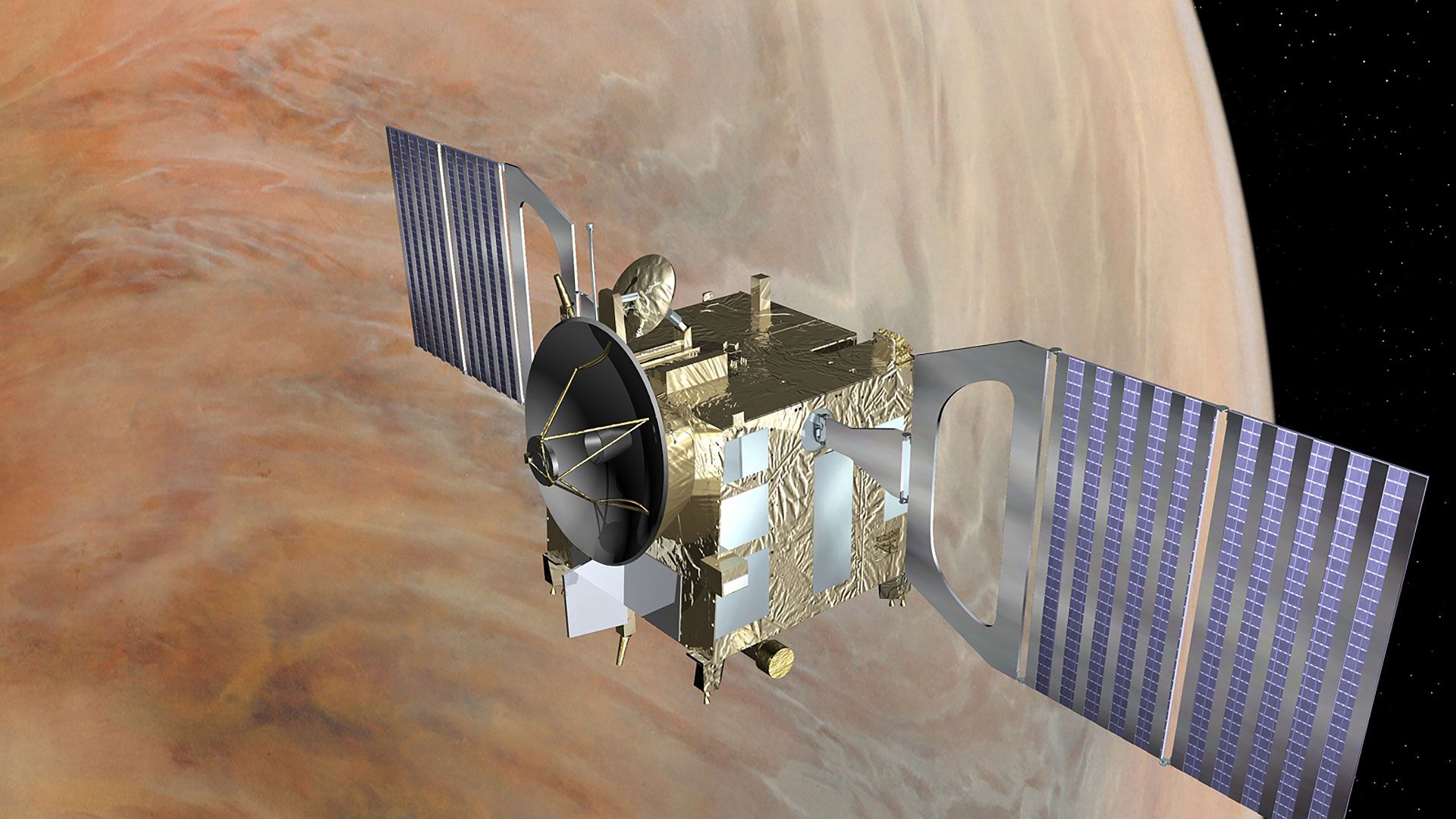
Equipped with a suite of sophisticated scientific instruments—including spectrometers, plasma analysers, and cameras operating across ultraviolet, visible, and infrared wavelengths—Venus Express entered orbit around the planet on April 11, 2006, following an intricate 153-day interplanetary cruise.
Key Discoveries and Scientific Breakthroughs
During its extended operational lifetime, Venus Express delivered a wealth of groundbreaking data that challenged existing planetary models and opened new avenues of space research. Among its most notable discoveries was the identification of a massive, double-eyed atmospheric vortex swirling violently around the planet’s south pole. This complex meteorological feature, similar to a perpetual hurricane, demonstrated the chaotic and dynamic nature of the upper atmosphere.
In addition to meteorology, Venus Express provided some of the most compelling indirect evidence to date that Venus might still be volcanically active. By mapping thermal emissions from various regions on the surface, scientists detected localized hotspots with distinct chemical signatures. These variations suggested that fresh volcanic lava flows could be relatively recent, indicating that the planet’s interior remains geologically alive.
The mission also revealed unexpected phenomena in the planet’s upper atmosphere, including the detection of nightside auroras. Unlike Earth’s auroras, which are driven by robust planetary magnetic fields interacting with solar wind, Venus lacks an intrinsic global magnetic field. Instead, Venus Express discovered that solar particles interact directly with the planet’s ionosphere, creating localized, transient auroral displays.
The Daring Dénouement: Aerobraking and Mission End

As the spacecraft entered its ninth year of operations, propellant reserves were rapidly dwindling. Rather than simply letting the mission fade away into a high-altitude orbital decay, mission controllers at ESA’s European Space Operations Centre (ESOC) in Darmstadt, Germany, devised a bold and unprecedented operational finale known as aerobraking.
Beginning in late-stage operations, Venus Express was commanded to periodically dip its orbit deep into the outer envelope of the planet’s dense atmosphere. Although the spacecraft was never structurally designed to function as an atmospheric probe, it successfully utilized the atmospheric drag to slow its speed and circularize its orbit. This daring maneuver allowed scientists to collect invaluable in-situ data regarding the density, temperature, and composition of the upper atmosphere at altitudes never before sampled by an orbiter.
By November 2014, the spacecraft had depleted virtually all of its remaining propellant. Deprived of station-keeping fuel, Venus Express steadily succumbed to the unrelenting gravitational pull and atmospheric drag of the planet. Communication with the orbiter was permanently lost in January 2015, and the spacecraft ultimately disintegrated as it descended deeper into the crushing, scorching atmosphere of the world it had spent nearly a decade studying.
The Geopolitical and Historical Context
The successful insertion and operation of Venus Express cemented the European Space Agency’s status as a major global player in deep-space exploration. Prior to the 2005 launch, only the space programs of the United States and the Soviet Union had successfully placed spacecraft into orbit around or onto the surface of Venus, legacy achievements that dominated the space race of the 1960s, 70s, and 80s.
By executing a complex planetary insertion and maintaining a long-term scientific campaign, the ESA joined this elite cohort. Five years later, the Japan Aerospace Exploration Agency (JAXA) would follow suit with the launch of its Akatsuki spacecraft, further expanding international interest in our planetary neighbor.

The broader implications of the Venus Express mission extend far beyond the data gathered on Venus alone. The Planetary Society and various independent astronomical institutions have frequently emphasized that comparative planetology is vital for understanding Earth’s own climatic future. By analyzing how a planet with similar initial size, mass, and composition to Earth could evolve into a runaway greenhouse, researchers gain critical insights into planetary evolution, atmospheric stability, and the fragile nature of habitable environments throughout the galaxy.
The Continuing Legacy of European Exploration
Although Venus Express concluded its operational life more than a decade ago, Europe’s relationship with the second planet did not end in 2015. In October 2018, the ESA—in collaboration with JAXA—launched the BepiColombo mission to Mercury. During its complex trajectory through the inner solar system, BepiColombo executed a carefully calculated gravitational assist maneuver past Venus in 2020, utilizing the planet’s gravity to adjust its velocity and trajectory toward the innermost planet.
Furthermore, the scientific community’s renewed interest in Venus has sparked a new wave of international exploration. With upcoming missions planned by NASA, ESA, and private entities, researchers hope to build directly upon the foundational discoveries made by Venus Express.
Ultimately, the Venus Express mission stands as a triumph of European engineering and interplanetary science. By enduring conditions that pushed technology to its absolute limits, the spacecraft transformed a distant, opaque world into a dynamic laboratory, ensuring that our understanding of planetary systems will forever be shaped by its pioneering journey.