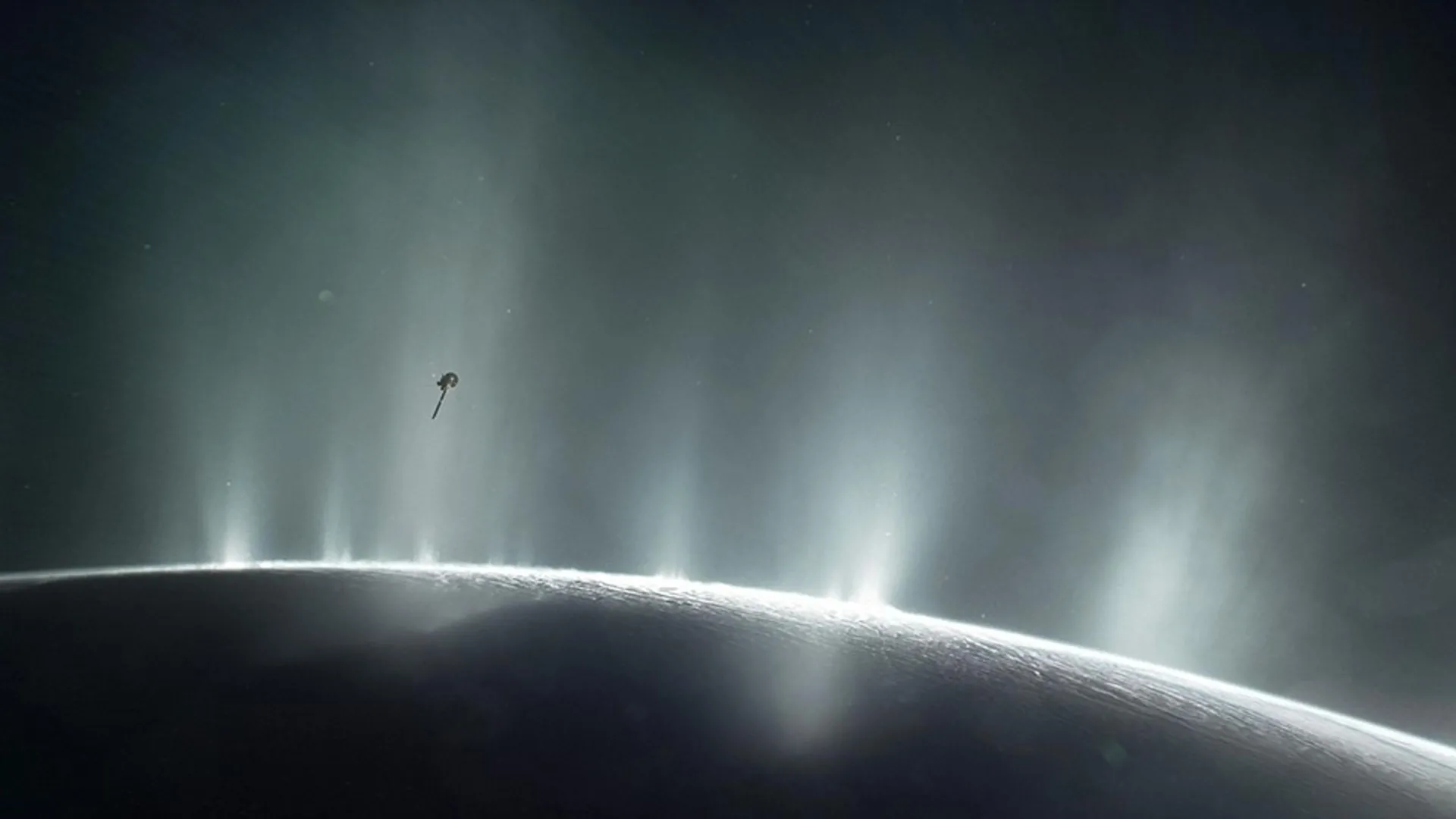
Saturn’s moon Enceladus has long captivated the scientific community as one of the most promising candidates for extraterrestrial life in our solar system. Hidden beneath a pristine, kilometers-thick shell of ice lies a global liquid water ocean, warmed by tidal forces from its parent planet. While the surface remains frozen, the moon’s south pole features dramatic fractures—often called "tiger stripes"—that launch plumes of water vapor and ice particles into the vacuum of space. These plumes serve as a natural laboratory, offering a rare opportunity for researchers to sample the contents of an alien ocean without the need for complex, high-risk drilling missions.
A recent collaborative investigation by an international team, featuring researchers from the Earth-Life Science Institute (ELSI) at the Institute of Science Tokyo and the Freie Universität Berlin, has unlocked a critical puzzle regarding these plumes. By analyzing data collected by NASA’s Cassini spacecraft, the team has determined that the chemical diversity found in the moon’s ice grains is not a direct reflection of the ocean’s composition, but rather the result of a complex, naturally occurring physical process during the journey from the depths to the surface.
The Cassini Legacy and the Mystery of Type 3 Grains
Between 2004 and 2017, NASA’s Cassini spacecraft provided an unprecedented window into the Saturnian system. Among its most significant contributions was the deployment of the Cosmic Dust Analyzer (CDA), which characterized the chemical signatures of individual ice particles found in Saturn’s E-ring. This ring is fed directly by the material ejected from Enceladus, acting as a massive, spread-out collection of the moon’s internal chemistry.
During the mission’s final years, Professor Frank Postberg of Freie Universität Berlin led an analysis of 961 mass spectra obtained from salt-rich ice particles, classified as "Type 3" grains. Under standard scientific assumptions, if these grains were representative samples of the same reservoir, one would expect a uniform chemical profile. However, the data revealed a starkly different reality. The particles exhibited a chaotic range of compositions: some were saturated with sodium chloride, while others were dominated by carbonates, phosphates, or potassium chloride. Most notably, the data showed an inverse relationship between chloride and carbonate, which rarely co-existed in the same salt-rich particle.
This chemical heterogeneity presented a fundamental challenge to planetary scientists. If the subsurface ocean is a single, well-mixed body of water, why do the ejected grains exhibit such wild variations?
Laboratory Simulations: Recreating the Freezing Process
To address this, Professor Yasuhito Sekine and his team at the Earth-Life Science Institute (ELSI) launched a series of experimental simulations. The researchers sought to replicate the physical transition of ocean water into frozen ice grains within a controlled laboratory environment. By creating micro-droplets containing salts known to exist in the Enceladean ocean—such as sodium chloride and sodium carbonate—the team observed how these chemical components behaved during the freezing process.
The experiments revealed that the rate of cooling is the primary variable determining chemical distribution. When droplets measuring approximately 200 micrometers were frozen at a slow, controlled rate of 10 Kelvin per minute or less, the salts underwent a process of fractional crystallization. They separated into distinct, concentrated regions within the ice matrix. Conversely, rapid freezing resulted in a homogeneous mixture where chemicals remained evenly dispersed.
The implications of these findings are profound. The diversity observed by the Cassini spacecraft is not necessarily evidence of a chemically stratified ocean, but rather a snapshot of a physical "sorting" process. The team concluded that if larger droplets freeze slowly as they ascend through the moon’s crust, and are subsequently shattered into smaller fragments, each fragment would inherit a distinct chemical composition based on the region of the droplet from which it originated.
The Journey Through the Subsurface Vents
This research challenges the prevailing model of how material travels from the Enceladean ocean to space. Previously, many scientists hypothesized that seawater spray was ejected rapidly through the vents, freezing almost instantaneously upon exposure to the near-vacuum conditions of the surface.
The new data suggests a much more protracted and complex journey. The droplets likely originate as larger volumes of spray that travel slowly through the subterranean vent systems. During this slow ascent, the droplets undergo gradual freezing, allowing the chemical separation observed in the ELSI experiments to occur. As these frozen droplets approach the surface, they encounter narrower, higher-velocity channels. The mechanical stress caused by colliding with the icy walls of these conduits likely fractures the frozen droplets into the smaller grains detected by Cassini.
"The Cassini data showed us that these salt-rich grains are far more chemically diverse than an average ocean composition would suggest," explained Professor Postberg. "Combining those observations with our freezing experiments gives us a physical explanation: Cassini may have sampled fragments of larger frozen ocean droplets, each preserving different components that became separated during their journey towards the surface."
Broader Impacts: Natural Sample Preparation
The process discovered by the ELSI team holds significant value for future astrobiology missions. A major hurdle in analyzing extraterrestrial samples is the dilution of potential biosignatures or organic compounds. On Earth, laboratory scientists must invest time and energy into isolating and concentrating samples to identify trace materials.
Nature appears to be performing this "sample preparation" on Enceladus. The freezing and fracturing process naturally concentrates various compounds, including organic substances, into specific grain fragments. This could make future missions significantly more effective, as the "natural filtering" would essentially pre-package concentrated samples for analytical instruments, potentially bringing faint signals of prebiotic chemistry within the detection range of high-resolution mass spectrometers.
Furthermore, the phenomenon of slow freezing may have implications for the development of life. As ice crystals form, they often trap small pockets of concentrated brine. These microscopic environments are ideal for promoting chemical reactions that would otherwise be impossible in a highly dilute oceanic environment. By concentrating salts and organic molecules into these liquid "pockets," Enceladus may be providing a venue for the complex prebiotic chemistry necessary for the emergence of life.
Future Perspectives and Scientific Consensus
The findings have been received with significant interest within the planetary science community. The ability to link the chemical heterogeneity of the E-ring to a specific physical mechanism provides a more robust framework for interpreting future data. It also underscores the importance of interdisciplinary research, where laboratory-based experimental physics and chemistry are used to interpret remote sensing data from deep-space missions.
As the scientific community looks toward future missions, such as potential landers or atmospheric sniffers, this study provides a crucial roadmap. Understanding the "sorting" mechanisms of Enceladus means that scientists can better distinguish between chemical signatures caused by planetary processes and those that might indicate biological activity.
The research also highlights a cyclic nature to the moon’s surface environment. Because a significant portion of the material ejected from the plumes eventually falls back onto the surface, this cycle of freezing, concentrating, and recycling may occur repeatedly. This suggests that the icy shell of Enceladus acts as an active, evolving geological system rather than a static barrier.
By synthesizing decades of data from the Cassini mission with cutting-edge laboratory techniques, the team has effectively "de-mixed" the secrets of Enceladus. This work confirms that the diversity of the moon’s plumes is a window into the complex, dynamic, and potentially habitable environment hiding beneath its frozen exterior. As technology advances, the ability to interpret these tiny ice grains will remain the most vital tool in our search for answers to one of humanity’s oldest questions: are we alone in the universe? The evidence from the tiger stripes of Enceladus suggests that the answer may be closer, and more complex, than previously imagined.