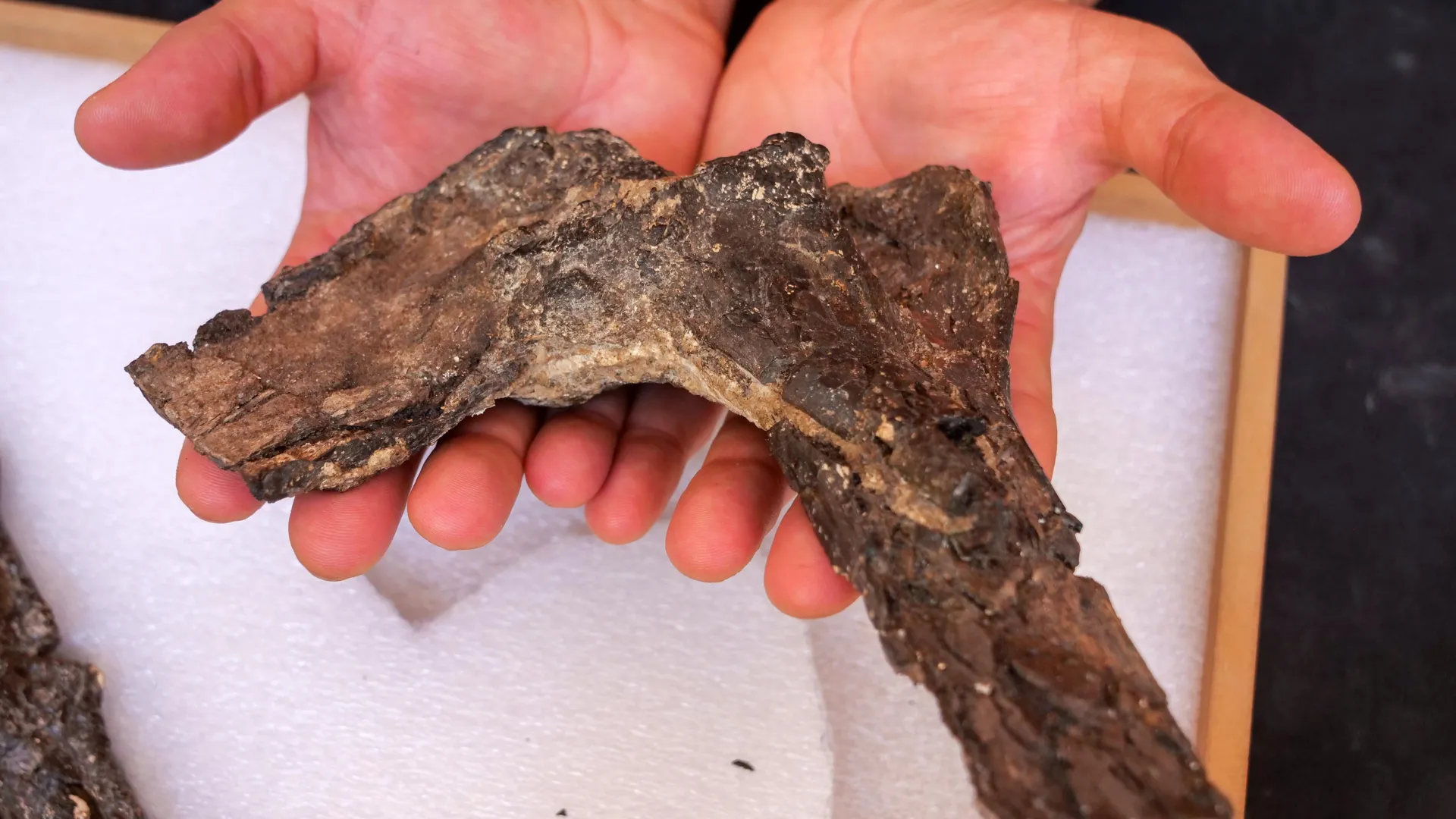
In a discovery that forces a radical reassessment of the limits of biological preservation, an international team of researchers has identified remarkably intact traces of dinosaur blood within the fossilized remains of a theropod that roamed the Earth 115 million years ago. This breakthrough, centered on the analysis of the meat-eating Aratasaurus museunacionali, reveals that delicate biological molecules—previously thought to vanish within a few thousand years—can persist across geological epochs under specific geochemical conditions. The findings, published in the Proceedings of the National Academy of Sciences, provide the first definitive chemical confirmation of heme-derived molecules within fossilized red blood cells, effectively bridging the gap between theoretical paleobiology and hard chemical evidence.
The Chronology of the Discovery
The journey toward this discovery began with the unearthing of Aratasaurus museunacionali in the Araripe Basin of northeastern Brazil. This region is world-renowned among paleontologists for its exceptional fossil preservation, characterized by the Crato Formation, a Lagerstätte that provides a unique window into the Early Cretaceous period.
Following the initial excavation, the fossilized limb bones were subjected to high-resolution imaging and sophisticated mass spectrometry techniques. The research, led by Curtin University’s WA-Organic and Isotope Geochemistry Centre, involved a multi-year collaborative effort between institutions including the Japan Agency for Marine-Earth Science and Technology, the Brazilian National Museum, the Regional University of Cariri, and Johns Hopkins University.
Throughout 2021 and 2022, the team utilized advanced synchrotron-based infrared spectroscopy and other analytical tools to peer inside the vascular canals of the bone. By late 2023, the data began to coalesce, revealing that the mineralized structures found within the canals were not merely fossilized impressions, but genuine molecular remnants of the dinosaur’s circulatory system.
Unpacking the Science: The Role of Mineralization
The fundamental question posed by this study is how organic molecules, such as hemoglobin and collagen, survived the ravages of 115 million years of heat, pressure, and microbial decay. The answer, according to the research team, lies in the presence of a specific manganese-based mineral: hausmannite.
Hausmannite acts as a geochemical catalyst. In the immediate aftermath of the dinosaur’s death, the carcass was rapidly buried in an environment characterized by low oxygen levels and high microbial activity. As the surrounding sediment hardened, the hausmannite interacted with the decaying biological material, essentially "locking" the chemical signatures in place. This created a natural time capsule, shielding the microscopic structures from the typical cycles of oxidation and degradation that usually render organic remains undetectable.
The study identified heme molecules—the oxygen-carrying component of hemoglobin—within the fossilized red blood cells. While previous researchers had noted circular, cell-like structures in various dinosaur fossils, skeptics had long argued that these were merely microbial biofilms or mineral artifacts. By providing definitive chemical proof of heme, the Curtin University team has successfully silenced these debates, confirming that the molecules are indeed indigenous to the animal.
Official Perspectives and Academic Impact
Professor Kliti Grice, the study’s lead author and a Distinguished Professor at Curtin University, emphasized the gravity of these findings during the presentation of the results. "To detect intact heme-derived molecules in 115-million-year-old red blood cells is astonishing," Grice noted. "This is a landmark discovery that does more than just extend the fossil record of blood; it provides a direct molecular window into the physiology of extinct animals. We are no longer limited to speculating about metabolic rates or oxygen consumption based solely on bone morphology; we can now look at the chemical machinery of the animal itself."
The implications of this study are being felt across the paleontological community. For decades, the "molecular clock" theory suggested that biological proteins would be entirely unrecognizable after approximately one million years. By pushing this boundary to over 100 million years, the research team has invalidated long-held assumptions regarding the stability of organic matter in the fossil record.
Dr. Martin Van Kranendonk, head of the School of Earth and Planetary Sciences at Curtin University, highlighted the interdisciplinary nature of the achievement. "This study exemplifies how coordinated efforts across institutions, continents, and scientific disciplines can unlock extraordinary insights," said Van Kranendonk. "We are changing the very definition of what is possible in the field of paleontology. If these structures can survive for over 100 million years, it necessitates a complete review of every major fossil collection globally."
The Shift Toward Molecular Paleontology
This discovery marks the birth of a new era of "molecular-level paleontology." Researchers are now tasked with re-examining existing fossil collections, particularly those found in sedimentary environments similar to the Crato Formation. The hypothesis is that many fossils currently considered "mineralized" may actually contain a treasure trove of trapped organic information that has been overlooked by traditional scanning methods.
If researchers can consistently extract amino acids and heme molecules from deep-time fossils, they could eventually reconstruct the evolutionary history of blood and immune systems with unprecedented clarity. This could shed light on the transition from cold-blooded to warm-blooded metabolism in dinosaurs, a topic that has remained one of the most debated subjects in evolutionary biology.
Implications for Astrobiology and the Search for Life
Perhaps the most provocative aspect of the Curtin University study is its potential impact on astrobiology. Scientists searching for life on Mars or the icy moons of Jupiter and Saturn have historically relied on finding large-scale biosignatures, such as atmospheric gases or fossilized microbial mats. However, the discovery that delicate biological molecules can persist for over 100 million years suggests that the search criteria for extraterrestrial life should be expanded.
"If biological molecules or their chemical signatures can persist under the right conditions for more than 100 million years, we may need to reconsider where and how we look for evidence of ancient organisms on other worlds," Professor Van Kranendonk stated. "We have been looking for the footprints of life, but we should perhaps be looking for the molecular ghost of life trapped within mineral matrices."
For missions like NASA’s Perseverance rover, which is currently collecting samples in the Jezero Crater, this study provides a new blueprint. The findings suggest that even in harsh, radiation-exposed environments, the right mineral chemistry could serve as a protective shield for ancient biological signatures.
Broader Scientific Context and Future Research
The study, titled "Heme signatures in mineralized red blood cells within vascular canals of a 115-million-year-old dinosaur bone," serves as a cornerstone for future research. As the scientific community digests these findings, several key questions remain:
- Universality of Preservation: Is the hausmannite-driven preservation mechanism unique to the Araripe Basin, or are there other minerals that serve similar functions in different geological environments?
- DNA Potential: While heme and collagen are durable, DNA is significantly more fragile. Can the same conditions that preserve blood cells also protect fragments of genetic material, or does DNA degradation occur at a fundamentally faster rate?
- Re-evaluation of Collections: Museums worldwide are now incentivized to apply non-destructive, high-resolution chemical imaging to their most prized theropod specimens to see if similar "molecular time capsules" exist.
The international research team is already planning follow-up studies to determine the extent of these molecular remnants. By mapping the distribution of these chemicals within the bone, they hope to create a comprehensive profile of the Aratasaurus’s health, diet, and physiological state at the time of its death.
As we move forward, this discovery serves as a humbling reminder that the fossil record is far more resilient than previously imagined. It challenges the academic community to look past the surface of the bone and into the chemical secrets hidden within. By treating fossils not just as statues of stone, but as complex chemical reservoirs, scientists are opening a new chapter in our understanding of life’s deep history—and perhaps, its future among the stars. The 115-million-year-old blood of a Brazilian predator has not only told us more about the dinosaur; it has fundamentally altered our perspective on the durability of life itself.