The contemporary fashion landscape has long been dominated by the relentless pursuit of digital virality, where independent designers often find themselves pressured to perform for social media algorithms. Few have mastered this modern digital theater quite as brilliantly—or exhaustively—as Beate Skonare Karlsson, the creative force behind the independent Swedish label Avavav. Known globally for staging provocative spectacles where models dramatically tumbled down runways or deliberately shed their garments, Karlsson previously leveraged shock value and hyper-conceptual internet culture to carve out a distinct identity amidst the crowded schedules of Milan Fashion Week. Yet, in a decisive pivot that has sent ripples through the industry, Karlsson chose to bypass Milan entirely for the Spring ready-to-wear season, opting instead to stage her presentation in her native Stockholm.
This homecoming is far more than a simple geographical relocation; it represents a profound philosophical rejection of algorithmic fatigue and a conscious return to foundational craftsmanship. Over the past several years, Karlsson has built a formidable reputation through uncanny, creature-inspired design signatures. Her portfolio features instantly recognizable items such as the scalloped "larva" bag, bulbous panda-inspired eyewear, the multi-fringed centipede scarf, and, most famously, her anthropomorphic "finger shoes"—a surreal footwear design that famously caught the attention of avant-garde icon Rick Owens, who has been spotted wearing them in public. These boundary-pushing accessories relied heavily on shock, humor, and digital-first communication strategies.
However, for her latest collection, Karlsson made the calculated decision to dial back the street-style theatrics that initially put Avavav on the map. By temporarily sidelining extreme streetwear silhouettes, the designer delivered her most mature, sophisticated collection to date, proving that her creative lexicon extends far beyond internet gags. While the collection possesses a newfound adult polish, it still safely retains the characteristic cartoonish charm and irreverent humor that her global clientele has come to expect.
Translating Accessories into Garments
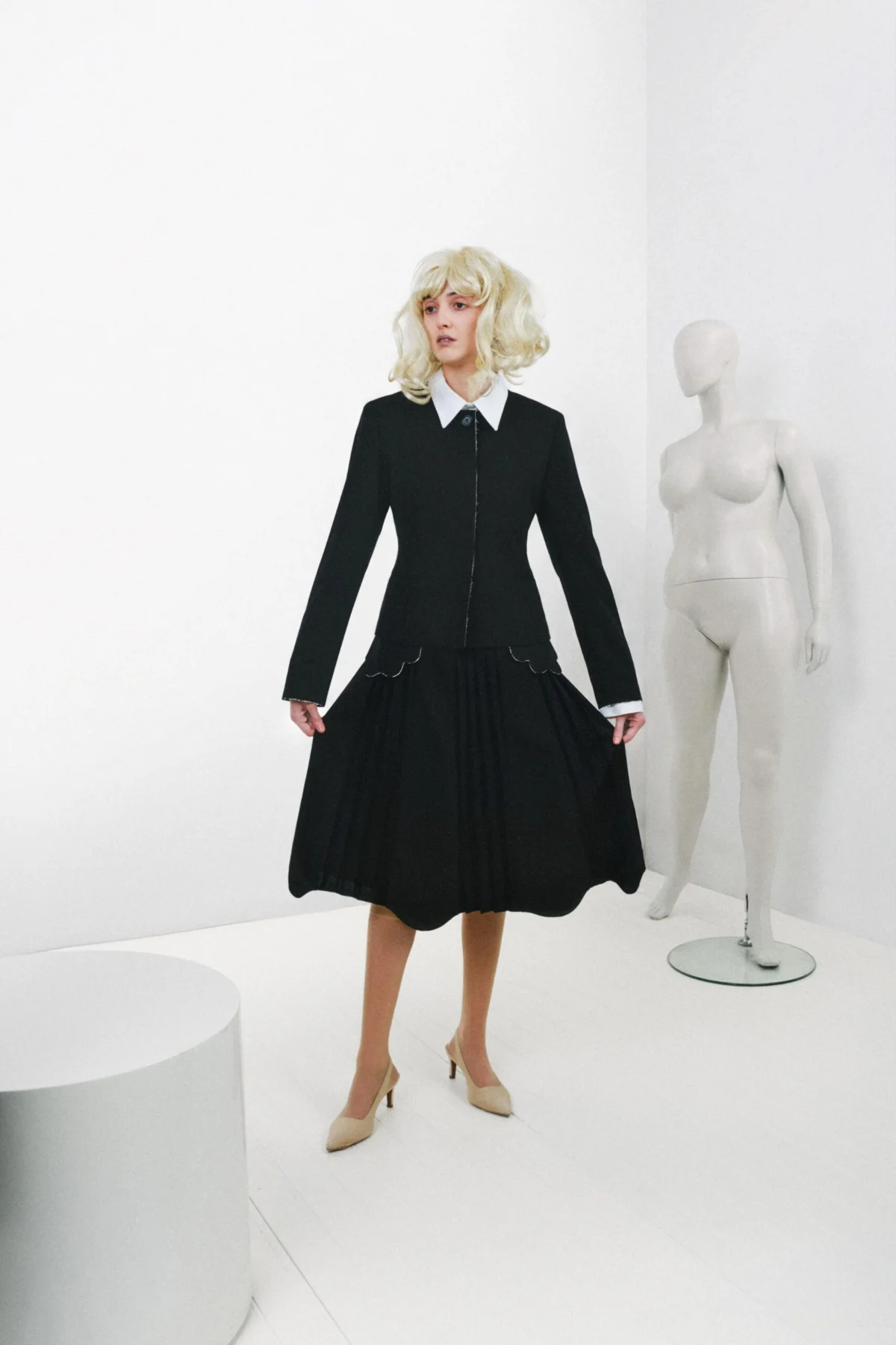
One of the most technically fascinating design triumphs of this new collection lies in Karlsson’s ability to seamlessly translate sculptural shapes from her accessories directly into ready-to-wear garments. This conceptual leap allowed the designer to experiment with volume and silhouette in unprecedented ways. For instance, the signature organic, curvy lines previously reserved for her popular larva bags were cleverly repurposed as structural, fluid pockets on impeccably tailored jackets. These jackets boast a clean, refined polish that would easily satisfy even the most traditional Milanese sciura—the effortlessly chic, sophisticated older women of Italy’s fashion capital—while retaining a distinct edge.
These softer, rounded organic contours were placed in direct dialogue with Karlsson’s primary design preoccupation for the season: rigorous pleating. The designer explored the manifold possibilities of plissé, manipulating the technique across both vertical and horizontal planes. A standout example of this textile manipulation is a slinky, accordion-like skirt that moves with fluid kinetic energy. Elsewhere, a stretchy minidress anchored by a single rigid hoop evoked the aesthetic of historical, turn-of-the-century bathing suits.
This garment occupies a fascinating space between high art sculpture and playful caricature. Fashion historians note that for centuries, womenswear was rigidly constructed around external cages, corsets, and heavy scaffolding to alter the human form. In sharp contrast, Karlsson’s hoop-accented dress feels refreshingly light, whimsical, and liberated from the oppressive historical burdens of garment construction.
Another visual highlight included a slashed skirt featuring exposed loops that deliberately revealed the garment’s raw underside, alongside a dress constructed from crumpled paper-like streamers yielding a delicate crepe-paper effect. According to the designer, these pieces drew unexpected inspiration from a holiday television episode of Pippi Longstocking, which famously featured abundant amounts of crumpled gift-wrapping paper. This translated into an aesthetic that captured the charming, rustic spirit of do-it-yourself paper crafts, yet executed with the uncompromising precision and technical finesse of high-end tailoring.
The Anti-Algorithm Movement and Digital Fatigue
Karlsson’s strategic withdrawal from Milan to Stockholm mirrors a broader, macroeconomic shift currently taking place across the global fashion ecosystem. As consumers and creators alike experience severe digital fatigue—exhausted by endless feeds, hyper-targeted social media algorithms, and fast-fashion micro-trends—a powerful counter-movement favoring the analog, the tactile, and the enduring is rapidly gaining momentum.
The designer’s intense focus on dimensional textures, tactile crafts, and smart hybrid pieces—such as a gingham-patterned jacket structurally reminiscent of a ribcage, complete with meticulous smocking at the wrists—directly aligns with these emergent market desires. Industry analysts note that independent labels are increasingly finding that the immense financial and psychological costs of staging high-impact, algorithm-chasing international runway shows often yield diminishing returns. By stepping away from the international calendar pressure cooker, Karlsson has reclaimed creative agency.
"I think it’s nice to just have calm for the eye," Karlsson reflected on her decision to strip back the excess. "My experience is that it’s a time where it’s just extra everything and layering—not just in fashion, but in life in general. I’m just trying to remove layers and see if the core and the actual essence is still interesting."
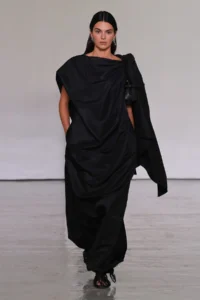
This minimalist exercise proved that the core of Avavav’s design philosophy remains potent. The success of the collection was most potently demonstrated through a deceptively simple pleated tube dress that Karlsson masterfully elevated into the ultimate Little Black Dress (LBD). Without relying on gimmicks, models falling over, or viral props, the garment stood entirely on its own architectural and aesthetic merits.
Industry Implications and the Future of Independent Labels
The strategic evolution of Avavav offers critical insights into the viability of independent fashion brands operating in a digitally saturated economy. When Karlsson first gained international acclaim, the fashion industry was heavily prioritizing shock-value marketing. Brands recognized that social media platforms like Instagram and TikTok rewarded disruptive imagery, viral mishaps, and outlandish accessories with massive digital engagement and, subsequently, retail sales.
However, data from consumer research firms indicates a growing consumer cynicism toward manufactured virality. Shoppers are increasingly demanding authenticity, supply-chain transparency, and garments of genuine longevity. For a small, women-owned, independent Swedish enterprise like Avavav, navigating this transition is a delicate balancing act. The brand cannot afford to completely abandon the eccentric, humorous identity that initially attracted its fiercely loyal cult following, yet it cannot survive on internet jokes alone.
By maturing her design vocabulary—merging the playful, creature-like proportions of her early accessory work with sophisticated tailoring and serene minimalism—Karlsson has successfully broadened her addressable market. High-end department stores and discerning buyers who previously viewed Avavav as merely a novelty streetwear brand are now re-evaluating the label as a serious player in contemporary design.
Furthermore, the decision to show in Stockholm rather than Milan highlights a growing decentralization in the fashion calendar. Independent designers are increasingly realizing that they do not need to subject themselves to the punishing financial demands and carbon footprint of traditional fashion weeks to capture global media attention. Digital communication channels, when managed with intentionality rather than desperation, allow strong creative visions to travel anywhere in the world without requiring the physical presence of a chaotic circus.
As the industry looks ahead, Beate Skonare Karlsson’s spring collection stands as a testament to the power of creative evolution. By bravely removing the digital layers, cutting through the noise of the algorithm, and returning to the raw essence of tailoring and craft, Avavav has not only survived the pressures of modern fashion—it has redefined its own future on its own terms.