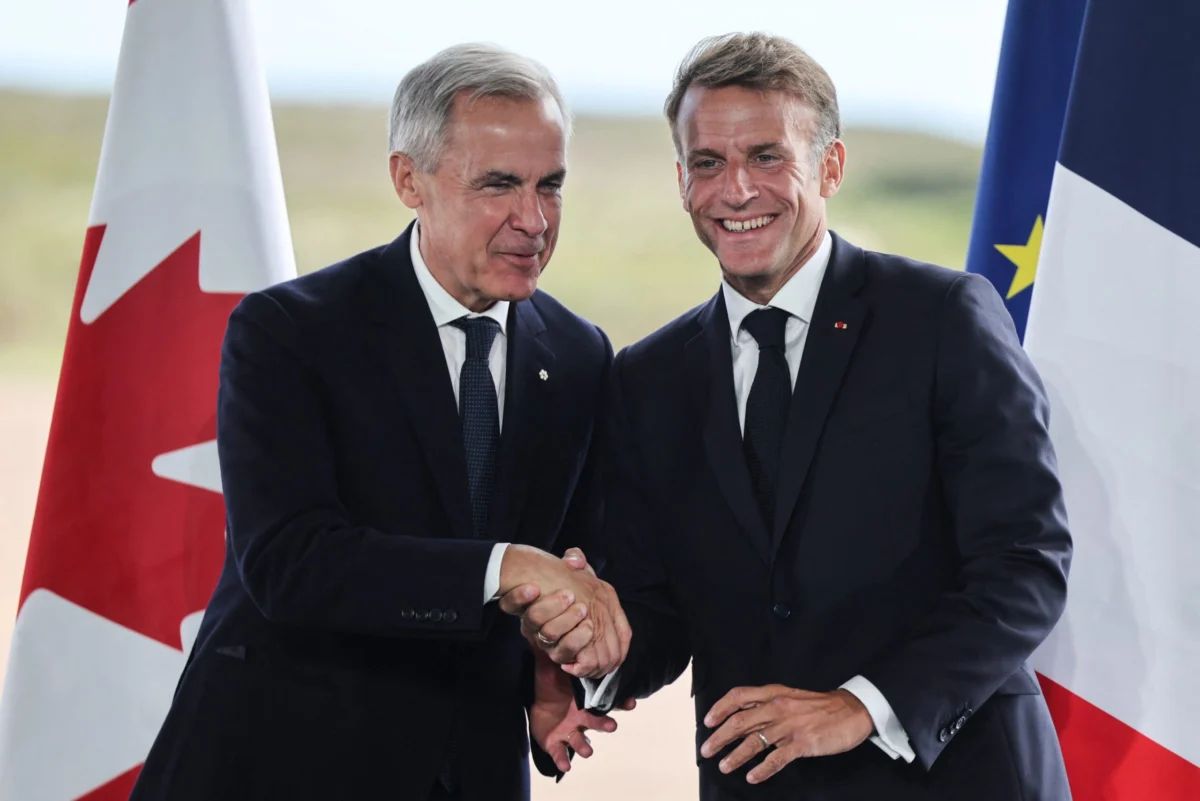
Canadian Prime Minister Mark Carney and French President Emmanuel Macron met Sunday in the French territory of Saint-Pierre-et-Miquelon to formalize a sweeping strategic partnership. The agreement marks a significant pivot in Canadian foreign policy, signaling an intentional move to diversify economic and defense dependencies away from the United States. As global geopolitical tensions rise and trade protectionism intensifies, the two leaders have outlined a framework for deep cooperation in aerospace, energy security, critical minerals, and telecommunications.
The summit, held on the small archipelago off the coast of Newfoundland, serves as a symbolic and practical assertion of sovereignty and cooperation between two nations seeking to navigate a fractured global order. For Canada, the partnership is a cornerstone of a broader diplomatic effort to insulate its economy from the unpredictability of its southern neighbor, while for France, the deal provides a vital pathway to securing energy resources amidst the supply shocks caused by the ongoing Iran war.
A Pivot Toward European Integration
The discussions in Saint-Pierre-et-Miquelon follow a transformative week in Canadian politics. Prime Minister Carney has publicly championed the concept of Canada pursuing associate membership status within the European Union. This proposed integration is designed to grant Canada a seat at the table in European regulatory and security frameworks, effectively creating a "transatlantic anchor" that offers a buffer against economic coercion.
The push for this deeper integration comes in the wake of escalating friction between Ottawa and Washington. U.S. President Donald Trump’s aggressive tariff policies, coupled with public rhetoric regarding the potential absorption of Canadian territory, have prompted a bipartisan reassessment in Ottawa of the risks associated with an over-reliance on the U.S.-Canada economic corridor. By seeking European alignment, the Canadian government aims to diversify its trade portfolio and solidify security guarantees that are not solely contingent on the shifting political climate in Washington.
Chronology of Shifting Alliances
The current diplomatic recalibration can be traced back to the onset of the latest round of protectionist trade measures initiated by the U.S. administration.
- Q1-Q2 202X: Increased frequency of U.S. tariff threats against Canadian raw materials, particularly steel and aluminum, creates economic uncertainty in the Canadian manufacturing sector.
- August 202X: President Trump issues repeated, non-standard commentary regarding the status of Canada as a sovereign entity, fueling concerns in Ottawa about the stability of the long-term bilateral relationship.
- Early September 202X: The escalation of the Iran war disrupts global energy markets, spiking crude oil and natural gas prices and prompting European leaders to seek stable, non-adversarial energy partners.
- Mid-September 202X: The U.S. reaches a deal with Denmark regarding the military footprint in Greenland, a development closely watched by both France and Canada as a bellwether for Arctic security.
- Sunday, September 22, 202X: Prime Minister Carney and President Macron meet in Saint-Pierre-et-Miquelon to sign a bilateral memorandum of understanding on defense and infrastructure sharing.
Energy Security and Critical Minerals
A primary driver of the France-Canada summit is the urgent need for energy diversification. President Macron emphasized that the war involving Iran has created an existential threat to European energy stability. France, which has historically relied on a mix of domestic nuclear power and diverse import streams, is now aggressively courting Canada to bolster its supply of Liquefied Natural Gas (LNG).
"Canada is a country with significant resources of critical minerals and rare earths," Macron noted during the press conference. "It is also a major oil and natural gas producer. What we want to do is conclude agreements to secure more liquefied natural gas that can be shipped to Europe’s Atlantic coast."
The proposed cooperation extends beyond simple extraction. The two nations are exploring joint infrastructure projects, including the development of port facilities and reception terminals capable of handling increased LNG volumes. Furthermore, the collaboration on critical minerals—essential for the production of semiconductors, batteries, and defense hardware—positions Canada as a primary supplier to the European industrial base, reducing European dependence on Asian supply chains.
Space, Defense, and Technological Sovereignty
The agreement also mandates that Canadian and French space agencies and defense ministries work in tandem to develop shared infrastructure. This includes the integration of satellite launch systems and the creation of ground-based reception facilities.
Technological sovereignty was a recurring theme, with the leaders identifying quantum computing, supercomputing, and satellite-based communication as "strategic sectors." The intention is to create a combined research-and-development ecosystem that allows both nations to innovate independently of the dominant American or Chinese tech spheres.
For the Canadian defense sector, this represents an opportunity to modernize capabilities through European technology transfer. For France, it provides a North American partner that shares its commitment to democratic values and international law, providing a strategic foothold in the Western Hemisphere that respects local sovereignty.
The Greenland Factor and Arctic Stability
The meeting took place against the backdrop of the recent U.S.-Denmark agreement concerning Greenland. While President Macron publicly praised the deal for its adherence to international law and Danish sovereignty, the undercurrent of the conversation was clear: the Arctic is becoming a theater of high-stakes competition.
Both France and Canada have expressed concerns that the militarization of the Arctic could destabilize the region. By coordinating their defense policies, Paris and Ottawa are signaling their intention to maintain a rules-based order in the North. The collaboration on satellite and ground-based monitoring is explicitly intended to improve surveillance capabilities in the Arctic, a region increasingly vital for both climate research and national security.
Economic Implications and Future Resilience
Analysts suggest that the "Associate Member" model for Canada-EU relations could be the most significant shift in Canadian foreign policy since the Second World War. By aligning regulatory standards, labor markets, and trade policies with Europe, Canada would gain access to a market of over 400 million people, significantly reducing the "Trump effect" on the Canadian dollar and domestic investment.
However, the transition is not without challenges. Integrating with the EU, even as an associate member, requires navigating complex regulatory landscapes and overcoming geographical hurdles. The economic cost of reorienting supply chains—traditionally geared toward a North-South flow—to an East-West flow will require massive investment in maritime and digital infrastructure.
Despite these hurdles, the political appetite in Ottawa is high. Prime Minister Carney’s framing of the alliance as a means to "live our lives as we choose based on the values that we share" resonates with a Canadian public that has grown increasingly wary of the unpredictability emanating from the United States.
Conclusion: A New Transatlantic Paradigm
The meeting in Saint-Pierre-et-Miquelon is more than a diplomatic photo opportunity; it is a declaration of intent. Canada and France have identified a mutual vulnerability—over-reliance on volatile global partners—and are moving to solve it through deep, multi-sector integration.
As the international community watches, the success of this partnership will depend on the speed at which the two nations can move from high-level agreements to tangible, infrastructure-based reality. If successful, the Canada-France axis could become the blueprint for a new form of middle-power cooperation, one that prioritizes collective security, energy independence, and shared technological advancement in an increasingly fragmented world. For the time being, the focus remains on the logistical execution of their aerospace and energy deals, a process that will likely define the diplomatic landscape of the Atlantic for the coming decade.