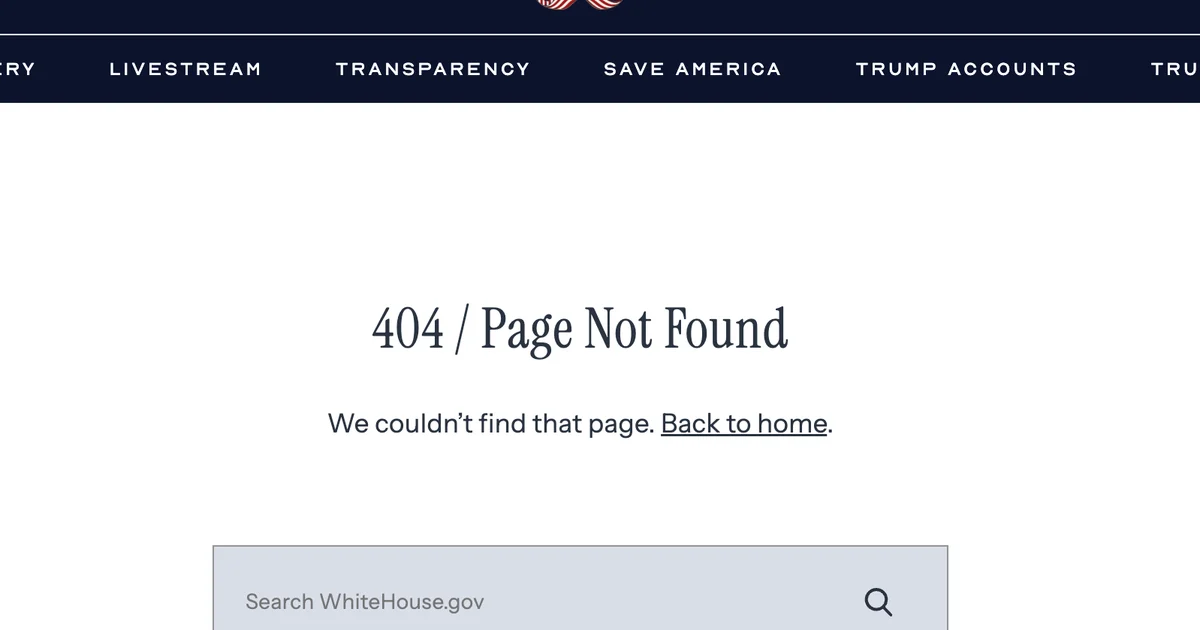
WASHINGTON — The official White House webpage serving as the centralized public database for financial disclosures of the president, vice president, and top-tier administration officials mysteriously vanished from the internet on a Friday afternoon, triggering immediate scrutiny from government watchdogs, ethics monitors, and news organizations. The portal, located at whitehouse.gov/disclosures, went offline without any prior warning or explanatory message, returning a standard 404 server error code before being quietly restored roughly an hour and a half later after journalistic inquiries were made to the administration’s press office.
The brief yet unexplained disappearance of the critical transparency portal highlights ongoing tensions surrounding federal ethics reporting, public accountability, and the accessibility of financial records for high-ranking government officials. While the underlying document files hosted on the server remained individually accessible via direct links if users knew where to look, the removal of the primary hub rendered the public directory completely inaccessible to ordinary citizens, researchers, and automated tracking software designed to oversee executive branch transparency.
Chronology of the Disappearance and Restoration
The incident unfolded during standard Friday afternoon hours, a traditional window for the release—or sometimes the obscuring—of sensitive government information. According to automated monitoring infrastructure operated by CBS News, which routinely scans government ethics portals every thirty minutes for newly published documents, the White House disclosure page was fully operational at 3:01 p.m. Eastern Time.
However, during the subsequent automated check executed precisely thirty minutes later at 3:31 p.m., the monitoring system flagged that the page had ceased to exist, returning a 404 Not Found status. This abrupt outage meant that anyone attempting to access the mandatory financial transparency records through the official government portal was blocked from viewing the index.
Recognizing the significance of the outage, journalists initiated formal contact with the White House press office at 4:20 p.m. Eastern Time. The inquiry explicitly asked whether the removal of the page was an intentional administrative action or the result of an unforeseen technical malfunction, setting a soft deadline of 5:00 p.m. for a formal response. The White House press office failed to acknowledge or reply to the inquiry within the requested timeframe.
Simultaneously, as reporters prepared to publish initial findings regarding the unexplained outage, the automated ethics monitoring system detected sudden activity on the dormant web address. Sometime between 4:31 p.m. and 5:01 p.m., the page was completely restored. An inspection of the webpage’s internal source code revealed a server-side timestamp of 22:00:00+00:00, corresponding precisely to 5:00 p.m. Eastern Time—the exact deadline set by journalists in their unanswered query to the administration.
Despite subsequent follow-up requests by news organizations, the White House has declined to provide any explanation for why the page was taken down, what caused the technical or administrative interruption, or why it was restored precisely at the hour when press inquiries were maturing into published reports.
Contents of the Disclosed Portfolio and New Filings
When the whitehouse.gov/disclosures hub reappeared online, it featured a single new addition: a periodic transaction report detailing stock trades executed by President Donald J. Trump, bearing a signature date of September 17.
Although the document appeared newly uploaded to the White House server at 3:14 p.m. on the day of the outage—data logs indicate it was placed on the server shortly before the page went offline—the identical report had already been publicly available for nearly a month. It was originally posted to the public database of the Office of Government Ethics (OGE) on October 8. Historically, the White House has maintained a practice of mirroring or posting these mandatory periodic stock transaction logs on its own server within a few days of their appearance on the OGE platform, making the timing of this specific upload and subsequent page takedown an anomaly in the administration’s routine disclosure cadence.
The whitehouse.gov/disclosures portal is designed to act as an umbrella repository for legally mandated financial transparency documents. It houses records for the president, the vice president, and more than 100 influential White House aides and policy architects, including high-profile staff members such as Susie Wiles and Stephen Miller.
The financial portfolios of top executives have faced intense public scrutiny. Disclosures filed earlier in the term revealed that the president’s accounts have executed thousands of individual stock transactions since the beginning of the year. Many of these trades involved major corporations that regularly conduct business before federal regulatory agencies, lobby executive departments, or stand to be directly impacted by the implementation of presidential policies and executive orders.
In response to past inquiries regarding potential conflicts of interest arising from these active investments, representatives for the White House have consistently maintained that the president is entirely insulated from the day-to-day management of his personal financial portfolio. Administration officials have stressed that all investment decisions and asset allocations are handled exclusively by independent, outside financial advisers without the input, knowledge, or direction of the president.
Legal Framework Governing Federal Ethics Disclosures
The requirement for public financial disclosures by executive branch officials is deeply rooted in federal statute, primarily stemming from the post-Watergate legislative reforms designed to restore public trust in government institutions.
The foundational document for these requirements is the Ethics in Government Act of 1978. This landmark legislation established statutory requirements for annual financial disclosure reports filed by high-ranking executive, legislative, and judicial branch officials, including the president and vice president. Under this framework, the Office of Government Ethics (OGE) was established to provide overall direction and oversight of executive branch ethics policies, receiving and publishing financial disclosure reports for the highest-level presidential appointees and elected officials.
Decades later, transparency laws were strengthened with the passage of the Stop Trading on Congressional Knowledge (STOCK) Act of 2012. While initially focused heavily on members of Congress, the STOCK Act also imposed strict periodic transaction reporting requirements on the president, the vice president, and other senior executive branch officials. Under the STOCK Act, covered individuals must report any purchase, sale, or exchange of stocks, bonds, or commodity futures transactions exceeding $1,000 within 30 days of receiving notification of a transaction, and no later than 45 days after the transaction itself occurs.
While the president, vice president, and Senate-confirmed cabinet members and agency heads file their comprehensive reports directly with the OGE—where they are cataloged and made accessible via the agency’s public online database—the administrative pipeline for lower-tier White House staffers operates differently.
A significant portion of White House staffers and policy advisers file their initial and annual disclosure documents internally with the White House counsel’s office or designated ethics officials rather than submitting them directly to the OGE. Consequently, many of these internal staff records do not automatically migrate to the central OGE public portal.
This structural division creates a notable transparency gap. An investigative review conducted earlier in the year revealed that more than 110 of the roughly 180 individual officials listed on the whitehouse.gov/disclosures directory did not appear anywhere within the OGE’s independent online public records system. For these specific individuals, the whitehouse.gov portal remains the sole public window through which citizens and watchdogs can inspect potential financial entanglements, outside employment, and asset holdings.
Implications for Government Transparency and Accountability
The sudden, unexplained vanishing of the White House financial disclosure hub has alarmed good-government groups and freedom-of-information advocates, who argue that the availability of public records should never be subject to abrupt, unannounced interruptions.
In an era where digital government records are increasingly relied upon by journalists, financial analysts, academic researchers, and voters to ensure accountability, the integrity of federal web portals is paramount. The fact that the page went dark immediately following the upload of a presidential stock transaction report—and only returned to service after direct media intervention—has fueled skepticism regarding the administration’s commitment to proactive transparency.
Transparency advocates note that even temporary outages of critical accountability infrastructure undermine public trust. When official databases become inaccessible without explanation, it breeds speculation about whether information is being intentionally suppressed, vetted, or quietly altered. Although the underlying documents remained accessible via deep links in this specific instance, the removal of the directory page effectively severed public navigation, illustrating the vulnerability of digital-first governance records.
As executive branch portfolios continue to draw intense public interest due to active trading and complex financial holdings, the episode serves as a stark reminder of the fragile nature of digital transparency. Without statutory protections guaranteeing uninterrupted access to government disclosure portals, watchdogs warn that the public’s right to know remains vulnerable to administrative oversight, technological opacity, and unexplained digital blackouts.